Key Points:
- Researchers used artificial intelligence to map microscopic point defects inside ultra-thin 2D materials known as MXenes.
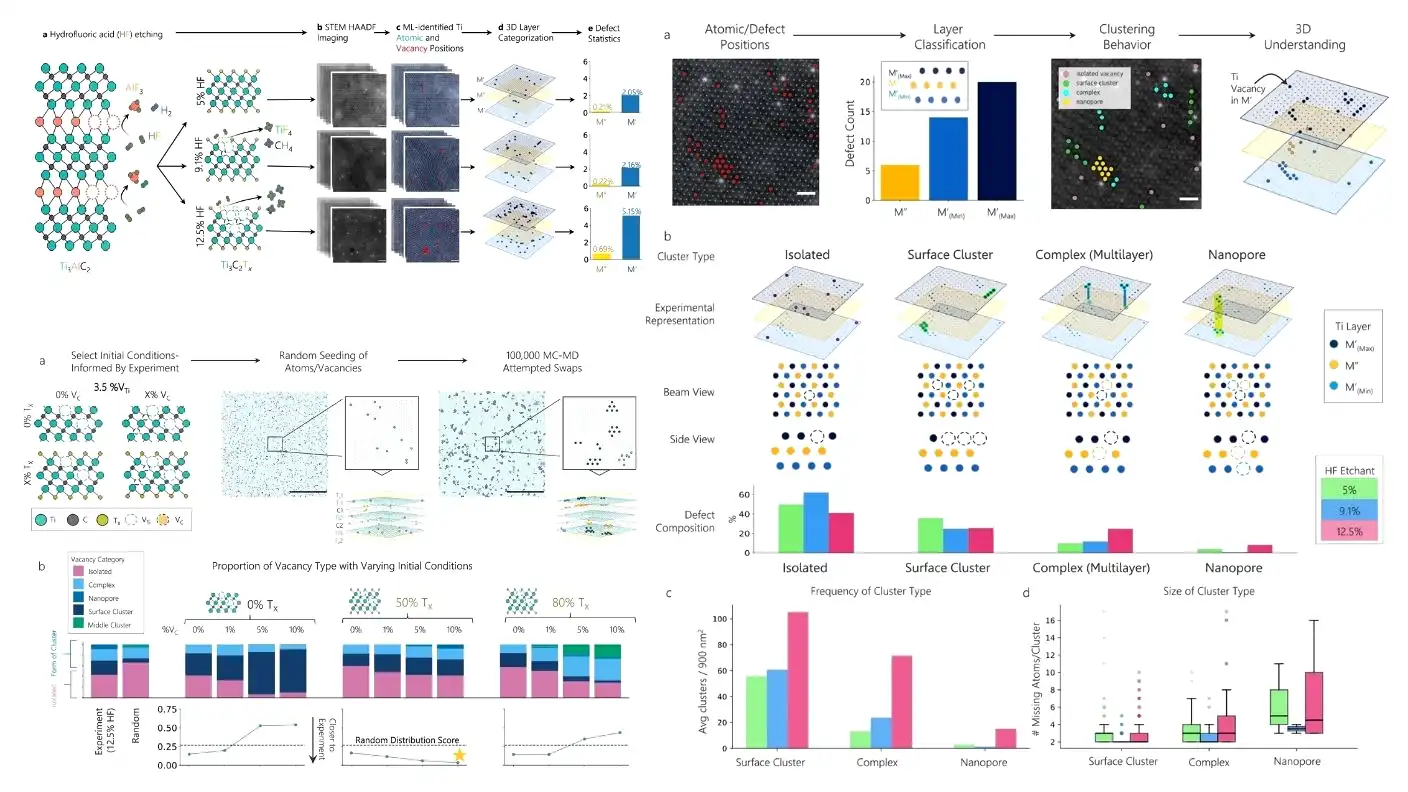
- The team successfully reconstructed 3D images from flat 2D electron microscope scans to locate missing atoms.
- Point defects are not always bad; they can actually strengthen materials or change how they react chemically.
- This breakthrough could improve future energy storage, water purification, and advanced electronics technology.
Scientists are using artificial intelligence to unlock the secrets hidden inside some of the thinnest materials on Earth. Researchers at the National Laboratory of the Rockies recently published a breakthrough study showing how AI can map complex microscopic structures. Their work helps explain how two-dimensional materials, known specifically as MXenes, behave at the atomic level. This deep understanding could eventually lead to massive improvements in energy storage, water purification, and advanced electronics.
The research team focused on a specific class of ultra-thin 2D crystalline structures. These materials are incredibly thin, usually made up of just a single or double layer of atoms. Because the materials are so small, scientists must use powerful electron microscopes just to see them. The team recently published their findings in the journal Nature Communications, titled “Revealing the Hidden Third Dimension of Point Defects in Two-Dimensional MXenes.”
The entire study focuses heavily on point defects. A point defect happens when a single atom goes missing from the crystal structure. Steven Spurgeon, a senior materials data scientist at the lab and the paper’s corresponding author, explained why these missing pieces matter so much. He noted that point defects strongly affect how a material conducts heat and electricity. Before this new research, actually seeing and mapping these tiny defects in three dimensions was a massive challenge for the scientific community.
Spurgeon wants to clear up a common misunderstanding about the word “defect.” He explained that people outside of the science field often assume defects are always bad, but that is simply not true. Point defects can actually strengthen certain materials and make them more useful. Spurgeon stressed that scientists must first deeply understand these missing atoms before they can gain total control over them.
The researchers used powerful microscopes to see exactly how different processes manipulate these tiny defects. They discovered complex 3D arrangements of atoms that previous scientists poorly understood. When an atom vanishes, creating a vacancy, it can significantly alter how the 2D material performs. Sometimes, the defect actually moves to the surface of the material, which completely changes how the surface reacts to outside chemicals.
Spurgeon explained the physical mechanics behind these changes. He noted that the materials they study are not rigid. Because the structure consists of loose atoms, pulling one atom out causes the remaining atoms to relax and shift. This physical movement changes the material’s entire structure, which in turn alters its chemical reactivity.
To conduct the study, the team examined a specific MXene composed of a transition-metal carbide containing titanium and carbon atoms. They placed the material under a powerful electron microscope guided directly by artificial intelligence. The AI software enabled the researchers to visualize and classify individual atoms and their specific defects clearly.
The real breakthrough came when the team applied machine learning to the problem. The advanced computer program allowed the researchers to take a flat 2D analysis and reconstruct it into a full 3D map of the defect topology. The AI could actually count the exact number of missing atoms in each layer of the material. Spurgeon called this the Holy Grail for a materials scientist. He said every scientist wants to know exactly where the atoms are, what they are doing, and how to control them to impart desired functionality.
Several major universities and laboratories collaborated on this complex project. The Anasori Lab at Purdue University helped synthesize the MXenes used in the study. Other major contributors included Argonne National Laboratory, the Colorado School of Mines, Baylor University, and the University of Colorado Boulder.
Despite his senior role, Spurgeon gave massive credit to Grace Guinan, a Ph.D. student in statistics at the University of Texas. Guinan joined the project through a student internship program at the lab. Because her background is entirely in math, she viewed the sheets of atoms as a purely mathematical puzzle. She successfully designed a clever mathematical approach to deconstruct the flat image and determine the exact configuration of each layer. Her unique math skills, combined with advanced AI, made the entire scientific breakthrough possible.
Source: Nature Communications (2026).