

Key Points:
- Researchers finally understand why rod-shaped bacteria grow longer but not wider.
- The bacterial cell wall acts like a “smart material” that controls its own shape.
- Pressure changes inside the cell act as a self-correcting feedback loop.
- The wall behaves like a Chinese finger trap when pressure drops.
When you blow air into a balloon, it gets longer and wider at the same time. However, rod-shaped bacteria manage to inflate themselves under intense pressure while only growing longer. Scientists have puzzled over this trick for decades. Now, a team from New York University has cracked the case, and their findings could change how we fight disease.
The study, published in Current Biology, focused on Bacillus subtilis, a common soil microbe. These bacteria live inside a tough shell called a cell wall. To grow, the bacteria must constantly break down old parts of this wall and weave in new material. This process should cause the cell to bulge outward. Instead, it perfectly maintains its narrow width, keeping it thousands of times thinner than a single human hair.
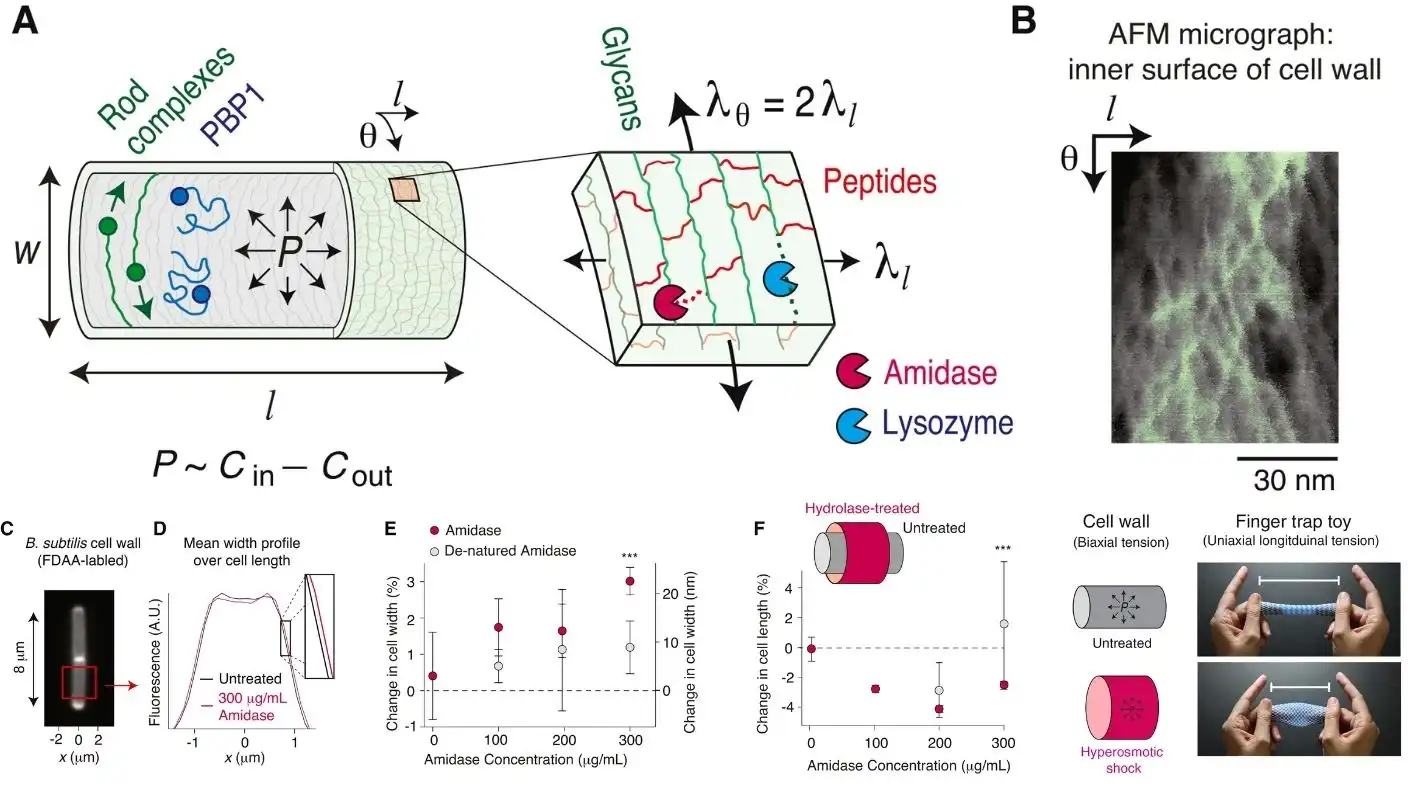
Lead author Paola Bardetti explained that the cell wall is essentially a “smart material.” The researchers tested this by changing the pressure inside living bacteria and measuring how the wall reacted. They found that the wall has a very specific tipping point.
When the internal pressure drops below normal, the wall acts like a Chinese finger trap toy, expanding sideways. When the pressure gets too high, the wall softens and widens. However, growing bacteria sit exactly at the transition point between these two states, keeping their width perfectly constant.
This system also includes an automatic self-correction feature. If a cell accidentally grows too wide, the wall slips back into the finger-trap mode, squeezing the cell back to its correct shape. The researchers even observed this exact same strategy in plant roots, showing that nature figured out this clever engineering trick more than once.
This breakthrough is a big deal for medicine. Currently, most antibiotics attack the physical structure of the bacterial cell wall. Bardetti pointed out that this new research reveals a completely different vulnerability. If scientists can figure out the exact molecular machinery that sets this pressure point, they could design a brand new class of drugs to destroy antibiotic-resistant bacteria from the inside out.






