

Key Points:
- South Korea’s export growth reached its strongest annual pace since January 1984, jumping 53.2% year-on-year to hit a record $87.75 billion in May 2026.
- An unprecedented global boom in artificial intelligence investment fueled a 169.4% surge in semiconductor shipments, reaching an all-time monthly high of $37.16 billion.
- Due to the stellar trade performance, the Bank of Korea recently raised its annual economic growth forecast for 2026 from 2.0% to 2.6%.
- While high-margin tech shipments led the gains, geopolitical disruptions and U.S. tariffs weighed down automobile exports, which fell 5.9%.
South Korea’s vast industrial export engine shifted into overdrive in May 2026, posting its strongest annual performance in more than forty years. As Asia’s fourth-largest economy and a primary bellwether for global trade, the country has found itself at the absolute center of the global artificial intelligence boom. The Ministry of Trade, Industry, and Energy released preliminary trade data on Monday, showing that global demand for advanced hardware has triggered a massive wave of capital spending. This trade-reliant nation is now reaping massive rewards, proving that physical microchips remain the ultimate currency of the modern digital economy.
The raw trade figures show a historic surge that far exceeded Wall Street’s expectations. South Korea’s total exports jumped 53.2% year-on-year to hit a record monthly high of $87.75 billion in May, easily beating the median 48.4% growth projection that economists forecast in a recent Reuters poll. This milestone marks the 12th consecutive month of uninterrupted year-on-year export expansion for the country. More importantly, the staggering percentage increase represents the fastest pace of outward shipment growth the nation has recorded since January 1984, signaling a massive structural shift in global manufacturing demand.
The primary driver behind this record-breaking trade performance is the insatiable global hunger for high-performance memory chips. South Korea’s semiconductor exports skyrocketed by 169.4% year-on-year to reach an all-time monthly record of $37.16 billion in May alone. This explosive growth stems directly from massive capital expenditures by U.S. technology conglomerates, which are racing to build out advanced artificial intelligence data centers. This intense demand has driven contract prices for advanced memory chips, particularly high-bandwidth memory (HBM) modules, to record levels, benefiting domestic giants like Samsung Electronics and SK Hynix.
A closer look at the tech sub-sectors reveals that the gains are highly concentrated in the components powering machine-learning models. Shipments of dynamic random-access memory (DRAM) and NAND flash memory chips surged by 369.8% and 206.8%, respectively. At the same time, computer-related exports climbed 290.7% year-on-year, driven by a massive wave of high-capacity solid-state drive (SSD) purchases for AI server clusters. This comprehensive tech rally also boosted exports of wireless communication devices by 12.6% and display panels by 9.4%, proving that the hardware supercycle is lifting all segments of the information technology industry.
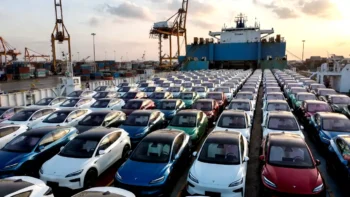
While high-tech silicon dominated the headlines, traditional export sectors showed a highly divided performance. Petroleum products rose 46.6% year-on-year, buoyed by elevated global crude oil prices linked to ongoing tensions in the Middle East. However, the automobile sector ran into significant roadblocks. Vehicle shipments fell 5.9% during the month, weighed down by shipping and logistics disruptions in the Middle East and the immediate impact of new U.S. tariff structures. This decline underscores the vulnerabilities that traditional manufacturing faces in an increasingly volatile geopolitical landscape.
The geographical distribution of South Korea’s exports reveals how aggressively the world’s leading economic superpowers are competing for tech hardware. Outward shipments to China surged by 80.9% in May, while exports to the United States increased by 59.1% year-on-year. These massive numbers prove that both Washington and Beijing are heavily reliant on Korean factories to build out their domestic AI infrastructures. Conversely, the unstable geopolitical environment in the Middle East took a toll on trade, causing South Korean exports to that region to slide by 7.7% during the same period.
On the import side of the ledger, South Korea’s incoming trade rose 20.8% in May to reach $60.80 billion, driven primarily by the high cost of importing crude oil and other raw energy materials. Despite this higher import bill, the sheer volume of high-margin tech exports allowed the country to secure a massive trade surplus. Daily average exports, adjusted for working days, jumped 60.7% to $4.28 billion, marking the first time in history that daily average shipments have crossed the $4 billion threshold. This performance follows a blistering first-quarter gross domestic product (GDP) growth rate of 1.7%, which represents the country’s fastest economic expansion in nearly six years.
This stellar economic momentum has forced central bankers to rewrite their economic projections for the year. Following the release of the bumper trade data, the Bank of Korea raised its official 2026 economic growth forecast to 2.6%, up significantly from its previous estimate of 2.0%. However, newly appointed monetary policymakers must navigate a complex landscape. While the AI-led export boom is driving historic wealth creation, the high cost of energy imports and a relatively weak Korean won continue to put upward pressure on domestic inflation, making future interest rate decisions highly delicate.
Ultimately, South Korea has firmly cemented its position as the indispensable hardware supplier of the artificial intelligence era. The country’s ability to bounce back from the deep semiconductor inventory slump of 2023 to record-breaking heights in 2026 demonstrates the incredible resilience of its manufacturing sector. As global tech giants continue to pour billions of dollars into building out the physical infrastructure for advanced machine learning, South Korea’s export-led economy is highly positioned to lead the global trade cycle, proving that the digital future remains deeply anchored in physical silicon.