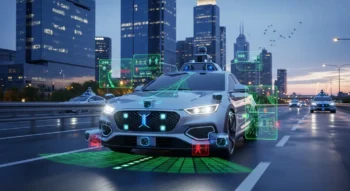
In our hyper-connected, technologically saturated world, we are surrounded by brilliance. We hold it in our hands as a smartphone, we drive it in our increasingly intelligent cars, and we rely on it in the critical infrastructure that powers our homes, hospitals, and industries. We know the names of the companies that build these final products—Apple, Tesla, Samsung, and Bosch. But beneath the polished glass screens and sleek metal chassis lies a hidden universe, a microscopic world of foundational components that make everything possible. This is a world of resistors, capacitors, inductors, diodes, and MOSFETs—the unsung, unglamorous, and absolutely indispensable building blocks of modern life.
In this hidden world, there is a giant. A quiet, sprawling, and profoundly influential behemoth whose products are in virtually every electronic device on the planet. That company is Vishay Intertechnology, Inc. (NYSE: VSH). For sixty years, Vishay has been the ultimate “ingredient brand,” the crucial component supplier whose name you may not know, but whose technology you use every single day. The story of Vishay is not one of flashy product launches or charismatic CEOs gracing magazine covers. It is a story of physics, precision, and relentless industrial strategy.
More than that, it is the story of its founder, Dr. Felix Zandman, a man whose life is one of the most remarkable and inspiring tales of the 20th century. It is the story of a Holocaust survivor who, armed with a genius intellect and an indomitable will, literally calculated his way to survival and went on to build a global industrial empire on a foundation of scientific innovation and profound human resilience. This is the definitive story of Vishay: from a revolutionary invention born of a genius mind to the vast, globe-spanning acquisition machine that became one of the world’s largest and most critical manufacturers of the electronic components that run our world.
The Founder’s Fire: The Improbable Journey of Dr. Felix Zandman
To understand the soul of Vishay Intertechnology, one must first understand the extraordinary life of its founder, Dr. Felix Zandman (1928-2011). His story is not a footnote to the company’s history; it is the bedrock upon which its culture of resilience, technical excellence, and disciplined management was built. His life journey is a powerful testament to the triumph of the human spirit and intellect over unimaginable darkness.
A Childhood in the Shadow of War
Felix Zandman was born in Grodno, Poland (now part of Belarus), into a well-off Jewish family. A brilliant student with a prodigious aptitude for math and science, his world was shattered in 1941 when Nazi Germany invaded. The Zandman family, along with the rest of the Jewish population, was forced into the brutal confines of the ghetto. As the Nazis began the systematic liquidation of the ghetto, sending its inhabitants to the Treblinka extermination camp, the Zandman family faced certain death.
In a desperate act of courage, a righteous Polish Catholic family, the Puchalskis, offered to hide them. Felix, along with his parents, uncle, grandmother, and two other Jewish fugitives, descended into a small, dark hole dug beneath the floorboards of the Puchalski’s home. The hiding place was suffocatingly small—just 5 feet long, 4 feet wide, and 3 feet high. For seventeen months, Felix Zandman and five others lived in this cramped, dark space, subsisting on scraps of food passed down by their saviors.
Physics as a Means of Survival
In this tomb-like existence, with death constantly lurking above, the young Felix did something extraordinary. To keep his mind from breaking, he turned to the world of mathematics and physics. His uncle, who had been a university student, would give him lessons in trigonometry, calculus, and advanced physics, all from memory, in the pitch darkness.
One day, one of the men hiding with them began to lose his mind, rocking back and forth and threatening to give them all away. Felix’s grandfather offered him the family’s last possession, a gold watch, to lie still. Felix, ever the physicist, had a different solution. He knew the man was lying on two wooden floor joists. He asked for the man’s weight and the distance between the joists, then performed a complex stress analysis in his head to determine the safest place for the man to lie to minimize strain on the floorboards above. The intellectual exercise calmed the man and kept Felix’s mind sharp and focused on logic and reason amid the madness. This moment, using advanced physics to solve a life-or-death problem, was a defining experience that would shape his entire life and career.
In July 1944, the area was liberated by the Soviet army. Felix Zandman emerged from the hole, blinking into the sunlight, emaciated but alive. He was one of the very few Jewish survivors from his town. The rest of his family had been murdered.
From Survivor to Scientist and Inventor
After the war, Zandman made his way to France. He enrolled in the University of Nancy, where, despite his interrupted education, he earned a degree in physics and a master’s degree in mechanical engineering in just three years. He went on to earn his Ph.D. in physics from the Sorbonne in Paris, writing his thesis on the esoteric subject of photoelasticity.
In 1956, he immigrated to the United States. He took a job as Director of Basic Research at the Tatnall Measuring Systems Company in Philadelphia, a division of the Budd Company, a major automotive supplier. It was here that his genius for invention would blossom. He was working on developing high-precision resistors—electronic components that resist the flow of electrical current. The problem with existing resistors was that their resistance values changed with temperature, making them unstable and unsuitable for high-precision applications such as aerospace guidance systems and scientific instruments.
Drawing on his deep knowledge of physics and materials science, Dr. Zandman had a breakthrough. He developed a new type of resistor by bonding a unique nickel-chromium alloy foil to a ceramic substrate. By carefully etching the foil, he could create a resistor whose physical properties canceled out the effects of temperature change. The result was a resistor that was incredibly stable, reliable, and precise—far superior to anything else on the market. He had solved a major engineering problem.
The Genesis of a Company: Vishay and the Bulk Metal® Foil Resistor
Dr. Zandman offered his revolutionary invention to his employer, the Budd Company. In a fateful decision, they showed little interest, telling him they were in the “automotive business, not the resistor business.” Seeing the immense potential of his creation, Dr. Zandman decided to strike out on his own.
The Founding of Vishay (1962)
In 1962, with the financial backing of his cousin Alfred Slaner, Dr. Zandman founded Vishay. The company was named in memory of his grandmother’s ancestral village in Lithuania, Vishay (Veisiejai), which had been wiped out during the Holocaust. It was a tribute to the family and the world he had lost.
The company’s first and only product was Dr. Zandman’s groundbreaking invention: the Bulk Metal® Foil resistor. In its early years, Vishay was a niche, high-technology company. Its resistors were expensive but offered unparalleled performance. They were not destined for consumer radios or televisions; they were destined for the most demanding applications imaginable.
Here is a summary of the markets where Vishay’s early products found a home. These were industries where failure was not an option and where the highest levels of precision and reliability were paramount.
- Aerospace and Defense: Guidance systems for missiles, instrumentation for satellites, and avionics for military aircraft.
- Medical Electronics: Critical components for medical devices like defibrillators and diagnostic equipment.
- Precision Instrumentation: Equipment for scientific laboratories and high-precision testing and measurement systems.
- Industrial Automation: High-reliability controls for complex manufacturing processes.
For nearly two decades, Vishay grew steadily and profitably by dominating this high-end niche. Dr. Zandman established a culture of meticulous engineering, uncompromising quality, and financial discipline.
The Great Transformation: From Niche Player to Broadline Behemoth
By the early 1980s, Dr. Zandman realized that while his high-end resistor business was successful, its growth potential was limited. The real volume in the electronics industry was in the broader market for more standard, less exotic components. He made a pivotal, audacious strategic decision: to transform Vishay from a specialized, high-margin niche player into one of the world’s largest and most diversified broadline manufacturers of electronic components.
He knew he couldn’t achieve this through organic growth alone. The only way to build a comprehensive product portfolio and achieve the necessary scale was through a relentless, aggressive acquisition strategy. This decision would define the company’s history over the next two decades and turn it into the industrial giant it is today.
The Acquisition Philosophy: A Disciplined Approach
Dr. Zandman’s approach to acquisitions was not a reckless buying spree. It was guided by the same discipline and logic that defined his scientific work. He targeted established, often underperforming, companies with strong brand names, complementary product lines, and solid manufacturing capabilities. He would then acquire them, often at a bargain price, and ruthlessly cut costs, streamline operations, and integrate them into the growing Vishay empire.
This strategy had a clear goal: to become a “one-stop shop” for the passive electronic components that every electronics manufacturer needed. By offering a complete bill of materials (BOM) for resistors, capacitors, and inductors, Vishay could become an indispensable partner to its customers, simplifying their supply chains and increasing its own market power.
The Age of Acquisition: Building the Empire, Piece by Piece
Beginning in the mid-1980s, Vishay embarked on one of the most successful acquisition campaigns in the history of the electronics industry. The company swallowed up dozens of its competitors, including some of the most iconic names in the business.
The “Big Three” in Passive Components
The cornerstones of Vishay’s transformation were the acquisitions of three major American and European competitors. These deals vaulted the company into the top tier of passive component manufacturers.
- Dale Electronics (1985): This was the first major, transformative acquisition. Dale, based in Nebraska, was a much larger company than Vishay at the time and was a leading manufacturer of a wide range of resistive products. The acquisition gave Vishay a massive manufacturing footprint in the U.S. and a broad portfolio of standard resistor technologies.
- Draloric (1987): A leading German manufacturer of resistors, this acquisition gave Vishay a strong foothold in the crucial European market.
- Sprague Electric (1992): A legendary name in the industry, Sprague was a pioneer in the development of tantalum and ceramic capacitors. This was a critical acquisition that moved Vishay beyond resistors and made it a major player in the capacitor market.
Expanding the European Footprint and the Push into Semiconductors
Throughout the 1990s and early 2000s, the acquisition spree continued, deepening Vishay’s product lines and geographic reach, and marking its bold entry into the semiconductor market.
This list highlights the key acquisitions that completed Vishay’s portfolio. Each one brought a critical piece of technology or market access that fulfilled Dr. Zandman’s “one-stop-shop” vision.
- Sfernice (1988): A French company that was a major producer of film resistors, potentiometers, and sensors, further strengthening Vishay’s position in Europe.
- Roederstein (1993): Another major German capacitor manufacturer, solidifying the product line, started with the Sprague acquisition.
- Siliconix (1998): This was a landmark acquisition that marked Vishay’s strategic entry into the semiconductor market. Siliconix, a California-based company, was a leader in power MOSFETs (Metal-Oxide-Semiconductor Field-Effect Transistors) and analog switch integrated circuits (ICs). This moved Vishay “up the value chain” from passive components to active, logic-based components.
- Telefunken (1998): The semiconductor division of the historic German company; this acquisition brought a portfolio of infrared and optoelectronic components.
- General Semiconductor (2001): A major U.S.-based manufacturer of diodes and rectifiers, this acquisition dramatically expanded Vishay’s semiconductor business and made it a leader in power diodes.
- BCcomponents (2002): The former passive components business of Philips Electronics. This was another massive acquisition that brought a huge portfolio of capacitors and resistors, particularly in Asia.
By the early 2000s, Dr. Zandman’s vision had been realized. Through this astonishing series of acquisitions, Vishay had transformed itself from a small, specialized resistor company into one of the world’s largest and most diversified manufacturers of both passive components and discrete semiconductors.
The Vishay Product Universe: The Building Blocks of Modern Technology
Today, Vishay’s product portfolio is immense, encompassing tens of thousands of individual components. These products can be broadly divided into two main categories: passive components and semiconductors. Understanding these products is key to understanding Vishay’s fundamental role in the electronic ecosystem.
Passive Components: The Unseen Regulators of Electricity
Passive components are the most fundamental elements of any electronic circuit. They do not generate or amplify electrical energy; instead, they control, store, and dissipate it. They are the essential “nuts and bolts” of electronics.
Here is a breakdown of Vishay’s main passive component product families. These are the workhorses that regulate the flow of power in every electronic device.
- Resistors: Components designed to resist the flow of electrical current. They are used to control voltage levels, divide signals, and limit current to protect other components. Vishay produces a vast range of resistor technologies, from its original ultra-high-precision Bulk Metal Foil resistors to common thick- and thin-film chip resistors used by the billions in consumer electronics.
- Capacitors: These are components that store electrical energy in an electric field, much like a tiny, rapidly charging and discharging battery. They are used for filtering noise from power supplies, storing energy for quick release (like in a camera flash), and in timing circuits. Vishay is a leader in tantalum, ceramic, and aluminum electrolytic capacitors, each suited for different applications.
- Inductors: These are components that store energy in a magnetic field when electric current flows through them. They are essentially tiny coils of wire. Inductors are critical for power conversion (in devices such as voltage regulators), filtering unwanted frequencies in radio circuits, and in transformers.
Semiconductors: The Active Brains and Switches
Semiconductors are the “active” components in a circuit. They can control and amplify electrical signals and act as switches. They are the foundation of all modern digital electronics. Vishay focuses on a specific, crucial class of semiconductors known as “discrete” semiconductors.
- MOSFETs (Metal-Oxide-Semiconductor Field-Effect Transistors): A MOSFET is essentially an electronic switch with no moving parts. It is one of the most important inventions of the 20th century. Vishay’s power MOSFETs are designed to handle high levels of power and are critical for switching and converting electricity efficiently. They are used in everything from the power supply in your computer to the motor controller in an electric vehicle.
- Diodes and Rectifiers: A diode is a component that allows current to flow in only one direction. They are the “one-way streets” of electronics. Rectifiers are diodes used to convert alternating current (AC) from a wall outlet into direct current (DC), which all electronic devices use. Vishay is a leading manufacturer of a huge variety of diodes for power conversion, signal processing, and circuit protection.
- Optoelectronics: components that interact with light. This category includes infrared (IR) emitters and receivers (used in remote controls and proximity sensors), optocouplers (which transmit signals using light to isolate circuits electrically), and solid-state relays.
The Engine of Modern Life: Vishay’s End Markets
The true impact of Vishay can be seen in the vast array of industries that rely on its components. The company’s diversification strategy has made it a critical supplier to nearly every major sector of the global economy.
Automotive: The Biggest and Fastest-Growing Market
The automotive industry is Vishay’s largest and most important end market. A modern car is a computer on wheels, containing thousands of electronic components. This trend is only accelerating with the rise of electric vehicles (EVs) and advanced driver-assistance systems (ADAS).
Here are some of the critical automotive systems where Vishay’s components are essential. The transition to electric and autonomous vehicles represents a massive long-term growth driver for the company.
- Electric Vehicles (EVs): This is a huge growth area. Vishay’s power MOSFETs, high-power resistors, and high-voltage capacitors are essential components of an EV’s core systems, including the battery management system (BMS), the onboard charger, and the main inverter that drives the electric motor.
- Advanced Driver-Assistance Systems (ADAS): Systems like adaptive cruise control, lane-keeping assist, and automatic emergency braking rely on a network of sensors (cameras, radar, lidar). Vishay’s components are used in the power supplies and control units for these safety-critical systems.
- Infotainment and Connectivity: The dashboard, navigation systems, and 4G/5G connectivity modules in a modern car are packed with Vishay components.
- Powertrain and Body Electronics: Even in traditional internal combustion engine vehicles, Vishay’s components are used extensively in engine control units (ECUs), transmission controls, and lighting systems.
Industrial: Powering the Fourth Industrial Revolution
The industrial sector is another massive market for Vishay. This includes everything from factory automation and robotics to power generation and distribution. Reliability and ruggedness are paramount in these applications, playing to Vishay’s strengths. Key applications include power supplies for industrial machinery, motor drives for robots, smart grid infrastructure, and control systems for renewable energy sources like solar and wind power.
Computing, Consumer, and Communications
Vishay’s components are found in a vast range of other products. In the computing space, they are in the power supplies for servers, laptops, and desktop computers. In consumer electronics, they are in everything from televisions and home appliances to gaming consoles and power tools. In communications, they are essential for the base stations that power our 5G mobile networks and the routers and switches that make up the internet’s backbone.
Aerospace, Defense, and Medical: The High-Reliability Frontier
These markets represent a return to Vishay’s roots. They demand the absolute highest levels of performance, reliability, and quality control. Vishay continues to be a key supplier of high-reliability (“hi-rel”) components for satellites, military guidance systems, avionics, and life-saving medical devices like pacemakers, defibrillators, and advanced diagnostic imaging equipment (MRI, CT scanners).
Corporate Strategy and Operations: The Vishay Way
Beyond its products and history, Vishay is defined by a distinct operational and financial philosophy, much of which is a direct legacy of Dr. Zandman.
A Culture of Financial Discipline and Cost Control
Dr. Zandman, having built his company from scratch, instilled a deep-seated culture of fiscal conservatism and relentless cost control. The company is known for its lean operations, profitability focus, and prudent balance-sheet management. This discipline has enabled Vishay to weather the notoriously cyclical nature of the electronics industry, including major downturns such as the dot-com bust of 2001 and the global financial crisis of 2008, emerging stronger while many of its competitors struggled.
Vertical Integration and a Global Manufacturing Footprint
Vishay is a true manufacturer, not just a component designer. The company has a massive global manufacturing footprint, with dozens of facilities in Asia, Europe, and the Americas. It is also highly vertically integrated, meaning it controls many steps of its production process, from processing raw materials to manufacturing the final component. This gives the company greater control over its costs, quality, and supply chain—a major advantage in a world of increasing geopolitical and logistical uncertainty.
A Customer-Centric, “One-Stop-Shop” Approach
The ultimate goal of the acquisition strategy was to become a “one-stop shop” for customers. By offering one of the broadest portfolios of passive and discrete semiconductor components in the industry, Vishay simplifies the procurement process for its major customers. A large automotive or industrial manufacturer can source a significant portion of their bill of materials from a single, trusted supplier, which is a powerful value proposition.
Leadership and Legacy: Beyond the Founder
The ultimate test of a founder-led company is its ability to thrive after the founder is gone. Dr. Felix Zandman passed away in 2011, leaving behind an incredible legacy. The transition of leadership has been a key chapter in the company’s modern history.
The Transition of Leadership
Initially, leadership passed to Dr. Zandman’s son, Marc Zandman, who served as Executive Chairman, while Gerald Paul, a long-time Vishay executive and Dr. Zandman’s right-hand man, took on the role of CEO. This provided a period of stability and continuity, ensuring that the core principles of the company’s founder were maintained. Gerald Paul has since steered the company for over a decade, guiding it through the immense challenges of the COVID-19 pandemic, global supply chain disruptions, and the ever-accelerating market demands.
Maintaining the Zandman Legacy
Vishay’s culture today still bears the unmistakable imprint of its founder. The commitment to technical excellence, the intense focus on quality and reliability, the financial discipline, and the deep sense of resilience are all part of the Zandman legacy. The company he named after a lost village has become a global industrial powerhouse, a testament to his vision and his indomitable spirit.
Navigating the Future: Challenges and Opportunities in a Dynamic World
Vishay operates in a fiercely competitive and rapidly changing industry. The company faces several significant challenges but is also uniquely positioned to capitalize on major secular growth trends.
The Challenges Ahead
- Intense Competition: The electronic components industry is highly fragmented, with intense competition from large Asian and European rivals. Price pressure is a constant reality.
- Supply Chain Complexity: Recent global supply chain disruptions have highlighted the complexities of managing a massive international manufacturing footprint.
- Geopolitical Tensions: Increasing trade frictions and geopolitical tensions can impact supply chains and market access.
- The Pace of Technological Change: The company must continually invest in R&D to keep up with demand for smaller, more efficient, and more powerful components.
The Tailwinds of Electrification and Digitization
Despite the challenges, Vishay is supported by powerful, long-term tailwinds. The world is becoming increasingly electrified and digitized, and every one of these trends requires more of the exact types of components that Vishay manufactures.
The future growth drivers are clear and compelling. The global transition to electric vehicles, the rollout of 5G infrastructure, the proliferation of Internet of Things (IoT) devices, the expansion of renewable energy, and the increasing automation of industry all create massive and sustained demand for Vishay’s broad portfolio of power semiconductors and passive components.
Conclusion
Vishay Intertechnology is more than just a successful company; it is a vital, if often unseen, part of the fabric of our modern world. It is the quiet enabler, the foundational layer upon which the great technological marvels of our age are built. Every time you start your car, turn on your computer, make a phone call, or even switch on a light, you are almost certainly relying on the precision, reliability, and ingenuity of a Vishay component.
The company’s story is a powerful fusion of human drama and industrial strategy. It is rooted in the incredible resilience of its founder, Dr. Felix Zandman, a man who survived the worst of humanity to dedicate his life to the precise and logical world of physics. His legacy is not just in the patents he filed or the company he built, but in the culture of excellence and discipline that continues to guide it.
In an industry defined by constant change and disruption, Vishay has endured and thrived by focusing on the fundamentals: making the essential, high-quality components that everyone needs. It remains the invisible giant, the silent partner in our digital lives, quietly and reliably powering the future, one resistor, one capacitor, and one MOSFET at a time.