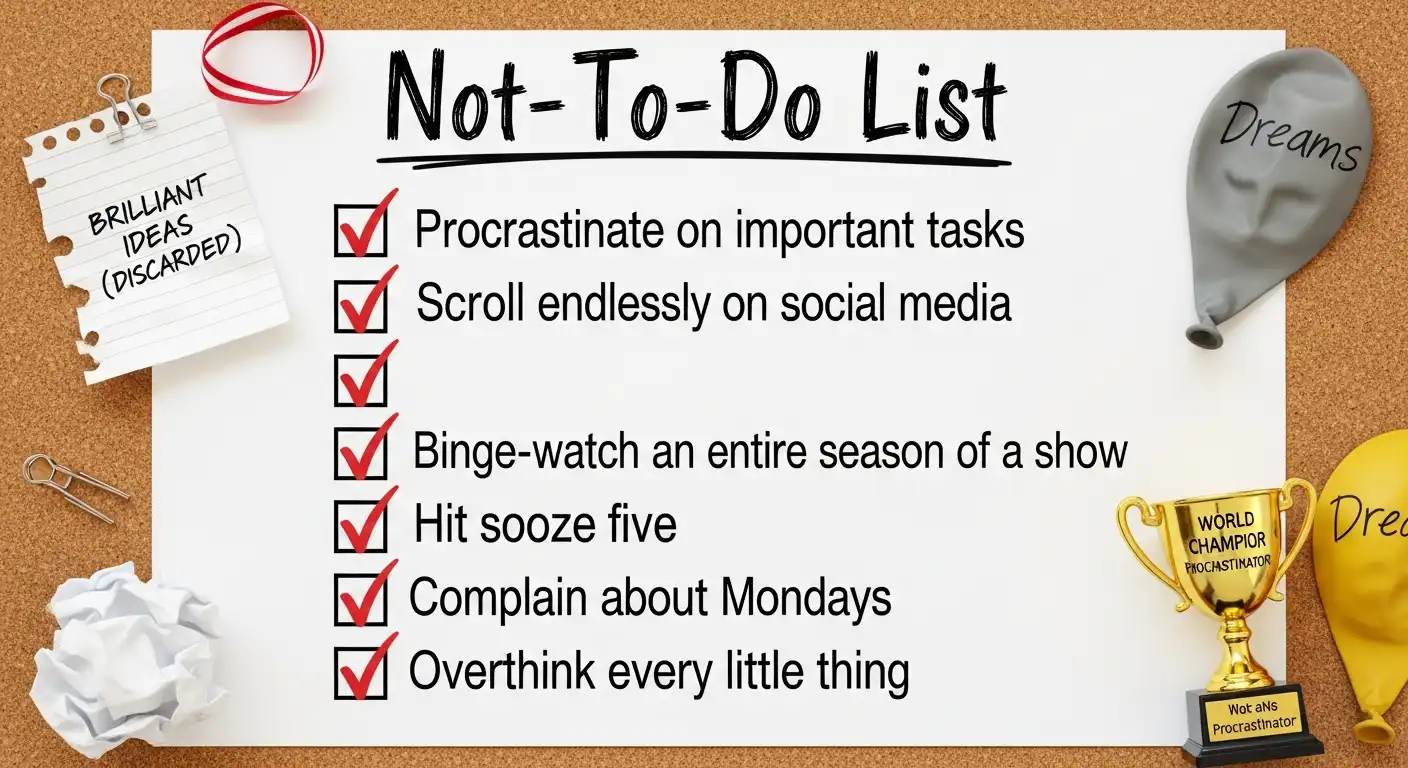
We are a culture obsessed with addition. We add more tasks to our calendars, more apps to our phones, and more goals to our resolutions, all in the relentless pursuit of “productivity.” We treat our lives like a game of Tetris, believing that if we just spin the blocks fast enough and cram them into every available space, we will win.
But we are not winning. We are burning out.
We end our days with a brain full of browser tabs, an inbox overflowing with unread emails, and a gnawing sense of having been incredibly busy but not remotely effective. We are caught in a cycle of “shallow work”—answering emails, attending pointless meetings, and reacting to notifications—while the deep, meaningful work that moves the needle on our careers and lives gets pushed to the margins.
The problem isn’t that you aren’t doing enough. The problem is that you are doing too many of the wrong things.
The antidote to this modern malaise is not a better to-do list. It is a “Not-To-Do” List.
This counterintuitive concept, championed by thought leaders like Warren Buffett, Tim Ferriss, and Jim Collins, is a strategic act of subtraction. It is a personal manifesto declaring what you will consciously ignore to protect your time, your energy, and your focus for the few things that truly matter. It is the fence you build around your life to keep the distractions out.
This comprehensive guide will walk you through the psychology of saying no, the process of identifying your personal “time vampires,” and the step-by-step framework for creating and enforcing a Not-To-Do list that will give you back your most precious resource: your time.
The Philosophy of Subtraction: Why “Doing Less” is So Hard
If the concept is so simple, why don’t we all have a Not-To-Do list? The answer lies deep in our psychological wiring. Our brains are not designed to subtract; they are designed to add.
The Fear of Missing Out (FOMO)
We say “yes” to projects we don’t have time for because we fear missing out on a career opportunity. We say “yes” to social events we are too tired for because we fear missing out on a connection. This is an evolutionary holdover from our tribal past, where being excluded from the group was a death sentence.
The Disease to Please
Many of us have a deep-seated psychological need to be liked and to be seen as helpful. Saying “no” feels like a rejection of the person asking. We would rather suffer in silence under the weight of an extra task than risk a moment of social discomfort.
The Illusion of “Busyness”
In our culture, “How are you?” is almost always answered with “Busy!” We wear our exhaustion like a badge of honor. A packed calendar makes us feel important and in-demand. An empty space on the calendar feels like a sign of laziness or failure. A Not-To-Do list forces us to confront this vanity and choose effectiveness over the appearance of effectiveness.
The Pareto Principle: The 80/20 Rule
Your Not-To-Do list is built on the foundation of the Pareto Principle, or the 80/20 Rule. This principle states that for many events, roughly 80% of the effects come from 20% of the causes.
- 80% of your business revenue comes from 20% of your clients.
- 80% of your happiness comes from 20% of your relationships.
- 80% of your results come from 20% of your efforts.
The Not-To-Do list is the ruthless act of identifying and eliminating the 80% of tasks that only produce 20% of the results. It is about creating the space to double down on the vital 20%.
Phase 1: The Audit (Finding Your Time Vampires)
You cannot eliminate what you cannot see. Before you write a single rule for your list, you need data. For one week, you will become a forensic accountant in your own time.
The Time and Energy Log
This is a non-negotiable first step. Use an app like Toggl or RescueTime, or a simple physical notebook. For three to five days, track your time in 30-minute intervals. Be brutally honest. If you spent 45 minutes scrolling TikTok, write it down.
Next to each activity, rate your energy on a scale of -5 (completely drained) to +5 (energized).
- 9:00 AM – 9:30 AM: Answered emails. Energy: -2.
- 10:00 AM – 11:30 AM: Wrote project proposal. Energy: +3.
- 2:00 PM – 3:00 PM: Attended “Weekly Update” meeting. Energy: -4.
At the end of the week, you will have a map of your personal “time and energy vampires.” The activities with the highest negative energy scores are the prime candidates for your Not-To-Do list.
The “Should” Audit
Listen to your internal monologue. How many times a day do you think, “I should check my email,” or “I should go to that networking event”?
The word “should” is often a red flag for an external expectation you have internalized. It is a task you are doing out of guilt or obligation, not genuine desire or strategic importance. List these “shoulds.”
Phase 2: Building the List (The Categories of “No”)
Now that you have your data, it is time to draft your manifesto. A robust Not-To-Do list is divided into categories that address the different areas where we leak time and energy.
Category 1: Digital Hygiene and Focus Protection
These rules are designed to combat the “Attention Economy” and reclaim your ability to concentrate.
- Do not check your email before 10:00 AM or after 6:00 PM. Your morning is for proactive, creative work. Your evening is for rest. Do not let other people’s agendas hijack these sacred times.
- Do not sleep with your phone in the bedroom. Buy an old-school alarm clock. The bedroom is for sleep and intimacy, not for doom-scrolling.
- Do not answer unknown numbers or respond to texts immediately. Your time is your own. Just because someone can reach you instantly does not mean they are entitled to an instant response.
- Do not engage in social media arguments. It is a black hole of energy with zero ROI. You will never change a stranger’s mind in a comment section.
- Do not have more than 5 tabs open at a time. Multitasking is a myth. It is just task-switching, and every switch comes with a cognitive cost.
Category 2: Social and Relational Boundaries
These rules protect you from other people’s priorities and the disease to please.
- Do not say “yes” on the spot. Implement a mandatory pause. The script is: “Thank you for thinking of me. Let me check my calendar, and I will get back to you by the end of the day.” This breaks the people-pleasing reflex and gives you space to decide if the request aligns with your goals.
- Do not attend meetings without a clear agenda and purpose. If you receive a meeting invite with a vague title like “Catch up,” reply with: “Sounds great! So I can prepare, could you send over a few bullet points on what you’d like to accomplish?” This forces the organizer to respect your time.
- Do not explain your “no.” You do not need a spreadsheet of excuses to decline an invitation. “I can’t make it, but I hope you have a great time!” is a complete sentence.
- Do not gossip. It creates a toxic environment and signals to others that you are not trustworthy.
- Do not spend time with “energy vampires.” You know who they are—the people who leave you feeling drained, negative, and small. Audit your social circle and limit your exposure.
Category 3: Work and Productivity Principles
These rules are about distinguishing “busywork” from “real work.”
- Do not start the day without a plan. Spend the last 15 minutes of your workday (or the evening before) defining the 1-3 Most Important Tasks for tomorrow. When you sit down at your desk, you execute, you don’t decide.
- Do not over-research. Set a timer for research. When it dings, stop collecting information and start creating. This combats “analysis paralysis.”
- Do not check stats/analytics more than once a day. Checking your website traffic, your stock portfolio, or your social media likes every 30 minutes is a form of procrastination disguised as work. It doesn’t change the outcome.
- Do not do tasks that can be automated or delegated. Are you manually copying data from one spreadsheet to another? Learn to use a tool like Zapier. Are you spending hours on scheduling? Get a Calendly subscription. Your time is worth more than that.
- Do not let perfection be the enemy of good. Ship the project. Send the email. The last 10% of perfection takes 90% of the effort.
Phase 3: The Implementation and Enforcement
Writing the list is easy. Living it is hard. The world will constantly test your new boundaries. You need systems to enforce them.
Make it Visible
Print your Not-To-Do list. Tape it to your monitor. Set it as your phone’s lock screen.
When you feel the unconscious urge to open Twitter at 9:30 AM, the physical list serves as an external conscience. It is a visual pattern interrupt that reminds you: We don’t do that anymore.
Use Digital Enforcers
Willpower is a finite and unreliable resource. Do not rely on it. Use software to enforce your rules.
- Rule: No social media during work hours. -> System: Install a site blocker like Freedom or Cold Turkey and set a recurring schedule.
- Rule: No email before 10 AM. -> System: Remove the mail app from your phone’s home screen. Use an app like Boomerang to “pause” your inbox.
The Power of the “Positive No”
When you have to say no to someone, frame it positively.
- Instead of: “No, I’m too busy.”
- Try: “Thank you so much for the offer. Right now, I’m fully committed to my current projects and couldn’t give this the attention it deserves. I’d be doing you a disservice if I said yes.”
This affirms the value of their request while protecting your own boundaries.
Advanced Strategies: Beyond the List
Once you have mastered the basic Not-To-Do list, you can integrate more advanced concepts.
The “Hell Yeah! or No” Rule
Popularized by Derek Sivers, this is a filter for new opportunities. When presented with a choice, if your immediate, gut reaction is not “Hell Yeah!”, then the answer is “No.”
This eliminates the “lukewarm” commitments that slowly drain your life force. It reserves your energy for the things that truly excite you.
Creating a “Stop Doing” List
This is a more dynamic version of the Not-To-Do list. At the end of every quarter, review your projects, habits, and commitments. Ask: “If I were starting from scratch today, what would I not start?”
This helps you prune the commitments that were once important but are no longer serving you.
Practical Examples of Not-To-Do Lists
Your list will be unique to your life, but here are some templates to get you started.
The Stressed Executive
- Do not attend meetings where I am not a primary decision-maker (I will read the minutes later).
- Do not answer non-urgent emails on weekends.
- Do not travel for meetings that can be done effectively via video call.
- Do not micromanage my team’s process; I will focus on the outcome.
- Do not check my phone during the first hour of the day.
The Creative / Freelancer
- Do not work for clients who haggle on price or show a lack of respect.
- Do not check email or social media until my “Morning Pages” (creative work) are done.
- Do not work from the couch (I will maintain a dedicated workspace to protect my posture and focus).
- Do not agree to “pick your brain” coffee chats without a clear agenda or purpose.
- Do not start a new project until the current one is finished.
The Busy Parent
- Do not volunteer for school events or committees out of guilt.
- Do not fold my children’s underwear (it’s a waste of time).
- Do not cook separate meals for picky eaters; they eat what is served.
- Do not browse my phone while my children are trying to talk to me.
- Do not say “yes” to every birthday party or playdate.
Conclusion
The ultimate goal of the Not-To-Do list is to move from the anxiety of FOMO (Fear Of Missing Out) to the profound relief of JOMO (Joy Of Missing Out).
There is a deep satisfaction in consciously deciding not to do things. When you stop checking the news every hour, you might miss some of the breaking drama, but you gain peace of mind. When you stop attending every social event, you might miss some of the gossip, but you gain restorative rest. When you stop doing busywork that makes you feel productive, you gain the time to do the actual productive work that will change your life.
Your time is your most non-renewable resource. You can always make more money, but you can never make more time. Stop giving it away cheaply to tasks and people that do not align with your deepest values.
Build your fence. Write your list. And watch as your life expands in the empty space you create. This is the art of subtraction, and it is the secret to a well-lived life.