Key Points:
- Researchers found the best way to design farmland windbreaks.
- Trees with 30-50% gaps offer the most effective wind protection.
- Proper shelterbelts can increase crop yields by up to 25%.
- Scientists recommend using AI and satellites for future planning.
Researchers from the Xinjiang Institute of Ecology and Geography in China have proposed a new way to design windbreaks to help farmers in dry areas. Their review, published in the journal Agricultural Systems, looks at how planting rows of trees can save crops from wind and drought. These “shelterbelts” act as green infrastructure that stops soil erosion and keeps the air around crops stable.
The team highlighted that how you plant the trees matters immensely. Key factors include how tall the trees are, how wide the belt is, and where they stand relative to the wind. The study found that you should not build a solid wall of vegetation. Instead, the best windbreaks have “porosity,” or gaps, of about 30% to 50%.
When farmers get this balance right, the benefits are clear. A good windbreak protects the field for a distance of 20 to 30 times the height of the trees. Inside this protected zone, the study found that water evaporation drops by 10-30%. Even better, the actual crop harvest typically increases by 10-25% because the plants are less stressed.
However, the researchers warned that there is a trade-off. If you plant too many trees to stop the wind, those trees might drink the groundwater that the crops need. This competition can actually hurt the farm if not managed correctly.
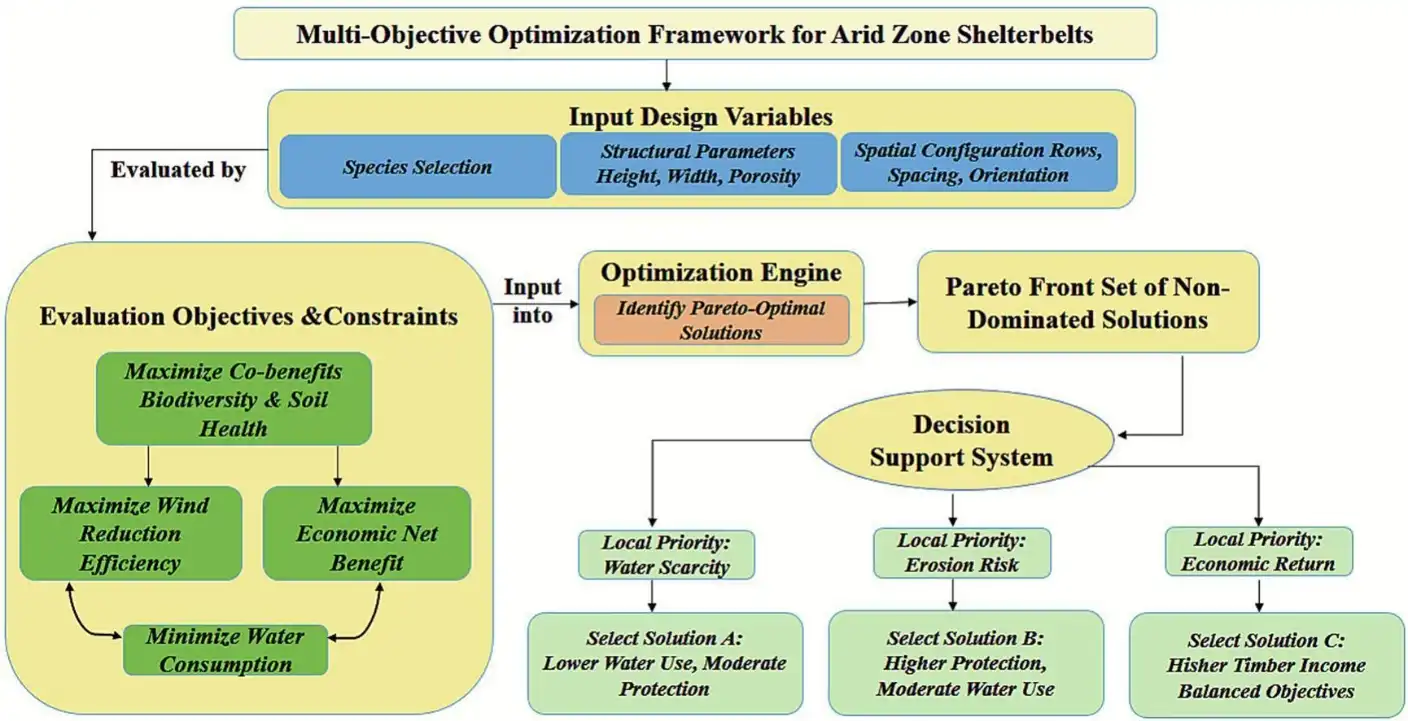
To fix this, the team suggests a “best-compromise” solution. Instead of just trying to stop the wind, planners should look at water limits, costs, and biodiversity at the same time. They call this a multi-objective optimization framework.
For the future, the review recommends using high-tech tools. Farmers and planners should combine drought-tolerant tree species with modern technology like artificial intelligence and satellite monitoring. By using these tools, they can create a design that fits the specific local climate and soil conditions, ensuring the farm remains productive for years to come.
Source: Agricultural Systems (2026).