Key Points:
- The Ariane 6 rocket lifted off from French Guiana early Thursday to place 32 Amazon Internet satellites into orbit.
- This launch marks the seventh flight for Europe’s new rocket and uses its maximum power configuration with 4 solid boosters.
- Amazon plans to build a network of 3,200 satellites to compete directly with Elon Musk’s massive Starlink internet service.
- French company Arianespace holds a contract for 18 total launches with Amazon, giving the European space industry a vital financial boost.
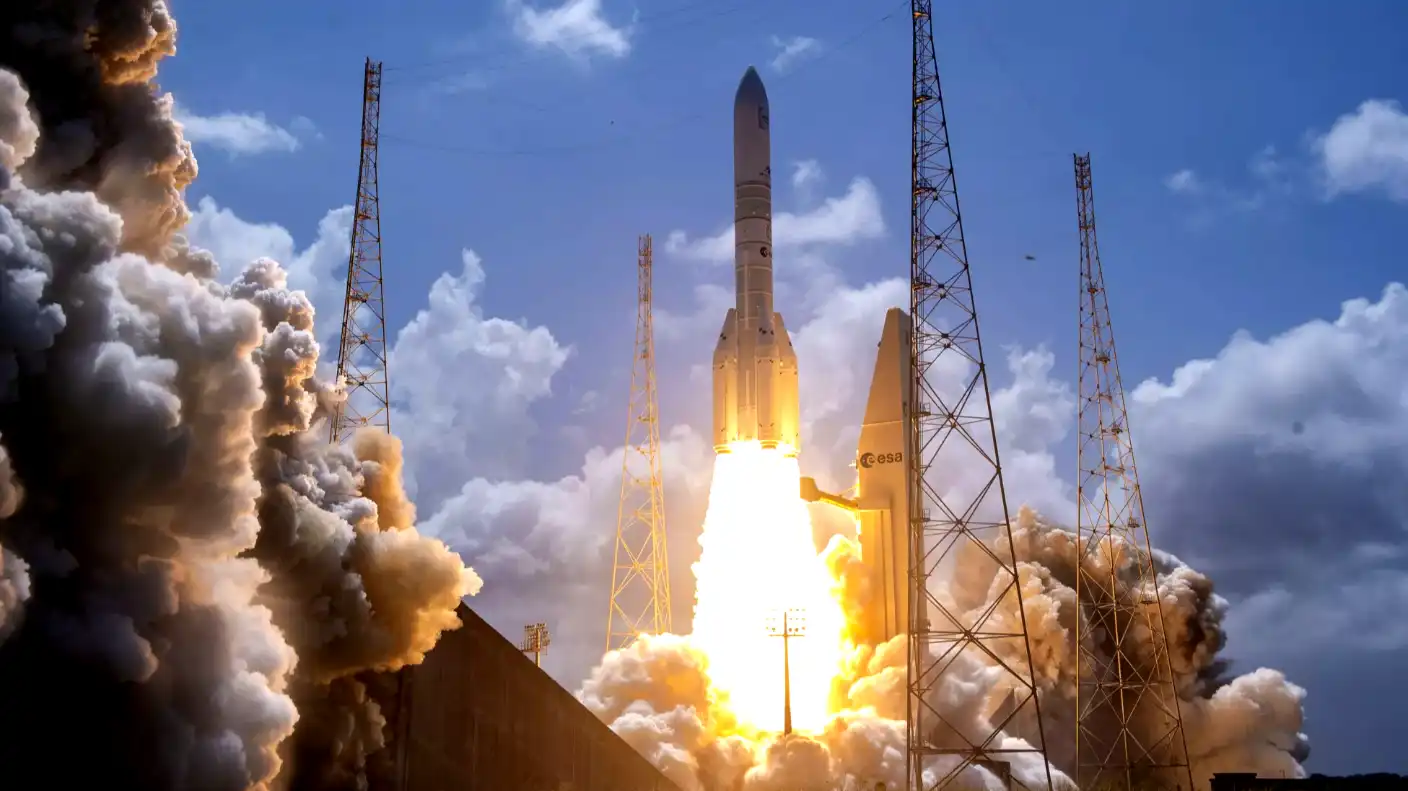
Europe launched its most powerful rocket, the Ariane 6, early Thursday morning. The giant machine blasted through the overcast skies above the spaceport in Kourou, French Guiana, at exactly 5:57 a.m. local time. The rocket carried a heavy payload of 32 internet satellites for Amazon, sending them on a precise trajectory into low Earth orbit.
The flight controllers monitored the mission as it went exactly to plan. A little under 2 hours after lift-off, the rocket’s upper stage released the satellites in a controlled sequence. The spacecraft separated smoothly and drifted into their designated orbital slots. This successful delivery gives Amazon another batch of hardware for its upcoming global internet network, which the company calls Amazon Leo.
This mission represents a major technical achievement for the European space industry. Arianespace, the French company that operates the rocket, flew the Ariane 6 for the seventh time overall. For this specific flight, engineers strapped 4 solid rocket boosters to the core stage. This setup marks the most powerful configuration available for the Ariane 6, providing the massive thrust needed to haul 32 heavy satellites into space on a single trip. This was only the second time Arianespace used the 4-booster version.
Amazon founder Jeff Bezos funded this project to challenge Elon Musk in the booming space internet market directly. Musk currently dominates the sky with his Starlink network. Both billionaires share the same business objective. They want to beam reliable, high-speed internet down to customers living in rural, isolated, or underserved areas where traditional telecom companies refuse to build physical cell towers or fiber-optic networks.
Amazon still has a massive gap to close before it can offer global service. The retail and tech giant plans to launch an initial wave of 3,200 satellites to activate its commercial network. Right now, Amazon has only 239 satellites orbiting Earth. The company suffered several industry delays over the last few years. To keep the project moving, Amazon even swallowed its pride and hired its direct rival, SpaceX, to launch a few of its early satellites.
Meanwhile, SpaceX maintains a commanding and historic lead over the rest of the industry. A French space surveillance startup called Look Up shared the latest orbital tracking data on Wednesday. According to their exact numbers, Starlink broke a massive barrier earlier this year in March when it crossed the 10,000-satellite mark. Today, Elon Musk controls exactly 10,162 active satellites in low Earth orbit.
To close this gap rapidly, Amazon needs a steady supply of reliable rockets. The tech giant signed a huge contract with Arianespace to use the new European rocket as its primary workhorse. Under this business deal, the French operator will execute 18 separate launch missions for the Amazon Leo project. Thursday’s launch served as the second flight under this long-term agreement, leaving 16 more trips on the schedule.
This specific business relationship basically guarantees the survival of the European rocket program. Arianespace faces brutal, relentless competition from SpaceX. Musk’s company completely disrupted the aerospace market by flying, landing, and reusing rocket boosters. Reusing rockets cuts launch costs drastically. Because Arianespace still uses disposable rockets that fall into the ocean, many European commercial customers abandoned the local space agency to buy cheaper, faster rides from SpaceX.
Securing Amazon as an anchor customer changes Arianespace’s financial reality. The massive order of 18 launches ensures the spaceport in South America stays fully operational and busy for the next few years. Factory workers across Europe will keep building rocket parts to fulfill the Amazon contract. As a result, Amazon secures a dedicated, reliable ride to space, and Europe retains its independent ability to launch heavy payloads without relying exclusively on American companies.