Key Points:
- A driver escaped unharmed after rushing floodwaters swept their expensive Tesla Model Y off a rural road.
- A local towing company rescued the luxury electric vehicle and jokingly called it a $100,000 toaster taking a bath.
- The same flooded creek trapped a rugged Mitsubishi Triton utility vehicle earlier this year.
- Car manufacturers are developing new safety features, such as self-shattering glass, to help people escape sinking vehicles.
A driver in the Northern Territory recently survived a terrifying ordeal after ignoring basic road safety rules. Rushing floodwaters swept their expensive electric car completely off a rural road. The scary incident serves as a strong and clear warning to everyone about the extreme dangers of crossing flooded creeks. Fortunately, the driver escaped the sinking vehicle without any physical injuries, but they left behind a heavily damaged luxury car.
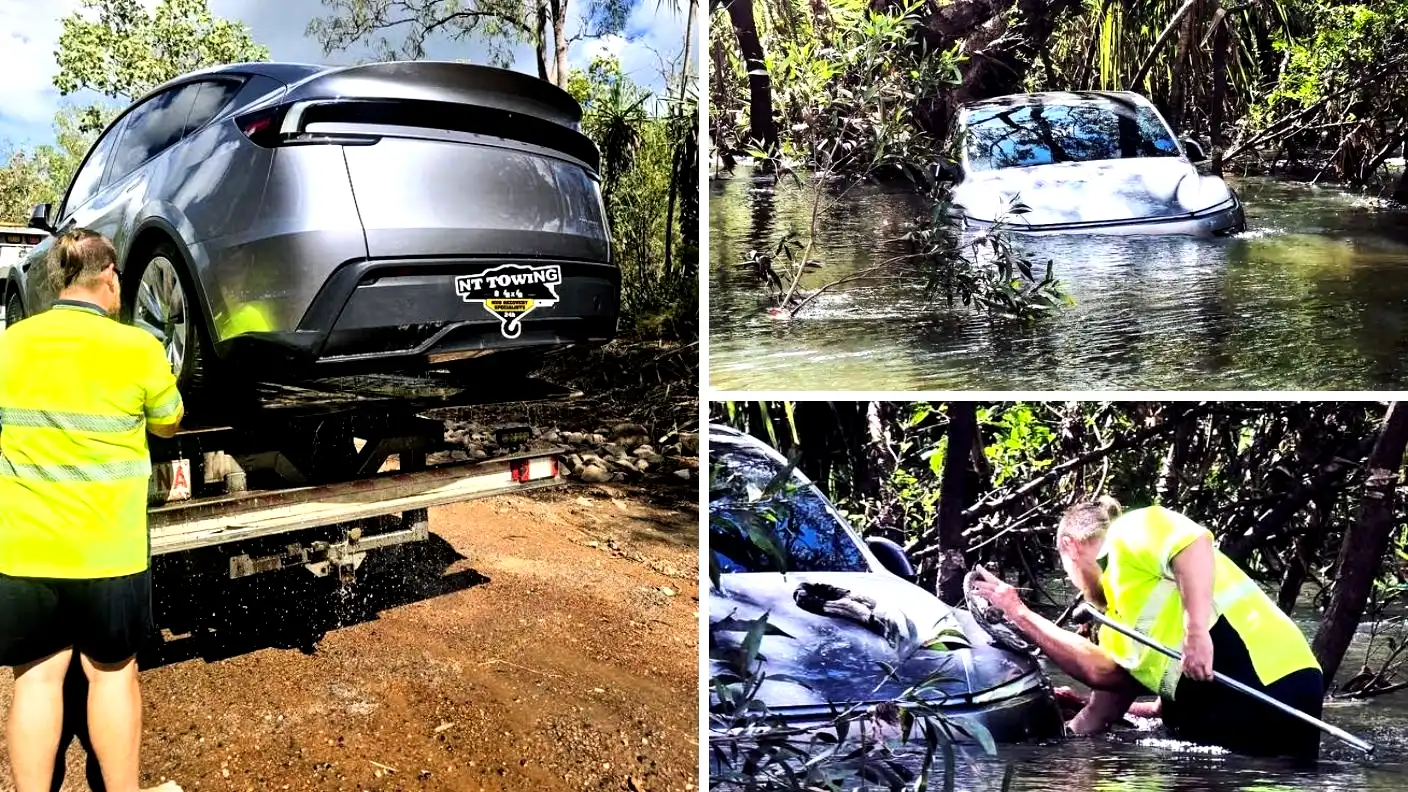
Experts from NT Towing and Recovery rushed to the scene to pull the stranded vehicle out of the rushing water. They retrieved the white Tesla Model Y from a dangerous creek crossing on Old Bynoe Road at Berry Springs. This rural location sits about 45 minutes south of Darwin. The electric vehicle completely failed to navigate the deep water and quickly became stuck in the powerful current, requiring professional heavy equipment to haul it back to dry land.
The towing business decided to share the rescue effort online to warn other drivers. They posted pictures of the waterlogged car directly to their Facebook page. In the caption, the recovery team jokingly described the costly incident as just a $100,000 toaster taking a bath. The internet quickly jumped in to mock the driver for making such a poor and expensive decision during bad weather.
Car enthusiasts flooded the comments section with jokes and heavy sarcasm. Many users poked fun at the car’s electric nature, calling it a self-diving vehicle rather than a self-driving one. Others asked sarcastically whether the driver was trying to recharge the battery using electric eels from the creek. Several commenters told the driver they could not park there. A few helpful jokers suggested the owner should just stick the massive car in a giant tub of rice for a bit, comparing the luxury vehicle to a dropped smartphone.
Beyond the jokes, many people felt the incident offered a timely and serious reminder. They correctly pointed out that drivers should never attempt to cross flooded roads under any circumstances. You can never tell exactly how deep the water is or how fast the current moves below the surface. A heavy vehicle can easily float away in just a few inches of fast-moving water, turning a simple commute into a deadly situation.
This specific creek crossing catches many drivers off guard every single year. In fact, the same towing business recovered a much more capable vehicle at this very spot earlier this year. A driver managed to strand a rugged Mitsubishi Triton utility vehicle in the same flooded creek. Even with a high ground clearance and strong 4-wheel-drive capabilities, the powerful water easily trapped the heavy truck, proving that no car is immune to the force of nature.
Both recent incidents occurred less than 5 minutes upstream of a site with a tragic history. The creek flows directly from the Darwin River, a waterway that demands absolute respect. Back in 2010, the fast-moving river claimed the life of a resident named Karen Margaret Kelly. Rushing water washed her Toyota Corolla right off Leonino Road, resulting in a devastating tragedy that shook the entire local community.
Following her death, the Northern Territory Coroner demanded major safety upgrades to the area to prevent future loss of life. Road crews changed the road surface, installed better warning signs, improved the drainage systems, and built strong physical barriers to guide drivers safely. Locals now call this safer section of the river the Karen Kelly Crossing to honor her memory and remind everyone of the dangers.
However, upgraded roads cannot fix bad human choices. Despite the new safety features and warning signs, an Uber driver still managed to strand a Mazda CX-5 at the crossing earlier this year. The NT News reported that 2 people sat trapped inside the flooded car while water rushed around them. Terrifyingly, one of the passengers did not know how to swim. The newspaper joked that the driver probably did not receive a 5-star rating for that terrifying trip.
Because drivers continue to drive their cars into deep water, automakers are taking drastic action to save lives. Car companies are working closely with safety organizations such as ANCAP to address the drowning problem. They want to design new features that make it much easier for passengers to escape a submerged vehicle during a panic. When electronic doors and electric windows fail underwater, trapped people desperately need a physical way out.
Some companies now equip their new cars with special emergency hammers hidden in the cabin. Drivers can use these heavy tools to shatter the tough safety glass and swim to the surface. Other brands are pushing the technology even further. In China, automaker Zeekr equipped its new 7X model with smart windows. The car features self-shattering glass that automatically breaks in the event of a water emergency, giving passengers a clear escape route without requiring any physical effort.