

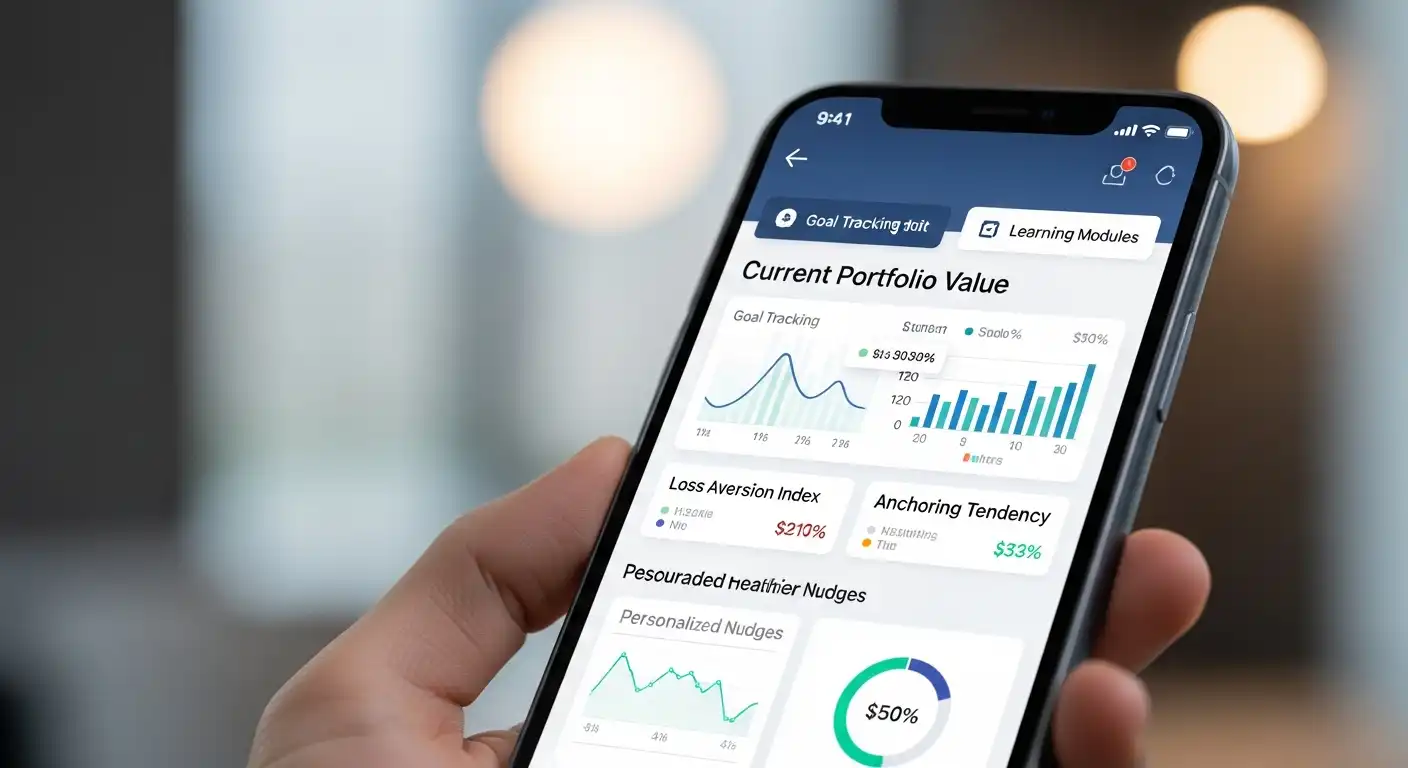
In traditional economic theory, humans are described as “rational agents.” This theoretical human—Homo Economicus—always acts in their own best interest. They save for retirement, they never buy things they can’t afford, they diversify their investments, and they never panic sell when the market dips.
If you have ever met a human being, you know this is nonsense.
Real humans are emotional, impulsive, and prone to cognitive biases. We buy shoes because we are sad. We sell stocks because we are scared. We procrastinate on saving for retirement because the future feels abstract. This gap between how we should act and how we actually act is the domain of Behavioral Finance.
For decades, behavioral finance was an academic discipline. Today, it is the secret weapon of the world’s most successful financial technology (fintech) apps. By understanding the psychological triggers that drive financial decisions, designers and developers are building interfaces that don’t just transact money—they change behavior.
This article explores the intersection of psychology and UX design, detailing how modern apps are leveraging behavioral science to nudge users toward wealth, health, and better decision-making.
The Cognitive Biases That Keep Us Poor
To design a solution, you must first understand the problem. The human brain is wired for survival on the savanna, not for managing a 401(k) or navigating cryptocurrency volatility. Several key cognitive biases consistently sabotage our financial health.
Present Bias (Hyperbolic Discounting)
We value immediate rewards significantly more than future rewards. A $100 bonus today feels much better than $150 a year from now. This is why saving is difficult; spending provides a dopamine hit now, whereas saving offers a theoretical benefit later.
Loss Aversion
The pain of losing $100 is psychologically about twice as powerful as the pleasure of gaining $100. This leads investors to hold onto losing stocks too long (hoping they will bounce back to avoid the “loss”) or sell winning stocks too early (to lock in the gain).
The Ostrich Effect
When markets are down or our bank account is low, we tend to ignore our financial information entirely. We bury our heads in the sand to avoid negative emotions, which usually leads to worse outcomes like missed payments or overdraft fees.
Mental Accounting
We treat money differently depending on its source. We might be frugal with our paycheck but blow a tax refund or a bonus on luxury items because we view it as “free money,” even though a dollar is a dollar regardless of the source.
Designing for “Nudges”: The Architecture of Choice
Behavioral economics teaches that we can counter these biases with “nudges”—subtle design choices that alter behavior in predictable ways without prohibiting any options.
Default Options: The Path of Least Resistance
The most powerful nudge is the default. Humans are lazy; we stick with the default setting.
- The Design Fix: Apps such as Acorns and Chime use this by making “Round-Ups” or “Auto-Save” the default during onboarding. When a user signs up, the app asks, “Do you want to save your spare change automatically?” The “Yes” button is highlighted. By reducing friction to zero, millions of users save money without thinking about it.
Reframing: Changing the Narrative
How information is presented affects how people respond to it.
- The Design Fix: Instead of asking a user to “Save $500 a month,” which feels like a loss of spending power (Loss Aversion), an app like Qapital asks users to “Fund your Road Trip Goal.” By tying money to a concrete, positive outcome, saving is reframed from a sacrifice into a purchase of a future dream.
Gamification: Making Finance Dopamine-Friendly
Finance is boring. Spending money is fun because it releases dopamine. To compete, financial apps must hijack the brain’s reward system using gamification mechanics.
Progress Bars and Visual Feedback
We have an innate desire to complete tasks. The “Zeigarnik Effect” states that uncompleted tasks stick in our memory.
- The Design Fix: Savings apps use circular progress bars to visualize goals. Seeing a bar at 85% creates a psychological urge to reach 100%. When the goal is reached, the app celebrates with confetti animations and haptic feedback (vibrations). This replaces the dopamine hit of spending with the dopamine hit of saving.
Streaks and Social Proof
We are social creatures who care what others think.
- The Design Fix: Apps such as Snapchat pioneered the “streak,” and financial apps are adopting it. “You have stayed under budget for 12 weeks in a row!” Breaking the chain feels like a loss, so users maintain good habits to keep the streak alive. Some apps also show anonymous data: “People with your income usually save 15%.” This leverages social pressure to encourage better habits.
Variable Rewards
This is the mechanism behind slot machines. If you get a reward every time, it becomes boring. If the reward is unpredictable, it is addictive.
- The Design Fix: Prize-Linked Savings accounts (like Yotta Savings) use this. Instead of a guaranteed 0.5% interest rate, your savings act as lottery tickets. You might win $0, or you might win $10,000. This satisfies the user’s desire for a “big win” and gambling excitement, but without the risk of losing their principal.
Friction: The Good, The Bad, and The Ugly
In UX design, “friction” (anything that slows the user down) is usually the enemy. Amazon wants “One-Click” ordering to remove friction. In financial wellness, however, friction is often the hero.
Positive Friction (Cooling-Off Periods)
To combat impulse spending (Present Bias), apps need to slow us down.
- The Design Fix: Some neobanks allow users to set “Safe-to-Spend” limits. If a user tries to buy something expensive, the app might introduce a forced delay or a “double confirmation” screen that asks, “This purchase will delay your Vacation Goal by 3 weeks. Are you sure?” This split-second pause allows the rational brain (Prefrontal Cortex) to catch up with the emotional brain (Amygdala).
Negative Friction (The “Sludge”)
Conversely, apps must remove friction from “good” behaviors.
- The Design Fix: Opening an investment account used to take days of paperwork. Apps like Robinhood or Wealthfront allow users to fund an account in 3 minutes. While Robinhood has been criticized for making risky trading too easy (removing necessary friction), the principle of reducing barriers to entry for investing is sound for long-term wealth building.
Visualizing the Abstract: Making the Future Real
One of the biggest challenges in finance is that the “Future You” feels like a stranger. It is hard to save for a stranger.
Time Travel via UX
- The Design Fix: Retirement calculators were once spreadsheets. Now, apps use “Age Progression” visuals. Some experimental interfaces allow users to upload a selfie and see an aged version of themselves. Studies show that people who view their future selves allocate significantly more to retirement funds because the connection to their future self becomes more visceral and emotional.
Concrete Bucketing (Mental Accounting)
Since we naturally use mental accounting, apps should lean into it rather than fight it.
- The Design Fix: Apps such as Monzo and Ally offer “Buckets” or “Pots.” Instead of one big savings account, you have a “Rent” bucket, a “Dog Food” bucket, and a “Date Night” bucket. This gives every dollar a job. It prevents the user from spending rent money on shoes because the app clearly indicates that the funds are “spoken for,” even if they are technically available in the total balance.
The Ethical Responsibility of Design
This power to manipulate behavior comes with immense ethical responsibility. The line between “nudging” (helping users achieve their goals) and “sludging” (manipulating users for the company’s profit) is thin.
Dark Patterns vs. Light Patterns
- Dark Pattern: A trading app that rains confetti every time a user makes a trade. This encourages overtrading, which typically costs users money but generates fees for the app. This exploits dopamine for profit.
- Light Pattern: A trading app that shows a warning when a user is about to make a highly volatile trade, or an app that celebrates when a user pays off debt.
Designers in fintech are not just building software; they are acting as digital financial advisors. They have a fiduciary duty to design interfaces that prioritize the user’s long-term financial health over short-term engagement metrics.
Case Studies: Apps Getting It Right
Some of the popular cases of financial technology apps are discussed below:
Qapital (Goal-Based Saving)
Qapital excels at Reframing. It allows users to set “Rules.” For example, the “Guilty Pleasure Rule”: every time you buy from McDonald’s, the app saves $10. It turns a “bad” habit into a trigger for a “good” habit. It leverages automation to make saving painless.
Betterment (Robo-Advising)
Betterment tackles Loss Aversion. During market dips, instead of showing red graphs (which trigger panic), they often show the user’s progress toward their long-term goal. They also automatically use a feature called “Tax-Loss Harvesting”. By framing the downturn as an opportunity to save on taxes, they keep users invested when their instinct is to sell.
Klarna (The Double-Edged Sword)
Buy Now, Pay Later (BNPL) apps such as Klarna leverage Present Bias to an extreme. They reduce the pain of paying by splitting the cost. While this increases conversion for merchants, it can lead users into debt spirals. The ethical challenge for BNPL UX is to ensure users clearly understand the total debt they are accumulating, rather than hiding it behind sleek “4 easy payments” interfaces.
The Future: Hyper-Personalization with AI
The next frontier of behavioral design is AI. Current apps use broad heuristics (rules of thumb). Future apps will know your specific psychological profile.
Imagine an AI that knows you specifically panic when the market drops 5%, but your partner doesn’t panic until it drops 10%. The app would interface with you differently.
- For the Panic Seller: The app might hide daily fluctuations and show only monthly trends to reduce anxiety (the Ostrich Effect used for good).
- For the Impulse Spender: The app might detect you are in a shopping mall (via GPS) and send a push notification: “Remember, you are only $200 away from your Paris trip goal!”
Conclusion
Behavioral finance teaches us that we cannot math our way out of money problems. If spreadsheets were the answer, everyone would be rich. The barrier is behavioral, not intellectual.
The most successful financial apps of the next decade won’t be the ones with the most complex charts or the most crypto tokens. They will be the ones who understand human nature. They will be the apps that forgive us for being irrational, anticipate our mistakes, and gently, invisibly nudge us toward the version of ourselves we want to be.
Designing for money is designing for emotion. By building empathy into the code, fintech has the capacity not just to move money but to improve lives.






