For the last century, the word “robot” has conjured images of rigid metal, whirring servos, hydraulic pistons, and silicon chips. From the assembly line arms of the automotive industry to the humanoid dreams of science fiction, robotics has been defined by the hard, cold materials of the industrial age. However, a quiet revolution is underway in laboratories worldwide. Engineers are putting down their soldering irons and picking up pipettes. They are looking to nature not only for inspiration but also for building materials.
This is the dawn of Bio-Hybrid Robotics.
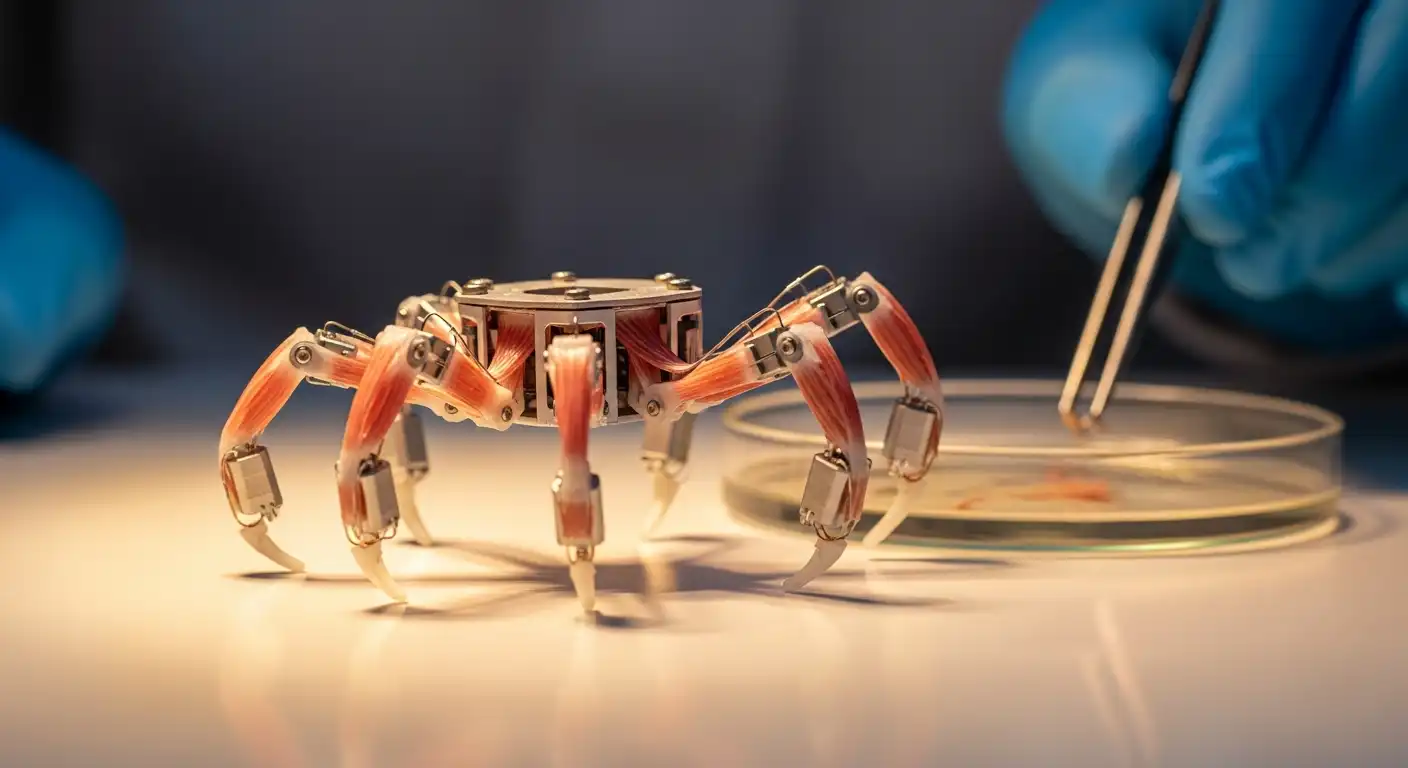
By merging synthetic materials with living biological tissue, scientists are creating a new class of machines that move, sense, and heal like living creatures. These robots do not run on batteries; they run on glucose. They do not have motors; they have muscles. This comprehensive guide explores the fascinating science of bio-hybrid robots, the engineering challenges of fusing flesh with synthetic skeletons, and the profound implications this technology holds for medicine, the environment, and our understanding of life itself.
The Limitation of the Machine and the Perfection of Biology
To understand why scientists are seeking to build robots from meat, we must first examine the limitations of traditional robotics. While traditional robots are powerful and precise, they suffer from significant drawbacks:
- Rigidity: Metal and plastic are stiff. While this is good for lifting cars, it is terrible for navigating delicate environments, such as the human body or a fragile coral reef.
- Energy Inefficiency: Motors require electricity. Batteries are heavy, toxic, and prone to degradation. Nature, conversely, is incredibly energy-efficient. A human heart pumps for decades without a recharge, fueled only by the food we eat.
- Lack of Self-Repair: If a gear breaks in a robot, the robot is dead until a human fixes it. If you cut your finger, your body repairs it automatically.
Bio-hybrid robotics aims to solve these problems by integrating the “software” of biology—cells and tissues—with the “hardware” of engineering. The goal is to create machines that are soft, energy-efficient, biodegradable, and self-healing.
The Anatomy of a Bio-Bot: How It Works
Building a bio-hybrid robot is a delicate exercise in tissue engineering and synthetic biology. It involves three primary components: the scaffold, the actuator (muscle), and the control system.
The Scaffold: The Skeleton
Just as muscles need bones to pull against, bio-hybrid robots need a structure. However, unlike the rigid chassis of a Terminator, these skeletons are usually made of soft, flexible materials.
- Hydrogels: These are networks of polymer chains that are highly water-absorbent. They mimic the extracellular matrix of natural tissue, providing a friendly environment for cells to attach and grow.
- 3D-Printed Polymers: Engineers use sophisticated 3D printers to fabricate microstructures that deform in specific ways under applied forces.
- Gold Nanofibers: In some designs, gold is incorporated into the polymer to conduct electricity, thereby stimulating cell contraction.
The Actuator: Living Muscle
This is the robot’s engine. Instead of using an electric motor or a pneumatic pump, bio-hybrid robots use living muscle tissue to generate movement.
- Cardiomyocytes (Heart Muscle): Heart cells are popular because they contract spontaneously. You do not need to tell a heart cell to beat; it does it on its own. Robots built with cardiac cells can “swim” or “pump” rhythmically without external input.
- Skeletal Muscle: This tissue is stronger but requires a signal (like a nerve impulse) to contract. This offers more control. If you want the robot to stop or turn, skeletal muscle enables this, provided you have a means to stimulate it.
- Insect Muscle: Some researchers prefer insect tissue (e.g., from the dorsal vessels of insects or other arthropods) because it is more robust, operates at room temperature, and is less sensitive to pH than mammalian tissue.
The Power Source: ATP
One of the most revolutionary aspects of bio-hybrid robotics is the fuel. Traditional robots carry their fuel (batteries), which adds weight. Bio-hybrid robots harvest energy from their environment.
The cells are fueled by Adenosine Triphosphate (ATP), which is generated by the oxidation of glucose in the surrounding liquid. As long as the robot is swimming in a nutrient-rich fluid (such as a sugar solution or blood), it has an unlimited fuel source.
The Control Problem: Taming the Tissue
Putting muscle cells on a piece of plastic is the easy part. Getting them to move in a coordinated way to perform a task is the engineering challenge. How do you tell a blob of muscle to “turn left”?
Electrical Stimulation
As a pacemaker controls the human heart, engineers can use electrodes to deliver electrical pulses through the scaffold. This forces the muscle tissue to contract. By timing these pulses, they can control the robot’s speed and rhythm.
Optogenetics: Control by Light
This is the state of the art in control systems. Optogenetics involves genetically modifying muscle cells to render them sensitive to light. Scientists insert a gene (usually from algae) that produces a light-sensitive protein.
Once the cells are grown, illumination induces contraction. This allows for incredibly precise control. By shining a laser on the left side of a ray-shaped robot, only the left fin beats, causing it to turn. This method enables wireless remote control of the biological machine.
Chemical Sensing
Some bio-hybrids are designed to be autonomous sensors. Cells can be engineered to contract only in the presence of specific chemicals. For example, a bio-bot could be designed to freeze up when it detects a toxin, acting as a microscopic “canary in the coal mine.”
Famous Case Studies: The Zoo of the Future
The field is young, but several high-profile success stories have proven that the concept is viable.
The Robo-Ray
In a landmark study published in Science, a team from Harvard created a bio-hybrid stingray.
- Construction: It had a gold skeleton for energy storage, a rubber body for flexibility, and 200,000 genetically engineered rat heart cells.
- Function: Using optogenetics, the researchers could steer the ray through an obstacle course by flashing lights. It swam exactly like a real stingray, undulating its fins with fluid grace.
Xenobots: The Living Programmable Organism
Researchers at the University of Vermont and Tufts University took a different approach. Instead of placing cells on a scaffold, they built the robot entirely from cells.
Using stem cells from the African clawed frog (Xenopus laevis), they used a supercomputer to design a configuration of skin cells (for structure) and heart cells (for movement). The result was the “Xenobot”—a tiny living blob that could walk, swim, push pellets, and even heal itself if cut in half. These are not just robots; they are a new, synthetic life form.
The Bio-Gripper
Engineers at the University of Illinois Urbana-Champaign developed a “bio-bot” that acts as a gripper. Using a muscle ring wrapped around a hydrogel skeleton, the bot responds to electrical stimuli by contracting and closing. This soft, biological touch is ideal for handling delicate objects that a metal claw might crush.
Applications: Why Do We Need Them?
While watching a tiny ray swim in a petri dish is cool, the potential applications of this technology are world-changing.
The Future of Medicine: The “Fantastic Voyage”
The Holy Grail of bio-hybrid robotics is Targeted Drug Delivery. Current cancer treatments involve flooding the whole body with toxic chemotherapy. Imagine instead a swarm of microscopic bio-bots injected into the bloodstream.
- They swim through the veins, powered by the glucose in the blood.
- They sense the chemical signature of a tumor.
- They swim to the site and release a concentrated payload of medicine directly into the cancer cells.
- Once the job is done, the robot simply dies and dissolves. Because it is composed of biological cells and hydrogel, the body degrades it and excretes it without eliciting an immune response or requiring surgical removal.
Environmental Cleanup
We have a massive problem with microplastics and toxins in our oceans. Bio-hybrid robots could be the solution.
Swarms of “Jellyfish-bots” could be released into the ocean. They would swim efficiently, collecting toxins or microplastics. Because they are biological, if fish eat them, they are just protein—not electronic waste. Sensors embedded in these bots could also monitor ocean acidity and temperature with unprecedented resolution.
Better Prosthetics
Current prosthetics are engineering marvels, but interfacing metal with the human nervous system remains challenging. Bio-hybrid technology bridges this gap. By growing muscle tissue on the prosthetic interface, we could create smoother, more natural connections between a human amputee’s nerves and their robotic limb, enabling finer motor control and potentially sensory feedback.
Lab-on-a-Chip
Pharmaceutical companies spend billions testing drugs on animals. Bio-hybrid robots offer an alternative. By building “organs-on-chips”—functioning miniature models of hearts, lungs, or muscles—scientists can test how a new drug affects tissue physiology without harming live animals.
The Engineering Challenges: Keeping the “Bio” Alive
Despite the promise, you won’t see bio-bots at your local hospital tomorrow. The challenge of working with living material is significant.
The Life Support Problem
A metal robot can sit in a closet for a year and work fine when you turn it on. A bio-hybrid robot will die. Cells require a constant supply of nutrients at the appropriate temperature (typically 37°C) and pH. Currently, most bio-bots live for only a few days to weeks in a nutrient-rich medium. Creating a system that keeps the cells alive in “dry” or harsh environments is a massive hurdle.
The Immune Response
Although bio-bots are biodegradable, injecting foreign cells (even from a frog or a rat) into a human body elicits an immune response. For medical applications, the bots would likely need to be grown from the patient’s own stem cells (autologous cells) to prevent rejection, thereby dramatically increasing cost and complexity.
Scalability
Currently, these robots are microscopic or millimeter-scale. Scaling them up to human size is difficult because large tissues need a vascular system (blood vessels) to deliver oxygen to the inner cells. Without a circulatory system, the core of a large muscle-bot would die of necrosis.
The Ethical Frontier: When Does a Robot Become Alive?
Bio-hybrid robotics forces us to confront uncomfortable philosophical questions.
If a robot is made of living cells, is it alive? Xenobots, for example, exhibit behaviors that appear to involve swarming and cooperation. If we program them to experience “pain” (as a damage sensor), is it unethical to inflict damage on them?
Furthermore, the “dual-use” concern exists. The same technology that can deliver drugs to a tumor could theoretically deliver a biological weapon. As the technology matures, bioethicists are racing to establish guidelines on the creation and disposal of these semi-living machines.
The Future: Self-Healing, Evolving Machines
The trajectory of bio-hybrid robotics points toward a future in which the boundary between the built and the born is erased.
We are moving toward Self-Healing Machines. Imagine a car bumper made of a bio-hybrid material that heals scratches overnight, or a bridge that repairs its own micro-cracks using bacterial calcification.
We are moving toward Evolving Machines. Researchers are using evolutionary algorithms to design these robots. They simulate millions of generations of bio-bots on a computer to identify the most efficient shape, then 3D-print the winner.
Ultimately, bio-hybrid robotics represents a shift in humanity’s relationship with nature. For thousands of years, we have tried to conquer nature with machines. We are now realizing that nature is the ultimate machine. By collaborating with biology rather than dominating it, we are stepping into a new era of technology—one that is softer, smarter, and decidedly more alive.