

Key Points
- Small aquatic worms can spontaneously clean their own environment by sweeping particles into piles.
- This behavior is not driven by intelligence, but by the worms’ natural movement and flexibility.
- Researchers replicated the effect using simple, “brainless” robots.
- This discovery could lead to new soft robots that can clean or sort materials without AI.
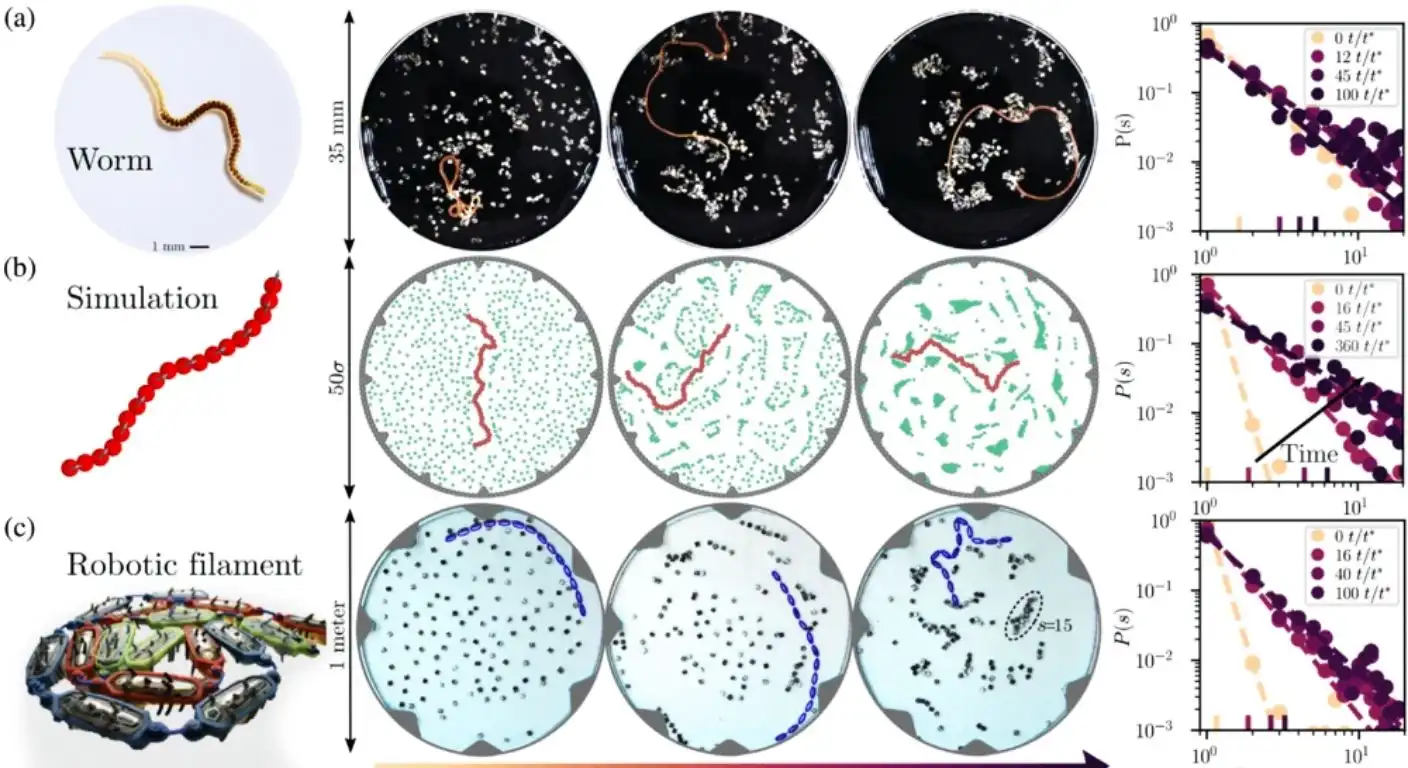
Scientists have discovered that some small aquatic worms have a surprising talent: they can clean their own environment. When these centimeter-long worms are placed in a Petri dish containing fine sand particles, they naturally begin sweeping the particles into neat, compact piles. This remarkable behavior, it turns out, has nothing to do with intelligence. It’s all about physics.
A team of researchers from the University of Amsterdam, Georgia Tech, and Sorbonne Université found that the worms’ natural wiggling motion and their flexible bodies are sufficient to create this cleaning effect. “Their activity and flexibility alone are enough to collect particles and reshape their environment,” said Saad Bhamla, one of the study’s leaders.
To prove this, the team built simple, “brainless” robots made of rubber links that mimicked the worms’ movement. These robots, which had no sensors or programming, were able to do the same thing: they wiggled around and, in the process, swept all the nearby particles into tidy clusters. Computer simulations confirmed the same result.
This discovery has some exciting implications. On the one hand, it helps us understand how simple organisms can have a significant impact on their habitats, such as how earthworms aerate the soil.
On the other hand, it could inspire a new generation of soft robots that can clean up the environment without requiring complex AI.
Imagine a swarm of these simple, wiggling robots being released into a river to collect microplastics, or used to sort materials in a factory. They would just move around, and order would naturally emerge from the chaos. This “brainless” approach could be a cheap and effective way to tackle some of our biggest environmental and industrial challenges.






