Key Points
- Chinese scientists broke a major density limit in their EAST fusion reactor.
- They packed the plasma fuel much more densely than previously thought possible without causing it to collapse.
- Denser plasma can lead to more powerful and efficient fusion reactions.
- They were the first to prove a new theory on the balance between the plasma and the reactor walls.
Scientists in China have made a breakthrough in the pursuit of clean, limitless energy from nuclear fusion. Working with their “artificial sun,” a reactor called EAST, they developed a method to pack the super-hot fuel much more densely than ever before without causing it to become unstable. This is a huge deal because the denser the fuel, the more power you can get out of a fusion reaction. They effectively broke a long-standing “speed limit” that has constrained fusion research for decades.
For years, one of the biggest challenges in fusion has been the “density limit.” Scientists knew that if they tried to cram too much fuel—a super-hot gas called plasma—into their doughnut-shaped reactors, it would go wild and collapse. This would shut down the reaction and could even damage the machine. It was a major obstacle preventing them from obtaining more power from their experiments.
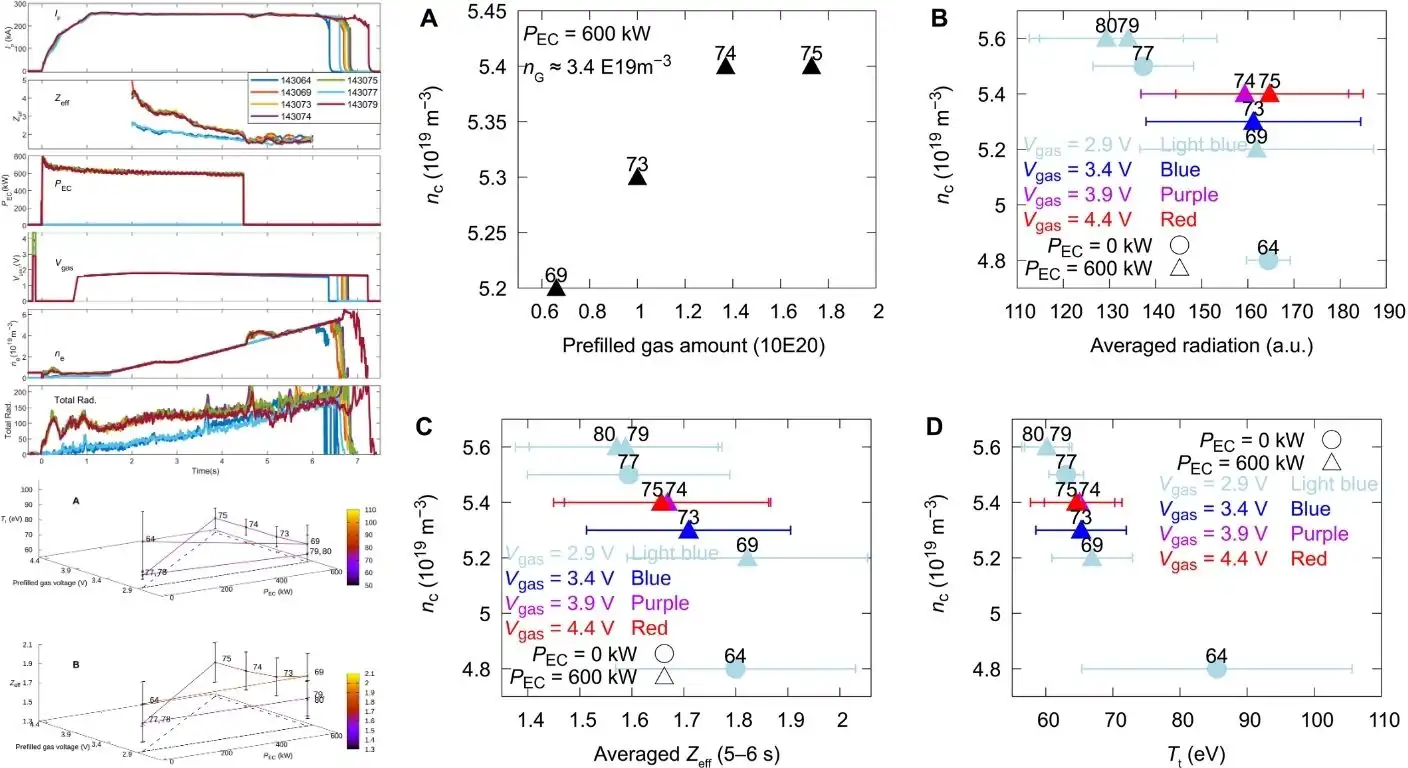
The Chinese team was the first to successfully test a new theory that predicted a “density-free regime.” The objective is to achieve a balanced distribution between the plasma and the reactor walls.
By using a special heating technique right at the beginning of the process, they were able to keep the plasma clean and stable. This allowed them to push the density far beyond the old limits without any of the dangerous disruptions.
The results, published in the journal Science Advances, provide a clear path forward for fusion energy. Professor Zhu Ping, one of the study’s leaders, said the findings offer a “practical and scalable” way to improve the performance of current and future fusion reactors.
The team now plans to use this new technique in more advanced, high-power experiments, pushing them even closer to the ultimate goal of igniting a self-sustaining fusion reaction and putting clean energy on the grid.