Key Points:
- Cornell researchers designed a flexible, gill-like tool to improve how liquids mix heat and molecules.
- Current machines, such as dialysis systems, use rigid components that often slow down and clog easily.
- Tests showed that the new flexible panels improved heat transfer temperatures by 37% to 94% compared to rigid ones.
- This biological design could eventually upgrade medical devices, water purifiers, and industrial cooling systems.
Cornell University researchers recently found a better way to mix heat and molecules inside flowing liquids. Yicong Fu and Sunghwan Jung looked at ordinary fish gills to solve a tricky engineering problem. They designed a soft, flexible tool that copies how fish breathe underwater. Their new biological approach will likely help engineers build faster medical machines, better heat exchangers, and smarter soft robots.
Efficiently moving heat and molecules through liquids plays a huge role in everyday technology. Renal dialysis machines and industrial cooling systems depend entirely on fluid dynamics. Right now, most companies use stiff, rigid components to move these liquids. Engineers have historically relied on increasing a machine’s total surface area to squeeze out a little more efficiency. Unfortunately, smooth fluid movement creates major bottlenecks. Fluids moving in a straight line avoid the messy, turbulent mixing that machines actually need to work well. Without good mixing, filters clog quickly and slow down the entire system.
Fu, a mechanical engineering doctoral student, wanted a better solution. He noticed that fish avoid these filtering problems completely. Fish gills consist of soft, highly porous tissues. These tissues constantly flap and stir the surrounding water, which keeps vital gases and ions flowing into the animal. Instead of sitting completely still, the gills move dynamically to keep the fluid well mixed. Fu decided to borrow this natural trick to upgrade human-made devices.
To properly understand the biology, Fu contacted Casey Dillman. Dillman works as the curator at the Cornell Museum of Vertebrates. He brought out several different fish species and showed the engineering team a huge variety of gill structures. Fu studied exactly how different fish pull water through their bodies. This deep dive into fish anatomy helped the engineering team figure out how nature overcomes the persistent problem of smooth-flow filtration.
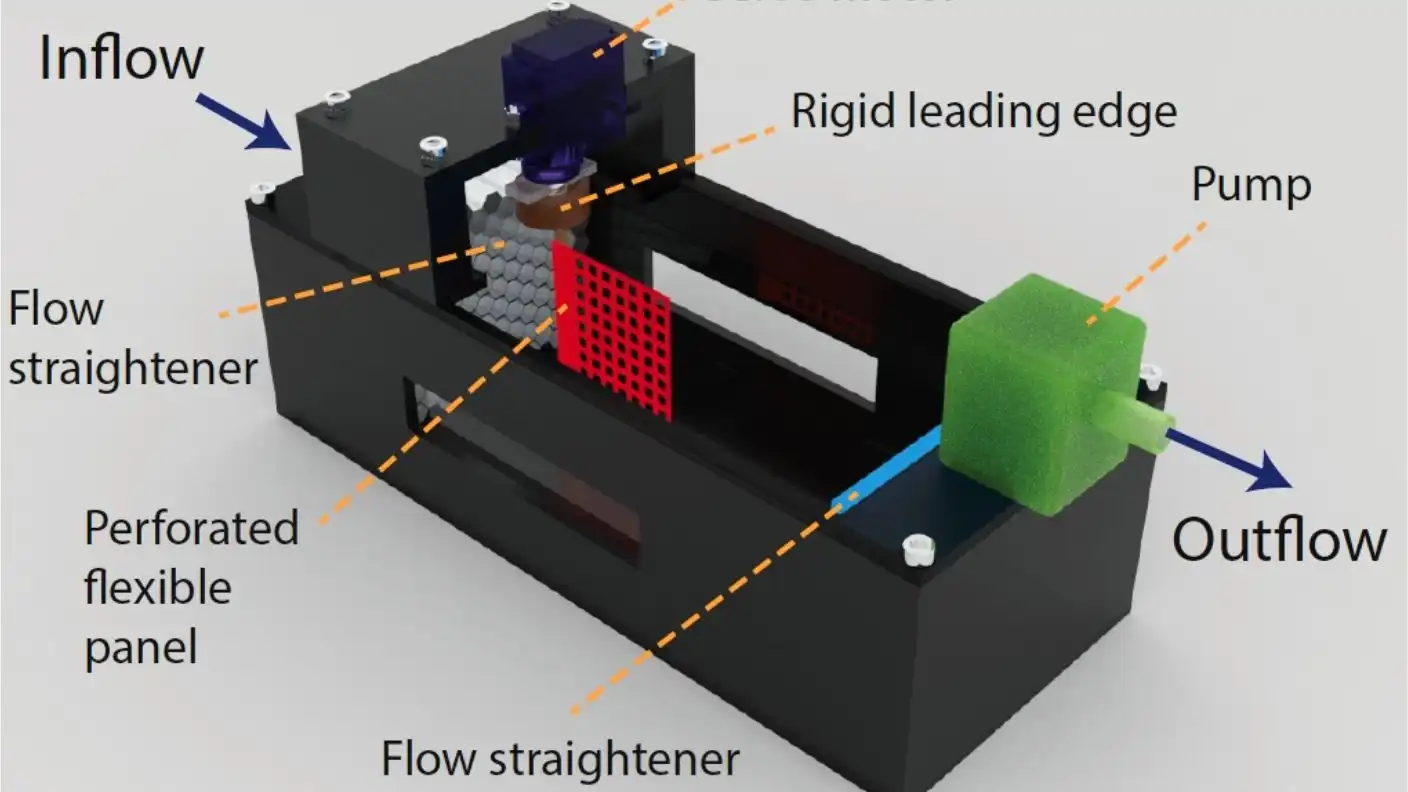
The research team built a unique, flexible panel to test their ideas. They punched tiny holes through the material to mimic the porous nature of real gills. The front edge of this panel actively pitches back and forth, while the trailing section simply flaps along with the water currents. The scientists set up a small flow tunnel inside a standard glass fish tank. They placed their new panel inside the tunnel and fired up high-speed cameras. These fast cameras tracked tiny particles to see exactly how the flapping panel stirred the water.
The experiments produced incredibly clear results. The flapping flexible panels generated strong, swirling vortex patterns in the water. These deep swirls looked entirely different from the weak patterns created by traditional solid panels. As the researchers increased the material’s flexibility, the spinning water behaved even better. The soft material maintained highly effective mixing rates even when the scientists changed the flapping speed.
The tests also revealed a major flaw in traditional rigid designs. Pushing a stiff, solid panel faster through the liquid actually ruined the mixing process. The extra energy simply disrupted the flow. Fu explained that adding physical flexibility solves this exact issue. The flexible system physically adapts to changing water pressure, thereby easily resolving the mixing problem.
After tracking the physical particles, the team wanted to measure heat transfer. They fed their visual data into advanced computer simulations. The computer models tracked how effectively the new panels moved heat across the water. The flexible panels produced a higher domain-averaged equilibrium temperature by a 37% to 94% margin compared to stiff alternatives. This massive jump in performance proves that soft materials handle thermal dynamics much better than hard plastics or metals.
Jung, a professor of biological and environmental engineering, sees a bright future for this technology. He pointed out that traditional filters act like dead-end sieves. Particles crash into the flat surface and permanently block the holes. Living tissues have a distinct advantage: they heal themselves, whereas engineered components simply break down.
Still, Jung believes these new biological designs will encourage future engineers to abandon rigid structures. He wants hardware designers to embrace flexible materials and explore new fluid configurations to build machines that rarely clog and never slow down.
Source: Physical Review Fluids (2026).