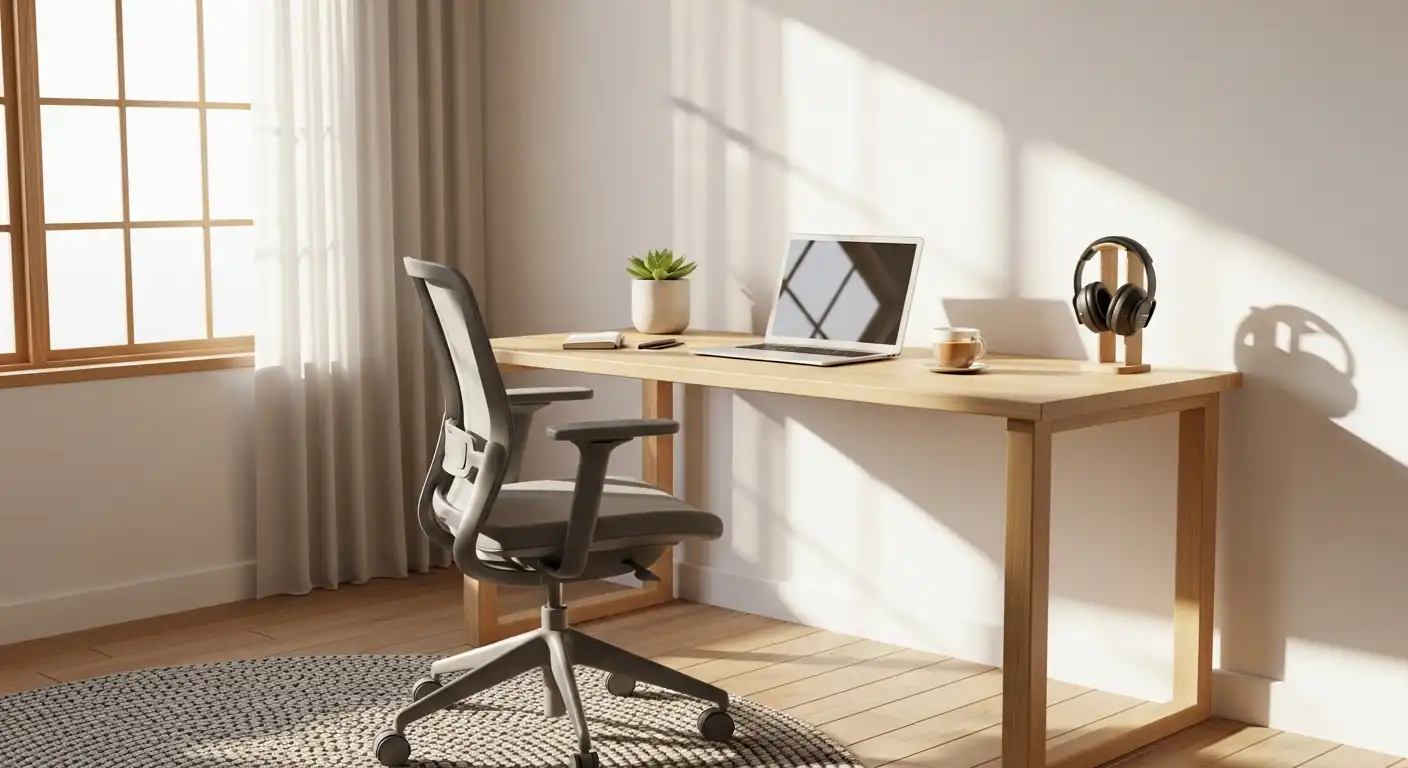
The modern home has become a confusing hybrid. It is a cafeteria, a dormitory, a gym, a movie theater, and now, for millions of people, a corporate headquarters. While the benefits of working from home are undeniable—zero commute, sweatpants flexibility, and autonomy—the drawbacks are equally potent.
The primary casualty of the remote work revolution is Focus.
When your office is ten feet away from your laundry pile, and your conference room doubles as the kitchen table where your children eat cereal, the brain struggles to switch gears. We find ourselves trapped in a state of “continuous partial attention.” We answer emails while watching the news—we Slack message colleagues while folding clothes. We are busy, but we aren’t productive. We are doing “Shallow Work.”
To achieve career-defining results—to write the code, draft the strategy, or create the art—you need what Professor Cal Newport calls Deep Work. Deep Work is the ability to focus without distraction on a cognitively demanding task. It is a superpower in the 21st-century economy.
But you cannot perform Deep Work in a shallow environment. You need a fortress. You need a sanctuary. You need a Focus Zone.
This is not just about buying a desk and a chair. It is about engineering an environment that triggers a neurochemical shift in your brain, signaling that it is time to perform. This comprehensive guide will walk you through the psychology, ergonomics, sensory design, and boundary-setting required to build the ultimate home Focus Zone.
The Psychology of Space: Context-Dependent Memory
Before we move furniture, we must understand why the “bed-office” or “couch-office” is a productivity killer. The human brain is an association machine. It relies on environmental cues to determine how to behave and feel.
If you work from your bed, you are confusing your brain. The bed is associated with rest and intimacy. When you bring a laptop into it, you weaken those associations. The result is a double failure: you feel sleepy when you try to work and anxious when you try to sleep.
This is known as Context-Dependent Memory. Your environment triggers specific mental states.
The goal of a Focus Zone is to create a space with a single purpose. When you step into this zone, your brain should instinctively know: “We are here to focus. The world outside does not exist.” Even if you live in a 500-square-foot studio apartment, you can create this psychological separation.
Location Scouting: Finding Your Sanctuary
The first step is identifying the territory. Ideally, this is a separate room with a door that closes. However, reality often dictates otherwise. Here is how to choose your spot based on your living situation.
The Gold Standard: The Spare Room
If you have a spare bedroom, guest room, or even a large walk-in closet, claim it. The ability to close a door is the single most effective tool for deep work. It provides a physical barrier against visual and auditory distractions.
The Silver Standard: The Nook or Corner
If a separate room isn’t an option, look for a “dead” corner in your living room or bedroom. The key here is orientation. Never face the room. If your desk faces the living space, you will see the dirty dishes, the TV, and the family moving around. Position your desk facing a wall or a window. By turning your back on your domestic life, you signal to your brain that you have left that space.
The Bronze Standard: The “Pop-Up” Zone
For those in tiny apartments using a dining table, you must rely on a Transformation Ritual. You cannot just open your laptop next to the salt shaker. You must change the environment.
- Clear the table completely.
- Lay down a specific “work mat” or tablecloth.
- Set up your equipment.
- When work is done, you must pack it all away.
The physical act of setting up and tearing down acts as your commute, signaling the beginning and end of the focus period.
Ergonomics: The Foundation of Endurance
You cannot focus if you are in pain. Deep work requires endurance; you might be seated (or standing) for 90-minute blocks. If your lower back aches or your neck is strained, your brain will divert energy to managing that discomfort, pulling you out of the flow state.
The Chair
Do not compromise here. A dining chair is designed for a 30-minute meal, not an 8-hour workday. You need a chair with lumbar support, adjustable height, and a seat pan that doesn’t cut off circulation to your legs. If a high-end ergonomic chair (like an Aeron) is out of budget, look for “gaming chairs.” They are often designed for long-term sitting and are cheaper than “office” brands.
The Monitor Hierarchy
“Tech Neck” is a focus killer. Your monitor should be at arm’s length, with the top of the screen at or slightly below eye level. You should not be looking down.
- Laptop Users: You must get a laptop stand (or a stack of books) to raise the screen. This necessitates an external keyboard and mouse. Working directly on a flat laptop forces you to hunch, which restricts breathing and causes fatigue.
The 90-Degree Rule
When seated, keep your elbows bent at 90 degrees to reach the keyboard, and keep your knees bent at 90 degrees with your feet flat on the floor. If your feet dangle, get a footrest. This grounding is essential for physical stability.
Sensory Architecture: Hacking Your Senses
Once the furniture is in place, you must design the environment. You are essentially acting as a set designer for a movie where you are the star, and the plot is “Productivity.”
Visuals: Lighting and Clutter
Lighting affects cortisol and melatonin levels.
- Cool/Blue Light (4000K – 6000K): This mimics daylight and suppresses melatonin. It promotes alertness and focus. Use this during deep work sessions.
- Warm Light (2700K-3000K): This is relaxing and cozy. Avoid this for high-focus tasks as it signals the brain to wind down.
Action: Get a smart bulb or a lamp with adjustable color temperature. Blast the cool white light when it’s time to grind.
Your field of vision should be boring but pleasant. A blank white wall can feel like a prison cell.
- The Green Hack: Place a plant in your direct line of sight. Studies show that viewing greenery reduces eye strain and lowers stress, thereby replenishing cognitive resources.
- The Clutter Rule: “Visual noise” creates mental noise. Your desk should only contain the items needed for the current task. Everything else must be in a drawer or behind you.
Auditory: The Sound of Silence (or Not)
Noise is the enemy of deep work. A sudden conversation or a siren can break a focus streak that took 20 minutes to build.
- Noise-Canceling Headphones: These are non-negotiable. Even if you don’t play music, active noise cancellation creates a “cone of silence” that reduces ambient noise.
- Soundscapes vs. Music: Music with lyrics is distracting because the language center of your brain tries to process the words while you are trying to write or think.
- Best: Video game soundtracks (designed to keep you engaged without distraction), Lo-Fi beats, or “Pink Noise” (which is softer and more consistent than White Noise).
- Tools: Apps such as Brain.fm and Endel generate scientifically designed soundscapes that align with brainwave frequencies to support focus.
Olfactory: The Smell of Success
Scent is the sense most strongly linked to memory. You can use this to create a Pavlovian response.
- The Lemon/Peppermint Trigger: Choose a specific scent (essential oil diffuser or candle) to use only during Deep Work.
- The Ritual: When you sit down, turn on the peppermint diffuser. Over time, your brain will smell peppermint and instantly think, “It is time to focus.” Do not use this scent for relaxation; keep the association pure.
Digital Defense Systems: The Firewall
You have built the perfect physical space. Now you must protect it from the digital invasion. Your smartphone is a slot machine designed to steal your attention. You cannot win against the algorithm with willpower alone; you need physical barriers.
The Phone Foyer Method
If your phone is on your desk, you have already lost. Even if it is face down, your brain is actively expending energy ignoring it.
The Rule: Create a charging station outside your Focus Zone—in the kitchen or the hallway. This is the “Phone Foyer.” When you enter the Focus Zone, the phone stays in the Foyer. If you need it for 2FA (Two-Factor Authentication), use it and immediately return it to the Foyer.
The Browser Blackout
On your computer, the internet is an infinite library of distractions.
- Use Site Blockers: Tools like Freedom, Cold Turkey, or StayFocusd allow you to block “time-sink” sites (Twitter, Reddit, News) for specific durations.
- Full Screen Mode: Always work in full-screen mode. Hiding the tabs and the clock helps you lose track of time and enter the flow state.
Establishing Boundaries: Managing the Humans
If you live with others, your Focus Zone is constantly under threat of interruption. “Do you know where the ketchup is?” or “Look at this meme!” are innocent questions that destroy deep work. You need to train your household.
The Signal System
You cannot expect your family or roommates to read your mind. You need a visible signal that indicates you are in Deep Work mode.
- The Door: If you have a door, closed means “Do Not Disturb unless there is blood or fire.” Open means “Come on in.”
- The Headphones Rule: In a shared space, wearing headphones signals “I am not here.” It is an invisibility cloak.
- The Traffic Light: Some remote workers use a literal light (like a smart bulb outside the door). Red = Working. Green = Free. This works exceptionally well for children.
The Concept of “Interruptibility”
Communicate your schedule. Tell your partner/roommate: “I am going into the Zone from 9:00 AM to 11:00 AM. I will be completely unavailable. At 11:00 AM, I will come out, and we can chat.”
By promising availability later, you reduce their anxiety about interrupting you now.
The Rituals of Entry and Exit
A Focus Zone is just a room until you activate it. Rituals are the key to crossing the threshold.
The Entry Ritual
Develop a 5-minute sequence that you perform every single time you sit down.
- Fill the water bottle.
- Put the phone in the Foyer.
- Put on headphones.
- Turn on the specific lamp/scent.
- Open your “To-Do” list and pick the one Deep Work task for this session.
This repetition primes the brain. It stops the “what should I do first?” procrastination loop.
The Shutdown Ritual
Equally important is how you leave. If you just walk away from a messy desk, you carry the stress of unfinished work into your evening (known as “Attention Residue”).
- Close all browser tabs.
- Tidy the physical desk (reset to neutral).
- Write down the first step for tomorrow morning.
- Say a phrase mentally or aloud, such as “System Shutdown.”
This allows your brain to disconnect and relax, ensuring you rest effectively to fuel the next day’s work.
Small Space Solutions: The “Cloffice” and Beyond
Not everyone has a spare room. Here is how to adapt if you are space-constrained.
The Closet Office (“Cloffice”)
If you have a reach-in closet, you can remove the doors (or keep them) and install a deep shelf as a desk. The beauty of the Cloffice is that at the end of the day, you can close the doors (or a curtain) and the “office” physically disappears.
The Room Divider
Use a bookshelf (such as an IKEA KALLAX) or a folding Japanese screen to block your view of the rest of the room physically. This creates a psychological “cubicle” that separates work from leisure.
Verticality
In small spaces, you can’t build out, so build up. Use wall-mounted monitors and shelving to keep the desk surface clear. A clear desk creates the illusion of space and reduces claustrophobia.
Maintenance: Keeping the Zone Sacred
Entropy is real. Over time, your Focus Zone will attract coffee cups, mail, random cables, and dust.
The Friday Flush: Spend the last 15 minutes of your work week deep-cleaning the Zone. Wipe the monitor, dust the keyboard, water the plant, and remove any trash. Entering a pristine workspace on Monday morning is a powerful motivator.
Furthermore, protect the sanctity of the space. Never eat lunch at your Focus desk. Never scroll TikTok at your Focus desk. Never pay bills at your Focus desk. If you pollute the space with “shallow” activities, the anchor weakens. Keep it sacred for Deep Work only.
Conclusion
Building a Focus Zone requires investment—money for a chair, time for setup, and social capital for setting boundaries. But the Return on Investment (ROI) is astronomical.
In a distracted world, the ability to focus is the ultimate competitive advantage. By creating a physical space that honors and protects your attention, you aren’t just decorating a room; you are building a machine for achievement.
Your environment dictates your performance. Stop fighting against your messy kitchen table and uncomfortable chair. Build your fortress. Step inside. And do the work of your life.