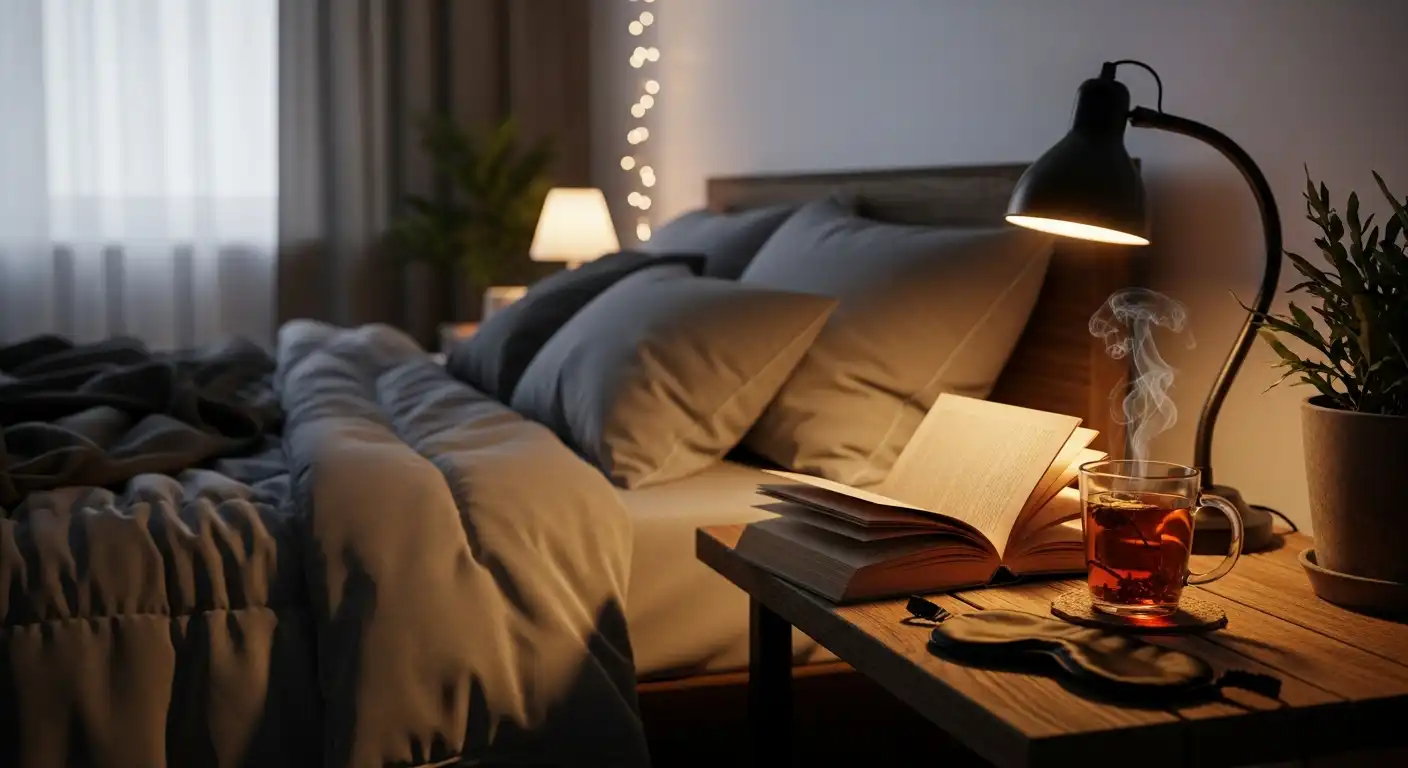
We live in a culture that treats sleep like a light switch. We assume that after sixteen hours of high-stress work, blinding screens, caffeine consumption, and constant information overload, we can simply collapse into bed, flip a switch, and instantly enter a state of deep, restorative rest.
When that doesn’t happen—when we stare at the ceiling, tired but wired, with thoughts racing like a Formula One car—we wonder what is wrong with us. We blame the mattress, the temperature, or our own biology.
But the problem isn’t usually your ability to sleep; it’s your transition.
Sleep is not a switch; it is a dimmer. It is a biological process that requires a gradual deceleration. Just as a pilot needs a checklist and a runway to land a plane safely, your brain and body need a specific sequence of events to shift from “fight or flight” to “rest and digest.” This sequence is known as a wind-down routine.
Creating a deliberate, consistent wind-down routine is the most effective way to improve sleep latency (how quickly you fall asleep) and sleep efficiency (how much time in bed is actually spent asleep). This comprehensive guide will walk you through the science of the wind-down and help you build a personalized protocol for deep, restful slumber.
The Science of the Transition: Why You Can’t Just “Pass Out”
To understand why a routine is necessary, we must examine the brain’s neurochemistry. Throughout the day, your body runs on cortisol and adrenaline. These alertness hormones keep you focused, responsive, and moving.
At night, your body needs to switch fuel sources. It needs to suppress cortisol and produce melatonin (the hormone that signals darkness) and adenosine (a chemical that builds up in the brain to create “sleep pressure”).
However, in the modern world, our environment actively sabotages this chemical shift.
- Blue Light: The LEDs from our phones and laptops mimic the sun’s wavelength, tricking the brain into thinking it is noon at 11:00 PM. This halts melatonin production.
- Cognitive Arousal: Checking email or doomscrolling news keeps the prefrontal cortex—the brain’s analytical center—highly active.
- Body Temperature: For sleep to initiate, your core body temperature must drop by about 2-3 degrees Fahrenheit. Heated homes and heavy blankets often prevent this natural drop.
A wind-down routine is a series of cues—known as zeitgebers, or “time givers”—that signal your ancient biological clock that the day is over, and safety has been established.
Phase 1: The Digital Sunset (90 Minutes Before Bed)
The first step of any effective sleep routine begins not in the bedroom, but with your relationship to light.
The Blue Light Blockade
Light is the primary governor of your circadian rhythm. If you are blasting your retinas with blue light until the moment you close your eyes, you are fighting a losing battle against your own biology.
Ninety minutes before your intended sleep time, initiate a “Digital Sunset.”
- The Gold Standard: Turn off all screens: no TV, no phone, no tablet.
- The Realistic Approach: If you must use screens, install software such as f.lux (for computers) or use “Night Shift” mode (for phones) to shift the screen to amber. Better yet, invest in a pair of blue-light-blocking glasses. Look for lenses with an amber or red tint, not clear lenses, as darker lenses block the specific wavelengths of light that suppress melatonin.
Lighting the Environment
Your home environment should mimic the fading sun. Overhead lights are generally too bright and cast shadows that simulate daylight.
- Switch to Lamps: Turn off the “big light.” Use floor lamps or table lamps with warm-colored bulbs (2700K or lower).
- Candlelight: If safe, candlelight is the most sleep-friendly light source. It emits almost no blue light and creates a natural, relaxing atmosphere.
Phase 2: Physical Decompression (60 Minutes Before Bed)
Once the lights are dimmed, the focus shifts to the body. You are likely holding tension in your shoulders, jaw, and hips due to today’s stress. You cannot enter deep sleep with a tense body.
The Warm Bath Effect
It may sound counterintuitive, but taking a hot bath or shower helps cool your body. When you immerse yourself in warm water, your blood vessels dilate (vasodilation). When you step out of the bath into a cooler room, the heat rapidly dissipates from your hands and feet, causing your core body temperature to drop.
This drop in core temperature is a massive biological trigger for sleepiness. For the best results, take a warm bath or shower 60 to 90 minutes before bed.
Gentle Movement and Stretching
High-intensity exercise (HIIT, heavy lifting) should be avoided this close to bed as it raises cortisol and body temperature. However, gentle movement is beneficial.
- Yoga Nidra is a form of “yogic sleep,” or guided relaxation. It involves lying down and mentally scanning the body to release tension.
- Static Stretching: Focus on the hips and hamstrings. A simple “legs up the wall” pose for 5 to 10 minutes can help drain fluids from the legs, lower heart rate, and calm the nervous system.
The Digestion Cut-Off
Sleep is for repair, not digestion. If your body is busy breaking down a heavy steak or a sugary dessert, it cannot focus on cellular cleanup (autophagy) and memory consolidation.
- The 3-Hour Rule: Try to finish your last heavy meal 3 hours before sleep.
- Sleep-Friendly Snacks: If you are genuinely hungry, choose a small snack rich in magnesium or tryptophan, like a handful of almonds, a banana, or a kiwi.
- Herbal Allies: Sip on chamomile, valerian root, or lemon balm tea. Avoid caffeine after 2:00 PM, as it has a half-life of 5-7 hours.
Phase 3: Mental Decoupling (30 Minutes Before Bed)
This is the hardest phase for high achievers. It involves turning off the “problem-solving” brain.
The Brain Dump (Closing Open Loops)
The most common reason people cannot fall asleep is worrying about tomorrow. “Did I send that email?” “I need to buy milk.” “What if the presentation fails?”
Your brain keeps these thoughts active because it is afraid you will forget them. This is known as the Zeigarnik Effect.
- The Technique: Keep a physical notebook by your bed. Write down tomorrow’s “To-Do” list and any worries circling your mind.
- The Result: Once it is written down, your brain feels safe to “let go” of the information, knowing it is preserved for tomorrow. You are outsourcing your memory to the paper.
Input Control: Fiction vs. Non-Fiction
What you consume before bed matters.
- Avoid: News, polarizing social media, or heavy non-fiction (business books, self-improvement) that gets your brain into “work mode.”
- Embrace: Fiction. Reading a novel requires imagination, which engages a different part of the brain than the analytical frontal cortex. It transports you to a different world, effectively severing the connection to your daily stressors. If you don’t like reading, listen to a calm audiobook or a “sleep story” on apps like Calm or Headspace.
Breathing for the Nervous System
If you are lying in bed and your heart rate remains elevated, use breathwork to manually engage the parasympathetic nervous system (rest-and-digest response).
- The 4-7-8 Technique: Inhale through the nose for 4 seconds, hold the breath for 7 seconds, and exhale audibly through the mouth for 8 seconds. Repeat this cycle 4 times. The long exhale acts as a natural tranquilizer for the nervous system.
Optimizing the Sleep Sanctuary
Your routine culminates in your bedroom. This room should have a singular association: sleep (and intimacy). It should not be a dining room, a gym, or an office.
The Cave Environment
For deep sleep, think like a bat. You want a cave.
- Pitch Black: Even a tiny LED from a smoke detector or a streetlamp outside can disrupt sleep cycles. Use blackout curtains. If that isn’t possible, invest in a high-quality, comfortable sleep mask (like a Manta mask) that lets you blink without your eyelashes touching the fabric.
- The National Sleep Foundation recommends a bedroom temperature between 60 and 67 degrees Fahrenheit (15 and 19 degrees Celsius). If you run hot, consider cooling mattress pads or breathable sheets, such as percale cotton or linen.
- Quiet (or Controlled Sound): Sudden noises cause “micro-arousals” that pull you out of deep sleep, even if you don’t fully wake up. If your environment is noisy, use a white noise machine or a fan to create a consistent “sound blanket” that masks sudden interruptions.
The Saboteurs: Habits That Ruin the Routine
Even a perfect routine can be undone by a few common mistakes.
The Alcohol Trap
Alcohol is the most misunderstood sleep aid. Yes, it is a sedative. It will help you lose consciousness faster. However, sedation is not sleep.
Alcohol fragments your sleep architecture. It suppresses REM sleep (the dreaming stage essential for emotional regulation) and causes dehydration and temperature spikes later in the night. If you want high-quality rest, stop drinking alcohol at least 3 hours before bed.
Revenge Bedtime Procrastination
This is a psychological phenomenon in which people who feel they lack control over their daytime lives stay up late to regain a sense of freedom at night. They scroll, watch TV, or play games, knowing they will be tired tomorrow but desperately craving “me time.”
- The Fix: Schedule “me time” earlier in the day or immediately after work. Acknowledge that the “freedom” of staying up late is borrowing energy from tomorrow at a high interest rate.
Checking the Clock
If you wake up in the middle of the night, never look at the clock.
Seeing the time triggers “sleep math” (“If I fall asleep now, I’ll get 4 hours…”). This math creates anxiety, which releases cortisol, which wakes you up further. Turn your alarm clock to face the wall.
Sample Routines to Try
Building a routine takes trial and error. Here are three templates based on different lifestyles.
The “Stressed Executive” Routine (Focus: Mental Clear-out)
- 9:00 PM: Phone is charged in the kitchen (not the bedroom). Blue light glasses on.
- 9:15 PM: 10 minutes of light stretching or foam rolling to release desk posture.
- 9:30 PM: “Brain Dump” journaling. Write down the top 3 priorities for tomorrow.
- 9:45 PM: Hot shower.
- 10:00 PM: Read fiction in bed until eyes are heavy.
- 10:30 PM: Lights out.
The “Busy Parent” Routine (Focus: Efficiency)
- 8:30 PM: Kids are asleep. House lights dimmed immediately.
- 8:45 PM: A cup of chamomile tea and a magnesium supplement. No TV.
- 9:00 PM: 5 minutes of box breathing (Inhale 4, Hold 4, Exhale 4, Hold 4) on the couch.
- 9:15 PM: Skincare/Brush teeth (Self-care cues).
- 9:30 PM: Listen to a sleep story or guided meditation in the dark.
- 10:00 PM: Asleep.
The “Biohacker” Routine (Focus: Physiological Optimization)
- 8:00 PM: Last food consumed.
- 9:00 PM: Red light therapy or wearing red-lens glasses.
- 9:15 PM: Contrast shower (Hot/Cold) ending on warm.
- 9:30 PM: Tape mouth (Mouth taping encourages nasal breathing, increasing nitric oxide).
- 9:45 PM: Lie on an acupressure mat for 10 minutes to release endorphins.
- 10:00 PM: Sleep in a room set to 65 degrees.
Troubleshooting: What If It Doesn’t Work?
You have done the yoga, dimmed the lights, and drank the tea. But you are still staring at the ceiling.
The 20-Minute Rule: If you haven’t fallen asleep after what feels like 20 minutes, get out of bed.
Lying in bed awake creates a psychological association between your bed and anxiety. You need to break that link.
Go to a different room. Keep the lights dim. Read a boring book or listen to soft music. Do not look at your phone. Return to bed only when you feel the wave of sleepiness hit you again.
Conclusion
The most important element of a wind-down routine is not the expensive sheets or the fancy supplements; it is consistency.
You cannot have a routine on Monday and Tuesday, stay up until 2 AM on Friday, and expect your body to understand what is happening.
Your circadian rhythm loves predictability. Try to start your wind-down routine at the same time every night, even on weekends.
It will take time. If you have spent years with poor sleep hygiene, your brain will not rewire overnight. Give it two weeks. Stick to the protocol. Eventually, the smell of your herbal tea or the feel of your journal in your hand will become a Pavlovian cue, signaling to your body that the day’s battles are over and it is time to rest.
Reclaim your evening, and you will reclaim your morning.