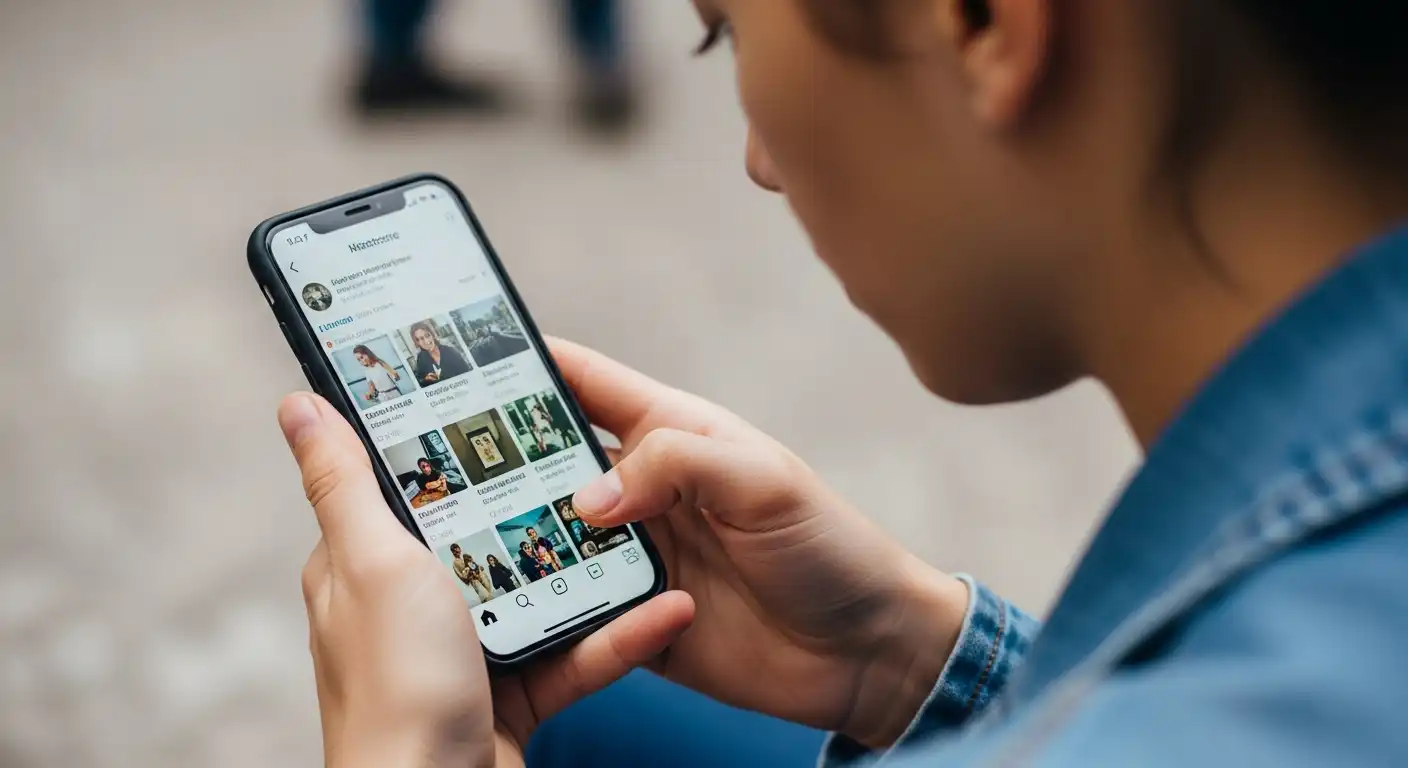
It starts as a subtle itch. You are standing in line at the grocery store, sitting at a red light, or perhaps watching a movie on the couch. There is a lull in the action, a moment of silence, or a split second of boredom. Almost without conscious thought, your hand drifts to your pocket or your bag. You pull out the rectangular slab of glass, tap the screen, and unlock it.
Maybe you can check your email. Maybe you refresh Instagram. Maybe you just swipe between home screens, looking for a red notification badge that isn’t there. You lock the phone, put it away, and thirty seconds later, you do it again.
This is the “Phantom Buzz,” the “Check Cycle,” the modern tic. We are the most connected generation in history, yet many of us feel a gnawing sense of fragmentation. We are physically present but digitally absent, tethered to a device that demands our attention with the persistence of a crying infant.
If you feel like you have lost control over your relationship with your smartphone, you are not alone. Studies suggest the average person checks their phone between 58 and 96 times a day. That is once every 10 to 15 minutes. We touch our phones over 2,600 times a day.
The problem isn’t that you are weak-willed, lazy, or undisciplined. The problem is that you are fighting against a trillion-dollar industry employing some of the smartest engineers and psychologists in the world, all working toward one singular goal: to capture and hold your attention.
Stopping the compulsive check is not just about “putting the phone down.” It is about understanding the neuroscience of addiction, redesigning your environment, and reclaiming your cognitive sovereignty. This comprehensive guide will walk you through the psychology of the scroll and provide a step-by-step framework to break the loop and return to the real world.
The Neuroscience of the Check: Why We Are Hooked
To defeat the compulsion, you must first understand the mechanism. Your phone is not just a tool; it is a portable slot machine.
The Dopamine Feedback Loop
The primary driver of phone addiction is dopamine. Often misunderstood as the “pleasure molecule,” dopamine is actually the molecule of desire and anticipation. It drives us to seek rewards.
When you check your phone, you are pulling the lever on a slot machine. Most of the time, you get nothing—a boring email or a spam text. But occasionally, you get a “win”—a funny meme, a like on your photo, a message from a crush, or breaking news.
This dynamic is known in psychology as Intermittent Reinforcement. Because the reward is unpredictable, the behavior becomes incredibly difficult to extinguish. If you got a reward every time you checked, you would eventually get bored. But because you might get a reward, you keep checking. Your brain is wired to hunt for that unpredictability.
The Cortisol Spike (FOMO)
The flip side of dopamine is cortisol, the stress hormone. When you are away from your phone, or when you haven’t checked it in a while, your brain begins to simulate anxiety.
- “What if there is an emergency?”
- “What if I’m missing out on a group chat?”
- “What if I miss an important email?”
This is FOMO (Fear Of Missing Out). Your brain generates a low-level cortisol spike that creates physical discomfort. Checking the phone relieves this anxiety, even if there is nothing new. This creates a negative reinforcement loop: you check not to feel good, but to stop feeling bad.
The Bottomless Bowl
Tech companies utilize a design principle called the “Infinite Scroll.” In the past, media had stopping cues—you finished the newspaper, the TV show ended, the chapter closed. Social media feeds have no bottom. This removes the natural “stop” signals that allow your brain to disengage, keeping you in a state of passive consumption.
Phase 1: The Awareness Audit
You cannot change what you do not measure. Before you try to change your habits, you need to confront the reality of your usage.
Confront the Numbers
Both iOS (Screen Time) and Android (Digital Wellbeing) have built-in trackers. Open them. Look at the data.
- Total Screen Time: How many hours a day? (Note: The average is 3-4 hours. That is 2 months of your life every year.)
- Pickups: This is the most crucial metric for compulsive checking. How many times do you unlock your phone?
- Most Used Apps: Which apps are stealing your time?
Write these numbers down. Do not judge yourself; just observe. This is your baseline.
Identify the Triggers (HALT)
For the next 24 hours, every time you reach for your phone, pause for one second and ask: “Why?”
Usually, the trigger falls into the HALT acronym:
- Hungry (or Thirsty)
- Angry (or Stressed)
- Lonely (or Bored)
- Tired
We often use the phone as a pacifier to numb uncomfortable micro-emotions. If you are bored, you scroll. If you are awkward in an elevator, you scroll. Identifying the emotion allows you to address the root cause rather than the symptom.
Phase 2: Friction Engineering (Making it Harder)
Willpower is a finite resource. If you rely on willpower to stop checking your phone, you will fail by 4:00 PM. The solution is to design your environment to add friction. You want to make the bad habit difficult and the good habit easy.
The Grayscale Nuclear Option
This is the single most effective technical change you can make. Smartphone interfaces are designed with candy-colored icons and red notification badges to stimulate the visual cortex.
Go into your Accessibility settings and turn your screen to Grayscale (black and white).
Suddenly, Instagram looks like a boring newspaper. The red badges disappear. The visual reward is gone. Your phone becomes a tool again, not a toy.
The Notification Slaughter
A notification is a demand. It is a stranger tapping you on the shoulder and demanding you look at them. You must reclaim your right to attention.
Go to your settings and turn off all non-human notifications.
- Keep: Phone calls, text messages (maybe), calendar alerts.
- Kill: Likes, comments, news alerts, game reminders, “This person you barely know posted a photo,” email.
You should check your apps on your schedule, not when the app summons you.
The Home Screen Lobotomy
Your home screen should be boring.
- Remove the Infinity Pools: Take Instagram, TikTok, Twitter, Facebook, and Reddit off your home screen. Delete the apps entirely if you can, forcing yourself to use the clunky mobile web versions. If not, bury them in a folder on the third page of your apps.
- Keep the Utilities: Your home screen should only have Maps, Calendar, Notes, Weather, and Camera. Tools that help you live your life, not escape it.
Biometric Barriers
FaceID and Thumbprint unlock are too fast. They remove the “pause” between impulse and action.
Turn off biometrics. Force yourself to type in a 6-digit passcode every time you want to unlock your phone. That 2-second delay gives your prefrontal cortex (the logical brain) just enough time to ask, “Do I really need to do this?”
Phase 3: The Replacement Therapy
When you stop checking your phone, you will create a vacuum. You will feel bored. You will feel fidgety. If you do not have a replacement behavior, you will relapse.
Relearning Boredom
We have forgotten how to be bored. Boredom is not a defect; it is a feature. It is the state where your brain consolidates memory, solves complex problems, and generates creative ideas (the “Default Mode Network”).
When you feel the itch to check your phone, try “Urge Surfing.”
acknowledge the urge. “I really want to check my phone.” Don’t fight it. Just watch the feeling rise like a wave. Breathe through it. Usually, the peak of the urge lasts less than 60 seconds before subsiding. Ride the wave.
Analog Fidget Tools
Sometimes the urge is purely physical—your hands need something to do. Carry an analog alternative.
- A small notebook and pen.
- A Rubik’s Cube.
- A fidget spinner or worry stone.
- A physical book or Kindle (which doesn’t have notifications).
When you are waiting in line, instead of checking your email, solve the Rubik’s Cube. Read a page. Doodle. Give your hands a job that doesn’t involve an algorithm.
The “Wristwatch” Hack
A massive amount of phone checking starts with “I just want to check the time” and ends 20 minutes later on TikTok. Wear a watch. If you need to know the time, look at your wrist. It eliminates the gateway to the digital world.
Phase 4: Structural Boundaries (The “No-Fly” Zones)
You need to establish physical zones and times where the phone is simply forbidden.
The Bedroom Ban
This is non-negotiable. The bedroom is for sleep and intimacy. It is not for doom-scrolling.
- Buy an alarm clock. A cheap, old-school alarm clock replaces the “I need my phone for the alarm” excuse.
- Charge outside. Charge your phone in the kitchen or living room overnight.
- The Morning Routine: Do not touch your phone for the first 30 minutes of the day. Start your day proactively (stretch, drink water, make coffee) rather than reactively (downloading the world’s problems and other people’s agendas).
The Dinner Table Rule
When you are eating, the phone should be absent. Not face down on the table (which still drains cognitive attention), but in another room.
If you are eating with others, this is a sign of respect. If you are eating alone, it is a practice of mindfulness. Taste your food.
The “Phone Foyer” Method
When you walk into your house, treat your phone like your keys or your shoes. Have a dedicated spot (a bowl, a charging station) near the door. Drop it there.
If you need to use it, stand there and use it. Then put it back. Do not carry it around the house in your pocket like an extra limb. This separates “home time” from “connected time.”
Phase 5: Changing the Social Contract
One of the hardest parts of disconnecting is the social pressure to be constantly available. We fear that if we don’t reply instantly, people will think we are rude or ignoring them.
“Phubbing” (Phone Snubbing)
We have normalized looking at our phones while talking to people. This destroys intimacy and empathy.
Make a pact with your friends and family. “I’m trying to be more present. If we are hanging out, I’m keeping my phone away.”
You will be surprised; most people will be relieved and may even join you.
Batching Communication
You do not need to reply to text messages instantly. Texting is an asynchronous medium. Tell your close contacts: “I’m checking my phone less to focus on work/mental health. If there is a true emergency, call me. Otherwise, I’ll reply when I take a break.”
This sets a boundary and trains people not to expect an immediate dopamine hit from your response.
Dealing with Relapse
You will fail. You will have a stressful day and find yourself doom-scrolling at 11 PM. You will turn off Grayscale because you want to see a photo.
This is normal. Do not beat yourself up. Shame leads to stress, and stress leads to seeking comfort… which leads back to the phone.
The “What, Not Why” Analysis
Instead of asking “Why am I so lazy?”, ask “What happened?”
- “I was tired.”
- “I brought the phone into the bedroom.”
- “I didn’t have a book to read.”
Analyze the slip-up, adjust your environment (add more friction), and try again.
Advanced Tactics: The Digital Detox
If you find that moderation strategies aren’t working, you may need a hard reset to recalibrate your dopamine receptors.
The 24-Hour Sabbath
Once a week (usually Saturday or Sunday), turn your phone off completely. Put it in a drawer.
Tell your family/friends in advance. Spend the day in the physical world. Go for a hike, cook a complex meal, play with your kids, stare at a wall.
The first few hours will be anxious. You will feel “phantom buzzes.” But by the afternoon, you will likely feel a sense of time slowing down and a deep mental clarity returning.
The “Dumb Phone” Experiment
If you are truly desperate, consider buying a “dumb phone” (a flip phone or a Light Phone) that only calls and texts. Swap your SIM card into it for the weekend or after work hours. This physically removes the possibility of the internet.
Conclusion
Your attention is the most valuable currency you possess. It is the only thing you can trade for love, for learning, for work, and for memories. When you compulsively check your phone, you are leaking this currency. You are trading diamonds for pennies.
Stopping the compulsive check is not about being a Luddite or hating technology. It is about being the master of your tools rather than their servant. It is about deciding that the face of your child, the taste of your coffee, and the quiet thoughts in your own head are more interesting than the algorithmically generated noise of the internet. It takes time to rewire your brain. It takes effort to resist the pull of the dopamine loop. But on the other side of that screen is your life. It is waiting for you to come back.
Start today. Turn on Grayscale. Buy an alarm clock. Leave the phone in the other room. Reclaim your mind.