For decades, the “Metaverse” was a concept confined to science fiction novels like Snow Crash and Ready Player One. It was a digital dreamscape where humans could escape the physical world. Today, the Metaverse is no longer fiction. It is a nascent yet rapidly growing sector of the global economy, attracting billions in investment from tech giants such as Meta (Facebook), Microsoft, and Nvidia, as well as fashion brands such as Gucci and Nike.
But the Metaverse is not just about VR headsets and video games. It is the foundation of a new economic system. It is a world where digital land sells for millions of dollars, where virtual sneakers are traded like stocks, and where people go to work in digital offices.
This comprehensive guide explores the structure of the Metaverse economy, the role of cryptocurrencies and NFTs, the opportunities for businesses and creators, and the risks of investing in a world that doesn’t physically exist.
What is the Metaverse Economy?
The Metaverse is a network of 3D virtual worlds focused on social connection. The “Metaverse Economy” refers to the financial ecosystem within and across these worlds. It encompasses the production, distribution, and consumption of virtual goods and services.
Unlike traditional video games, where the money flows one way (you pay the developer), the Metaverse economy is increasingly circular. Users create value, sell it to other users, and cash out into the real world.
The Layers of the Economy
- Infrastructure: The hardware (VR headsets, GPUs) and networks (5G, Cloud) that power the simulation.
- Platforms: The virtual worlds themselves (Decentraland, The Sandbox, Roblox, Fortnite).
- Content & Assets: Digital items (avatars, clothing, buildings) created by users and brands.
- Payments: The financial rails (Crypto, Tokens, Fiat) that facilitate trade.
The Engine of Value: NFTs and Ownership
In the old internet (Web2), you didn’t own your digital items. If Fortnite shut down, your skins disappeared. In the Metaverse (Web3), ownership is codified by Non-Fungible Tokens (NFTs).
NFTs act as digital deeds. They prove that you own a specific digital asset on the blockchain.
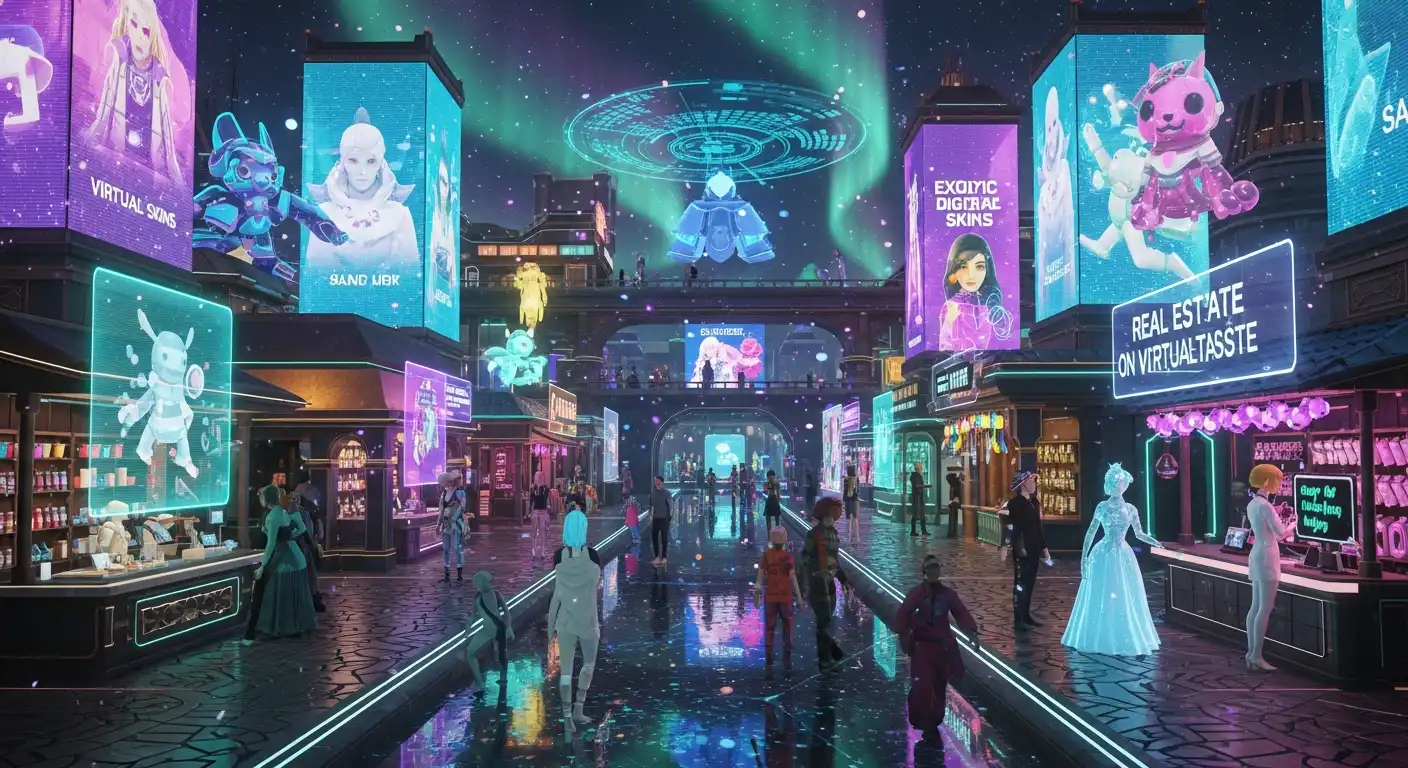
- Virtual Real Estate: In worlds like Decentraland, land is scarce. There is a fixed number of plots. NFTs allow users to buy a plot, build a virtual store or gallery on it, and sell it later—often for a profit.
- Wearables and Identity: Digital fashion is booming. Your avatar is your identity. People are willing to pay for “Flexing” rights in the virtual world just as they do in the real world. A digital Gucci bag was famously sold on Roblox for more than the price of the physical bag.
Virtual Real Estate: The Digital Land Rush
Perhaps the most speculative and headline-grabbing aspect of the Metaverse economy is land.
Companies and investors are buying digital land to secure “foot traffic.”
- The Logic: If millions of users hang out in The Sandbox, owning land there is like owning a billboard in Times Square. You can rent it out for events, build a game on it, or advertise your brand.
- The Risk: Unlike physical land, digital land is theoretically infinite. If Decentraland becomes too expensive, developers can just create a new world. The value relies entirely on the network effect (popularity) of that specific platform.
The Job Market: Work in the Metaverse
The Metaverse isn’t just for play; it’s for work. A new class of jobs is emerging.
The Creator Economy
3D modelers, digital fashion designers, and architects are in high demand. If you can build a beautiful virtual house or design a unique avatar skin, you can sell it directly to users globally.
Service Workers
Casinos in the Metaverse hire real humans to act as greeters. Virtual events need bouncers and guides. We are seeing the rise of the “Metamate”—assistants who navigate the virtual world for you.
Play-to-Earn (P2E)
Games like Axie Infinity introduced a model where players earn crypto tokens by playing. In some developing nations, playing these games became a viable full-time job, providing income higher than the local minimum wage. While the sustainability of P2E is debated, it has been proven that time spent in the Metaverse can have financial value.
Brands Entering the Matrix
Why are Nike, JPMorgan, and Sotheby’s opening offices in the Metaverse?
- Marketing: It creates an immersive brand experience. Nike’s “Nikeland” on Roblox allows kids to play games and try on digital shoes, building brand loyalty with the next generation.
- Direct Sales: Selling virtual goods has almost zero marginal cost. Once you design a digital sneaker, selling 1 million copies costs the same as selling one. The profit margins are astronomical compared to physical manufacturing.
The Crypto Connection
Cryptocurrencies are the native currency of the Metaverse. You don’t use dollars in Decentraland; you use MANA. You don’t use Euros in The Sandbox; you use SAND.
This creates a seamless, borderless economy. A designer in Brazil can sell a shirt to a user in Japan instantly, without currency conversion fees or banking delays. DeFi (Decentralized Finance) protocols allow users to lend their assets or take out loans against their virtual land.
Conclusion
Is the Metaverse economy a speculative bubble driven by hype? Parts of it certainly are. The prices of digital land and NFTs are volatile. However, the underlying trend—the digitalization of human interaction—is undeniable.
As we spend more of our lives online, we will naturally assign more value to our digital presence. The Metaverse economy is the framework for that value. Whether it becomes a multi-trillion-dollar utopia or a fragmented niche, it is creating real wealth, real jobs, and real opportunities today.