

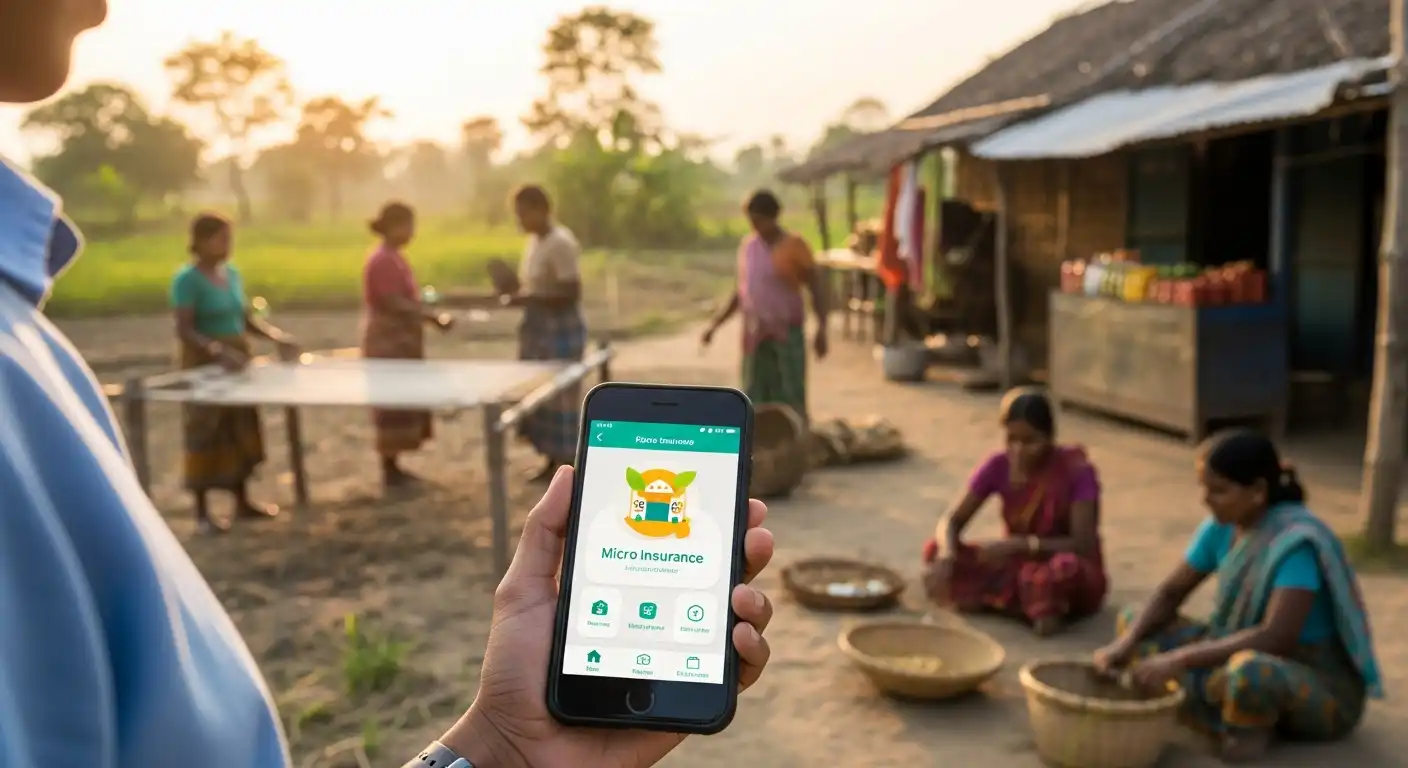
For a wealthy individual in London or New York, an unexpected illness, a car accident, or a flooded basement is a headache. It involves paperwork, deductibles, and frustration. But it rarely means destitution. Insurance acts as an invisible shield, protecting assets and ensuring that a single bad day doesn’t ruin a lifetime of work.
For billions of people in the developing world, however, that shield does not exist. A subsistence farmer in Kenya whose crop fails due to drought faces starvation. A rickshaw puller in India who breaks a leg faces a total loss of income. A market vendor in the Philippines, whose stall burns down, loses their entire livelihood. For the poor, risk is not just a possibility; it is a constant, existential threat.
This gap in protection is where Micro-Insurance steps in.
It is one of the most transformative financial innovations of the 21st century. By tailoring insurance products specifically for low-income populations—offering low premiums and simplified coverage—micro-insurance is creating a safety net where none existed before. It is not charity; it is a sustainable business model that empowers the vulnerable to take economic risks, invest in their futures, and break the cycle of poverty.
This comprehensive guide explores the mechanics of micro-insurance, its diverse applications, the technological revolution driving its growth, and the challenges of insuring the “uninsurable.”
Understanding the Protection Gap
To understand the necessity of micro-insurance, one must first grasp the scale of the problem. The “Protection Gap” is the difference between total economic losses and insured losses. In developed nations, about 30-40% of economic losses are covered by insurance. In developing nations across Africa, Asia, and Latin America, that figure is often less than 5%.
The Poverty Trap
Without insurance, low-income households rely on negative coping strategies when disaster strikes:
- Selling Productive Assets: Selling a cow or a plow to pay for hospital bills (which destroys future income).
- Taking Children out of School: To save on fees or send them to work.
- High-Interest Loans: Borrowing from local moneylenders at predatory rates (often 100%+ APR).
These strategies might solve the immediate crisis, but they push the family deeper into the “poverty trap,” making recovery impossible. Micro-insurance provides liquidity in times of crisis, preventing such desperate measures.
What is Micro-Insurance?
Micro-insurance is fundamentally the same as traditional insurance: the pooling of risk. However, it is designed differently to address the realities of low-income households.
Key Characteristics:
- Low Premiums: Costs are minimal, often $1 to $5 per month, or even pennies per day.
- Simplified Policies: The “fine print” is eliminated. Policies are often one page, written in local languages, with clear inclusions and exclusions.
- Low Coverage Limits: Payouts are small but significant relative to the beneficiary’s income (e.g., $500 to rebuild a hut or replant seeds).
- Accessible Distribution: It is not sold by brokers in suits. It is sold through mobile phones, local shopkeepers, microfinance institutions (MFIs), or bundled with products such as fertilizer.
The Evolution: From Community Pools to Tech Giants
Micro-insurance has deep roots. Informal burial societies and community savings groups have existed for centuries. If a neighbor’s house burned down, the village chipped in.
Modern micro-insurance began by piggybacking on Microfinance. When institutions like Grameen Bank began lending to the poor, they realized that a borrower’s death meant the loan defaulted. So, they introduced “Credit Life Insurance”—a small fee added to the loan that would pay off the debt if the borrower died. This protected the bank and the borrower’s family.
From there, it expanded into health, agriculture, and property. Today, the sector is being supercharged by InsurTech (Insurance Technology). Mobile money platforms like M-Pesa in Kenya allow users to pay premiums and receive claims instantly via SMS, removing the high administrative costs that previously made insuring the poor unprofitable.
Types of Micro-Insurance Products
The industry has diversified far beyond simple life insurance. Innovators are creating products that address the specific vulnerabilities of the developing world.
Index-Based Crop Insurance
This is arguably the most critical innovation for rural poverty. Traditional crop insurance requires a claims adjuster to visit the farm, inspect the damage, and verify the loss. This is too expensive for a small 1-acre farm.
How Index Insurance Works:
Payouts are not based on actual loss, but on an external index—usually weather data (rainfall) or satellite imagery (vegetation health).
- If the local weather station records rainfall below a certain threshold (e.g., 50mm) during the growing season, every insured farmer in that district gets paid automatically via mobile money.
- No claims adjuster needed.
- No fraud possible.
- Instant payout.
This allows farmers to buy higher-quality seeds and fertilizer, knowing that if the rain fails, they won’t lose everything.
Micro-Health Insurance
In many developing nations, healthcare is “free” on paper but expensive in practice (medical costs, lost wages, transportation). Micro-health products often function as “Hospital Cash” plans.
- If a policyholder is hospitalized for more than 24 hours, the insurance pays a fixed daily cash benefit.
- This replaces lost income and covers incidental costs, preventing the family from sinking into debt due to illness.
Funeral Insurance
In many cultures, specifically in Africa, a proper funeral is a social obligation that can cost a year’s income. “Burial riders” are extremely popular products. They provide a quick cash lump sum upon death to cover funeral expenses, preserving the family’s inheritance.
Parametric Disaster Insurance
Similar to crop insurance, this covers catastrophic events like typhoons or earthquakes. In the Philippines or the Caribbean, policies can be linked to wind speed. If a Category 4 hurricane hits a specific GPS coordinate, funds are released immediately to help residents rebuild, often before international aid arrives.
The Technology Revolution: Mobile-First Insurance
The smartphone is the engine of micro-insurance. In regions with no bank branches, mobile penetration is high.
The Freemium Model
Telecom companies (Telcos) like Tigo, MTN, and Airtel have successfully used insurance as a loyalty perk.
- “Recharge and Get Covered”: If a user spends $5 on airtime in a month, the telco provides free life insurance coverage for the next month.
- This introduces millions of people to insurance for the first time. Once they see it works, they can “upsell” themselves to paid, higher-coverage plans via USSD codes (text menus) on their phones.
Satellite and Blockchain
- Satellites: Provide the data for crop index insurance.
- Blockchain: Smart contracts can automate the payout. If the weather data source confirms a drought, the smart contract automatically triggers the payment, reducing bureaucracy and increasing trust.
Case Studies: Success Stories from the Field
Some success stories from the micro-insurance sector are discussed below.
BIMA (Global)
BIMA is a leading micro-insurer operating in Asia and Africa. They partner with mobile operators to offer health and life insurance. A user can sign up in 2 minutes via their phone. BIMA has reached over 30 million customers, 75% of whom had never previously accessed insurance. They pioneered the “teledoctor” service, bundling insurance with unlimited phone consultations with a doctor.
Kilimo Salama (Kenya) / ACRE Africa
Originally known as Kilimo Salama (“Safe Agriculture”), this project revolutionized crop insurance. They installed solar-powered weather stations across Kenya. Farmers buying a bag of seed could pay 5% extra to insure it. A barcode inside the bag was scanned to register the policy. When drought hit, M-Pesa payments were sent automatically.
Blue Marble Microinsurance
A consortium of large insurers (such as Zurich and AIG) is collaborating to share the costs of entering micro-markets. They launched a pilot in Zimbabwe to protect maize farmers, using advanced satellite data to monitor crop health.
The Challenges: Why It Is Hard to Scale
Despite the success stories, micro-insurance is a difficult business. The margins are razor-thin. If a policy costs $1, the profit might be pennies. To survive, insurers need massive volume.
Trust and Literacy
The biggest barrier is not cost; it is culture. In many communities, paying money for something you might not receive (if no disaster happens) looks like gambling or a scam.
- Financial Literacy: Educating consumers on how insurance works (“risk pooling”) is expensive and time-consuming.
- Trust: If an insurer delays payment once, the reputation in the village is destroyed forever.
Basis Risk
This is the Achilles’ heel of Index Insurance. “Basis Risk” occurs when the index indicates one price, but reality indicates another.
- Scenario: The weather station 10 miles away records enough rain, so the insurance doesn’t pay out. But on your specific farm, it didn’t rain, and your crop died. You paid the premium but got nothing. This destroys trust in the product.
Distribution Costs
Even with mobile phones, reaching the “last mile”—remote villages in the Andes or the Himalayas—is hard. Agents (often local women) need to be trained to explain the product, collect premiums, and assist with claims. This “high touch” model conflicts with the “low cost” requirement.
Regulatory Hurdles
Insurance is heavily regulated to prevent fraud. However, regulations written for multi-million dollar corporate policies often strangle micro-insurance.
- Example: Requiring a “wet ink” signature or a certified death certificate (which might not exist in a rural village) prevents digitization. Regulators need to create “sandbox” environments to allow for simplified KYC (Know Your Customer) rules for small policies.
The Business Case: Why Big Insurers Are Interested
Why are global giants like Allianz, AXA, and Swiss Re investing in $2 policies?
- Market Saturation at Home: Insurance markets in the West are mature and saturated. Growth is stagnant.
- The Emerging Middle Class: The poor of today are the middle class of tomorrow. By building brand loyalty with a farmer now via a $5 crop policy, the insurer positions itself to sell car and home insurance to that farmer’s children as the economy grows.
- Climate Change Data: Operating in these volatile regions provides insurers with valuable data on climate risks that improve their global modeling.
The Future: Bundling and Resilience
The future of micro-insurance lies in bundling. Insurance should not be a standalone product; it should be an embedded layer within other services.
- Seed + Insurance: Every bag of seed comes with drought protection.
- Loan + Health: Every micro-loan comes with health cover.
- Solar + Warranty: Pay-as-you-go solar panels come with theft insurance.
Furthermore, we are moving toward Resilience Building. Insurers aren’t just paying for damage; they are incentivizing prevention. A farmer may receive a premium discount if they use drought-resistant seeds or practice soil conservation.
Conclusion
Micro-insurance is rewriting the social contract in the developing world. It transforms the poor from victims of circumstance into managers of their own destiny.
It is not a silver bullet. Insurance alone cannot fix bad roads, corruption, or lack of markets. But it is a critical pillar of development. It provides the psychological and financial security required to take risks—to plant that extra acre, to open that shop, to send that child to school.
As technology lowers the cost of delivery and data improves the accuracy of risk models, micro-insurance has the potential to weave a global safety net, ensuring that while the weather may be unpredictable, the future of the world’s most vulnerable people doesn’t have to be.






