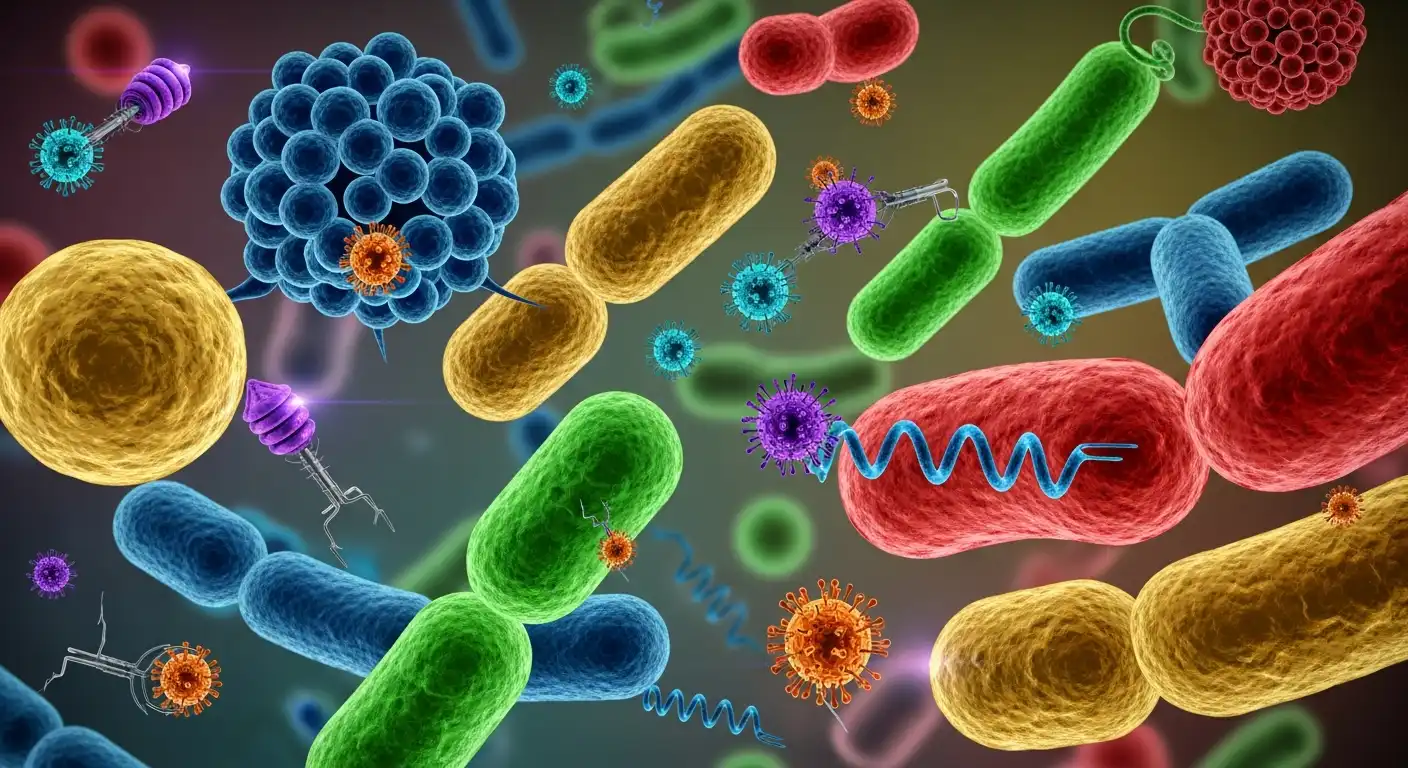
When we look at the world, we see trees, animals, mountains, and oceans. But if we were to look through a different lens—a microscope—we would realize that the visible world is just the tip of the iceberg. We are living on a microbial planet. Microorganisms, or microbes, were the first life forms on Earth, appearing roughly 3.5 billion years ago. They are the architects of our atmosphere, the recyclers of our waste, and the guardians (and sometimes destroyers) of our health.
Despite their critical importance, microbes are often misunderstood, usually feared as “germs.” While some do cause disease, the vast majority are benevolent, essential partners in the web of life. From the bacteria in your gut that digest your food to the phytoplankton in the ocean that produce half the oxygen you breathe, microorganisms run the world.
This article delves deep into the invisible empire of microbes, exploring their classification, their role in the environment and human health, and the future of microbiology.
What is a Microorganism?
A microorganism is any living organism that is too small to be seen with the naked eye. They are ubiquitous—found in boiling hot springs, frozen glaciers, deep-sea vents, and high-altitude clouds.
They are generally single-celled (unicellular), though some form colonies. The microbial world is incredibly diverse, far more so than the plant and animal kingdoms combined.
The Big Five: Types of Microorganisms
Microbiologists generally classify microbes into five major groups. Each has distinct biological characteristics.
Bacteria
Bacteria are the most abundant life forms on Earth. They are prokaryotic, meaning they lack a nucleus.
- Structure: Simple, single-celled organisms with a cell wall.
- Shapes: They come in spheres (cocci), rods (bacilli), and spirals (spirilla).
- Role: While infamous for diseases like Strep throat or Tuberculosis, bacteria are primarily beneficial. They fix nitrogen in the soil (essential for plants), ferment foods (yogurt, cheese), and synthesize vitamins in our intestines.
Viruses
Viruses are the outliers. They sit on the fence between living and non-living. They cannot reproduce on their own; they must hijack a host cell to replicate.
- Structure: Genetic material (DNA or RNA) wrapped in a protein coat.
- Role: While almost exclusively associated with disease (Flu, COVID-19, HIV), viruses also play a role in evolution by transferring genes between species (transduction). Bacteriophages are viruses that kill bacteria and are being researched as an alternative to antibiotics.
Fungi
This group includes yeasts (unicellular) and molds (multicellular). They are eukaryotes, meaning they have a complex cell structure with a nucleus, similar to human cells.
- Role: They are the world’s decomposers. Without fungi, dead trees and leaves would pile up indefinitely. They are also responsible for penicillin (the first antibiotic) and the fermentation of beer and bread. However, they can cause infections like Athlete’s Foot or Ringworm.
Protozoa
These are single-celled eukaryotes that behave like tiny animals. They hunt and gather food.
- Role: Found largely in water and soil. Some are harmless, while others are parasites causing devastating diseases like Malaria (Plasmodium) and Dysentery (Amoeba).
Algae
These are plant-like microbes that perform photosynthesis.
- Role: They are the base of the aquatic food web. Microscopic algae (phytoplankton) produce an estimated 50% to 80% of the Earth’s oxygen.
The Human Microbiome: You Are Not Alone
Perhaps the most fascinating discovery in modern biology is the Human Microbiome. You are not just a single organism; you are a walking ecosystem.
The Numbers
It is estimated that the human body contains roughly 30 to 40 trillion human cells. However, we carry about the same number—roughly 38 trillion—of bacterial cells, mostly in our gut. In terms of genetic material, we are 99% microbial; human genes are vastly outnumbered by microbial genes.
The Role of the Microbiome
- Digestion: They break down complex carbohydrates and fibers that our bodies cannot digest.
- Immunity: They train our immune system to distinguish between friend and foe. A healthy microbiome prevents autoimmune diseases.
- Mental Health: The “Gut-Brain Axis” connects our intestines to our brain. Gut bacteria produce neurotransmitters like serotonin (90% of serotonin is made in the gut, not the brain), influencing our mood and anxiety levels.
Microbes in the Environment: The Planetary Life Support
If humans disappeared tomorrow, the planet would likely thrive. If microbes disappeared, life on Earth would collapse within weeks.
Nitrogen Fixation
Plants need nitrogen to grow, but they cannot use the nitrogen gas (N2) in the atmosphere. Specialized bacteria (like Rhizobium) living in the roots of legumes convert this gas into ammonia, a form plants can use. This natural fertilizer feeds the world.
Decomposition and Recycling
Microbes are the recyclers. They break down dead organic matter, releasing carbon, nitrogen, and phosphorus back into the soil and atmosphere. Without this cycle, nutrients would be locked away in dead bodies, and new life could not grow.
Bioremediation
Microbes can eat poison. Certain bacteria and fungi have evolved to consume toxic waste, oil spills, and even plastic. Scientists use Bioremediation—releasing specific microbes into polluted sites—to clean up environmental disasters like the Exxon Valdez oil spill.
The Double-Edged Sword: Pathogens and Disease
While we celebrate the good microbes, we must acknowledge the bad. A tiny fraction of microbes are pathogens—organisms that cause disease.
Mechanisms of Disease
- Toxins: Some bacteria produce poisons (exotoxins) that damage host cells (e.g., Tetanus, Botulism).
- Direct Damage: Viruses burst host cells during replication.
- Immune Response: Often, the damage is caused not by the microbe, but by the body’s violent overreaction to it (inflammation, fever).
The Antibiotic Crisis
The discovery of antibiotics in the 1920s turned deadly bacterial infections into minor inconveniences. However, the overuse of these drugs has led to Antimicrobial Resistance (AMR). Bacteria evolve rapidly. They are developing defenses against our best drugs, creating “Superbugs” like MRSA. The World Health Organization lists AMR as one of the top 10 global public health threats facing humanity.
The Future: Microbiology and Biotechnology
We are entering the “Century of Biology.” We are moving from simply observing microbes to engineering them.
- CRISPR: This gene-editing technology was originally discovered in bacteria (it is their immune system against viruses). It allows us to edit DNA with unprecedented precision.
- Biofuels: Scientists are engineering algae and bacteria to produce ethanol and diesel, offering a renewable alternative to fossil fuels.
- Synthetic Biology: We are using microbes as factories. We insert human genes into bacteria to produce Insulin for diabetics, growth hormones, and even spider silk.
Conclusion
Microorganisms are the true masters of the planet. They were here billions of years before us and will be here long after we are gone. Understanding them is key to understanding our health, our environment, and our future. We must move away from the “war on germs” mentality and embrace a stewardship model—protecting our beneficial microbes while targeting the pathogens with precision. The invisible world is vast, and we have only just begun to explore it.