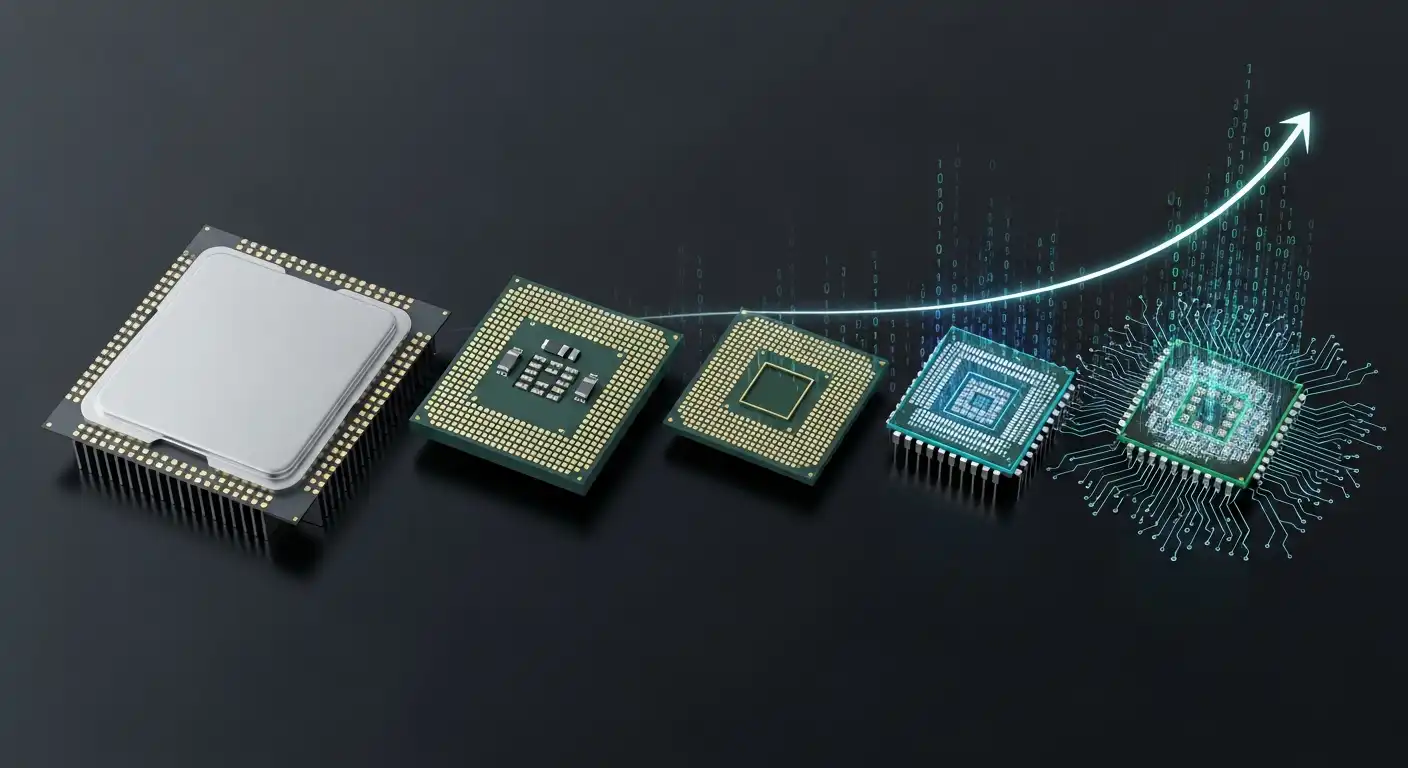
For half a century, the tech world had a steady, reliable heartbeat. It was called Moore’s Law. The simple observation, made by Intel co-founder Gordon Moore in 1965, was that the number of transistors we could cram onto a silicon chip would double roughly every two years. This wasn’t just an observation; it became a self-fulfilling prophecy, an engine that drove the entire digital revolution. This relentless, predictable march of progress powered every new phone, every faster computer, every leap in technology. But now, that heartbeat is fading.
The End of the Easy Road
The simple truth is that we are encountering the laws of physics. The transistors on modern chips are already unimaginably small, measured in the single-digit nanometers. We are approaching a point where the components are only a few atoms thick. Shrinking them further is not just difficult; it’s becoming astronomically expensive, with each new generation of factory costing billions more than the last. The predictable two-year doubling is over. The easy road of just making things smaller has come to an end.
Smarter Design, Not Just Smaller Parts
But this is not the end of progress. It’s the end of one kind of progress. The death of Moore’s Law has forced the industry to get creative, and the first major shift is toward smarter design. Instead of building one general-purpose chip that does everything okay (a CPU), we are now building specialized chips that do one thing brilliantly. This is the “System on a Chip” (SoC) revolution, pioneered by Apple with their M-series chips. They integrate the CPU, the graphics processor (GPU), and other specialized engines on a single chip. It’s like trading a generic wrench for a custom-built toolkit. The result is a substantial increase in performance and efficiency without requiring any transistor shrinkage.
If You Can’t Go Wider, Go Taller
The next frontier is three-dimensional. For decades, we built computer chips like sprawling, single-story suburbs, spreading everything out flat. Now, engineers are starting to build skyscrapers. This technique, called 3D chip stacking, involves layering processors and memory directly on top of each other. This dramatically reduces the distance information must travel, making the chip faster and more energy-efficient. The flat surface of the silicon no longer limits us; we can build upward, opening up a whole new dimension for innovation.
The Next Frontier: New Kinds of Computing
Beyond smarter design and 3D stacking lies an even more radical future. In labs around the world, scientists are working on the successors to silicon itself. Quantum computing promises to solve certain types of problems that are impossible for even the most powerful supercomputers today. Optical computing aims to use light instead of electricity to process information at incredible speeds. These are not technologies that will be in your laptop next year, but they represent the long-term future. They show that the human quest for more powerful computation is far from over.
The Spirit Lives On
So, is Moore’s Law dead? As a specific, literal prediction, yes. The era of easy, predictable doubling is over. But if we think of Moore’s Law as the spirit of relentless innovation, the belief that we can always make our tools faster and more powerful, then it is very much alive. The path forward is no longer a straight line; it’s a creative maze of new architectures, new dimensions, and new physics. The engine of progress hasn’t died; it’s just being rebuilt into something new.