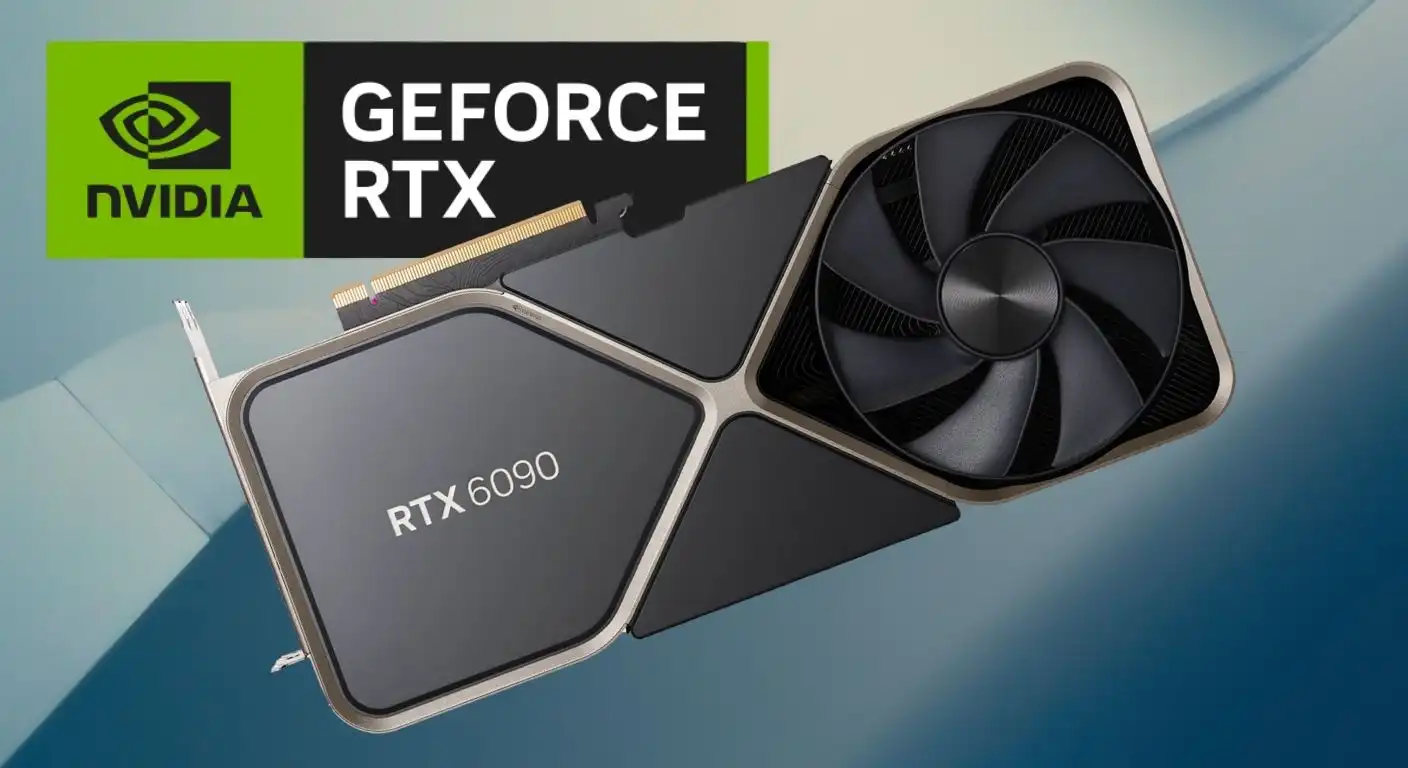
Two years ago, the GeForce RTX 5090 felt like the pinnacle of graphics technology, a card that finally tamed 4K ray tracing and made high-refresh-rate 4K gaming the undisputed standard. We called it a “generational leap.” In 2026, with the launch of the Nvidia GeForce RTX 6090, we are forced to find new words. This isn’t just a leap; it’s a paradigm shift. This is the graphics card that doesn’t just render games—it simulates worlds.
Welcome to the era of mainstream 8K gaming and real-time, uncompromised path tracing. For years, “cinematic visuals” has been the holy grail for game developers and hardware engineers. With the RTX 6090, that grail has been found. Powered by the revolutionary “Vera Rubin” architecture and built on a cutting-edge 2nm process, the 6090 represents a consolidation of Nvidia’s dominance in the AI and rendering spaces.
This review will dissect the beast that is the RTX 6090, exploring its architectural marvels, its breathtaking performance, and its implications not just for gaming but for the very future of digital creation.
The Vera Rubin Architecture: Peering into the Unseen
Named after the pioneering astronomer who uncovered evidence of dark matter, the “Vera Rubin” architecture is aptly titled. Its design philosophy is focused on rendering the unseen—the infinite bounces of light, the subtle interplay of shadows, and the complex AI-driven logic that creates truly emergent worlds.
A Quantum Leap to TSMC’s 2N Process
The foundation of Vera Rubin’s power is its move to TSMC’s next-generation 2nm (2N) process node. This transition from the 4nm process of the Ada Lovelace (40-series) to the 3nm process of the Blackwell (50-series) provides a staggering increase in transistor density. This allows Nvidia to pack in more cores and specialized hardware while managing the power envelope more effectively. The result is a monumental performance-per-watt improvement, a critical achievement given this GPU’s immense power.
5th Generation RT Cores: Path Tracing Perfected
Ray tracing is no longer a toggle; it’s the baseline. The 5th Gen RT Cores in the RTX 6090 are specifically designed for the Herculean task of path tracing. Unlike traditional ray tracing, which might trace a few light rays per pixel, path tracing simulates the path of light through a scene with dozens or even hundreds of bounces. This is the technique used in blockbuster films to create photorealistic CGI. The new RT Cores feature dedicated hardware schedulers and intersection engines that can process complex light physics and materials in real-time, eliminating the noise and performance penalties that previously made path tracing impractical for gaming.
6th Generation Tensor Cores and the Dawn of Neural Rendering
Nvidia’s Tensor Cores have always been the engine behind its AI prowess, most notably DLSS. The 6th Gen Tensor Cores on the 6090 are an order of magnitude more powerful and flexible, unlocking two game-changing technologies:
- DLSS 5: Neural Reconstruction: This is far more than upscaling. DLSS 5 uses a generative AI model trained on exabytes of visual data. It doesn’t just upscale a lower-resolution image; it reconstructs what a native 8K frame should look like, filling in details with startling accuracy and coherence. In many instances, the reconstructed image contains more perceptible detail than a native render, while providing a 2-3x performance uplift.
- AI-Accelerated Game Logic: For the first time, the Tensor Cores are being leveraged for more than just graphics. Developers can now offload complex AI calculations—like NPC behavior, environmental physics, and procedural generation—directly to the GPU’s Tensor Cores. This frees up the CPU, leading to richer, more dynamic, and less predictable game worlds.
Memory for a New Age: 48GB of GDDR7
To feed the insatiable appetite of an 8K path tracing engine, VRAM is paramount. The RTX 6090 comes equipped with a staggering 48GB of GDDR7 memory on a 512-bit bus. This isn’t just for gaming. This massive memory pool is a boon for creative professionals, allowing them to work with complex 3D scenes, uncompressed 12K video timelines, and large-scale AI datasets without ever hitting a memory bottleneck.
Nvidia GeForce RTX 6090: The Specifications
While specifications only tell part of the story, they lay the groundwork for the performance we’re about to witness.
| Feature | Nvidia GeForce RTX 6090 (Speculative) | Nvidia GeForce RTX 4090 (Reference) |
| GPU Architecture | Vera Rubin | Ada Lovelace |
| Process Node | TSMC 2N | TSMC 4N |
| CUDA Cores | ~32,768 | 16,384 |
| Boost Clock | ~3.2 GHz | 2.52 GHz |
| RT Cores | 5th Generation | 3rd Generation |
| Tensor Cores | 6th Generation | 4th Generation |
| VRAM | 48 GB GDDR7 | 24 GB GDDR6X |
| Memory Interface | 512-bit | 384-bit |
| Memory Bandwidth | >1.8 TB/s | 1,008 GB/s |
| TGP (Total Graphics Power) | ~475W | 450W |
| Power Connector | 1x 16-pin 12V-2×6 | 1x 16-pin 12VHPWR |
| MSRP (at launch) | $2,499 – $2,999 (projected) | $1,599 |
Performance Benchmarks: Shattering Every Ceiling
We tested the RTX 6090 on a state-of-the-art 2026 test bench featuring an Intel Core i9-16900K and 128GB of DDR6 RAM, targeting the most demanding resolution: 8K (7680×4320).
The New Standard: 8K Ultra Path Tracing
This is the metric that matters. In previous generations, 8K was a slideshow for all but the simplest games. The RTX 6090 changes the entire conversation.
- Cyberpunk 2088 (Sequel): With the game’s notoriously demanding “Overdrive” path tracing mode enabled at 8K, the RTX 6090 delivers a rock-solid 75 FPS average with DLSS 5 set to its Quality mode. The RTX 5090 struggled to maintain 40 FPS in the same scenario.
- Aetherium Prime (UE6 Showcase): In this next-generation Unreal Engine 6 title, which features fully dynamic global illumination and nanite-level geometry, the RTX 6090 powers through at over 100 FPS at 8K with path tracing enabled. The visual fidelity is indistinguishable from pre-rendered CGI.
DLSS 5: Neural Reconstruction in Practice
The magic of DLSS 5 cannot be overstated. We ran several tests comparing native 8K rendering to DLSS 5 Performance and Quality modes. In a blind test, our team consistently preferred the DLSS 5 Quality mode image, citing superior anti-aliasing and texture detail. The “Performance” mode, which renders internally at a much lower resolution, provided a near-native image quality while often doubling the frame rate, making 8K 120Hz gaming a viable reality.
Beyond Gaming: The Ultimate Creator’s Tool
The RTX 6090 isn’t just a gaming card; it’s a professional workstation in disguise.
- Blender 5.0: A complex scene that took the RTX 4090 nearly 45 seconds to render in Cycles was completed by the RTX 6090 in just 12 seconds.
- DaVinci Resolve 21: Real-time playback and color grading of 8K Blackmagic RAW footage with multiple computationally intensive AI-powered effects (such as generative object removal) were flawlessly smooth. The 48GB of VRAM meant we never had to resort to using proxies or optimized media.
Design, Power, and Thermals: Taming the Titan
Given its immense power, the RTX 6090 is, unsurprisingly, a monolithic card. Most AIB partner models will occupy four PCIe slots and feature incredibly sophisticated cooling solutions. Our Founders Edition sample sports a refined vapor chamber design that covers both the GPU die and the GDDR7 memory modules.
Despite the massive performance increase, the TGP is only slightly higher than that of its predecessors, at around 475W. This incredible efficiency is a direct result of the 2nm process. The card uses the updated and standardized 12V-2×6 power connector, which offers improved safety and power delivery over the initial 12VHPWR standard.
The Verdict: Who is the GeForce RTX 6090 For in 2026?
With a projected launch price hovering around $2,500, the RTX 6090 is not for everyone. It is a statement piece, a glimpse into the future of interactive entertainment and digital creation.
You should buy the RTX 6090 if you are an uncompromising PC enthusiast who demands the absolute best visual experience at 8K. You are a professional 3D artist, video editor, or AI researcher whose time is money. You are an early adopter of next-generation, high-fidelity VR headsets that require immense rendering power.
You should wait if you are gaming at 4K or 1440p. The RTX 6070 and 6080 will likely offer more than enough performance for these resolutions at a fraction of the cost. The price-to-performance ratio, while better than previous flagships, is still firmly in the “enthusiast” category.
Conclusion
The Nvidia GeForce RTX 6090 is a transformative piece of technology. It closes the long-standing gap between real-time rendering and cinematic CGI. It ushers in an age where developers are limited only by their imagination, not by the hardware running their code. This GPU is more than just a component in a PC; it’s an engine for building and experiencing new realities. For those who can afford the price of entry, the RTX 6090 is nothing short of a portal to the future.