Key Points:
- Researchers at the University of Oulu developed a new particle sorting method.
- The technique solves the problem of tiny particles moving randomly.
- The method combines electric fields with special elastic fluids. Tests showed a 30% to 50% improvement in purification.
- Doctors could use this for better blood analysis and cancer detection.
Researchers at the University of Oulu have created a new way to separate and purify tiny particles. This breakthrough solves a long-standing problem in biotechnology and could lead to major advancements in cancer research.
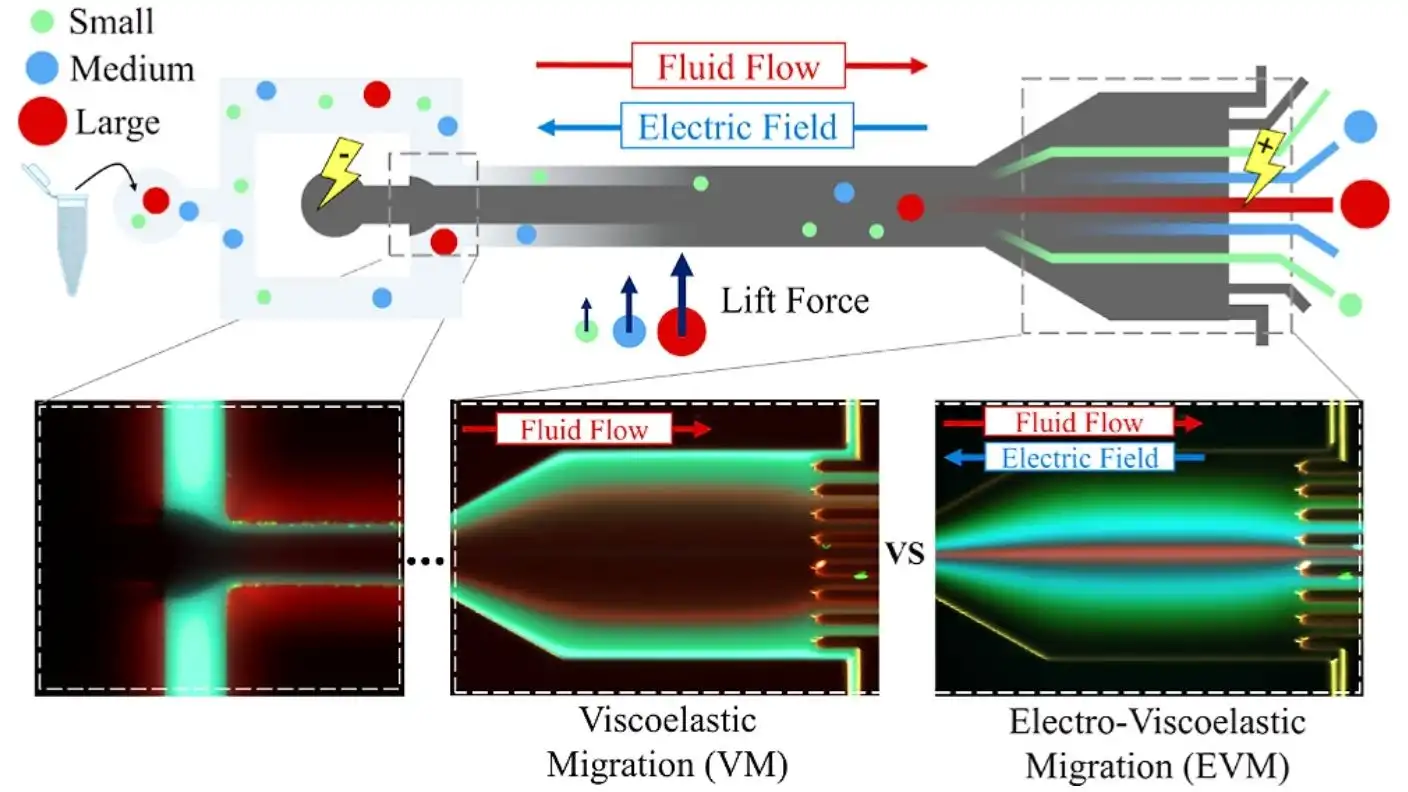
Sorting nanoparticles is notoriously difficult. When particles are smaller than a few hundred nanometers, they do not stay put. Instead, they wiggle around randomly in a process called diffusion. This random movement makes it hard for scientists to guide them into specific groups. Consequently, the accuracy of older separation methods often fails.
Professor Caglar Elbuken and his team found a solution by combining two different physical forces. First, they used an electric field. Instead of pulling the particle directly, this field moves the fluid around it. Second, they used a “viscoelastic” fluid. This special liquid behaves partly like water and partly like an elastic material. When the fluid moves, it creates lateral forces that do not exist in standard water-based solutions.
This combination allows the team to guide the particles with high precision. Seyedamirhosein Abdorahimzadeh, the lead author of the study, explained that previous methods were often slow and required tiny, complex channels that clogged easily. The new approach works in standard microchannels, making it faster and easier to scale up for larger tasks.
The results are promising. In tests using synthetic polystyrene beads, the team improved separation purity by roughly 30% to 50%. These beads are the standard model for checking accuracy. More importantly, they tested the method on biological samples. They successfully improved the purity of vesicles secreted by cancer cells by more than 20%.
This improvement matters because biological processes happen at the nanoscale. Tiny carriers in the body can reveal early signs of disease, but only if scientists can isolate them from impurities. With this new method, researchers hope to improve blood sample analysis. In the future, this could help doctors detect cancer and understand cellular communication much earlier than they can today.
Source: Analytical Chemistry (2026).