Key Points
- Researchers have developed a new method to study the complex energy structure of the 173Yb+ ion.
- They used the atom’s own electrons as a “magnifying glass” to investigate the structure of its nucleus.
- The method combines high-resolution laser and microwave spectroscopy with advanced theoretical calculations.
- The findings provide new insights into the distribution of a nucleus’s magnetic field.
Every atom has a unique “fingerprint” of energy levels, and some are more interesting than others. One particular atom, 173Yb+, has a highly complex energy structure that makes it a promising candidate for future quantum technologies. However, that same complexity has also made it very difficult to study.
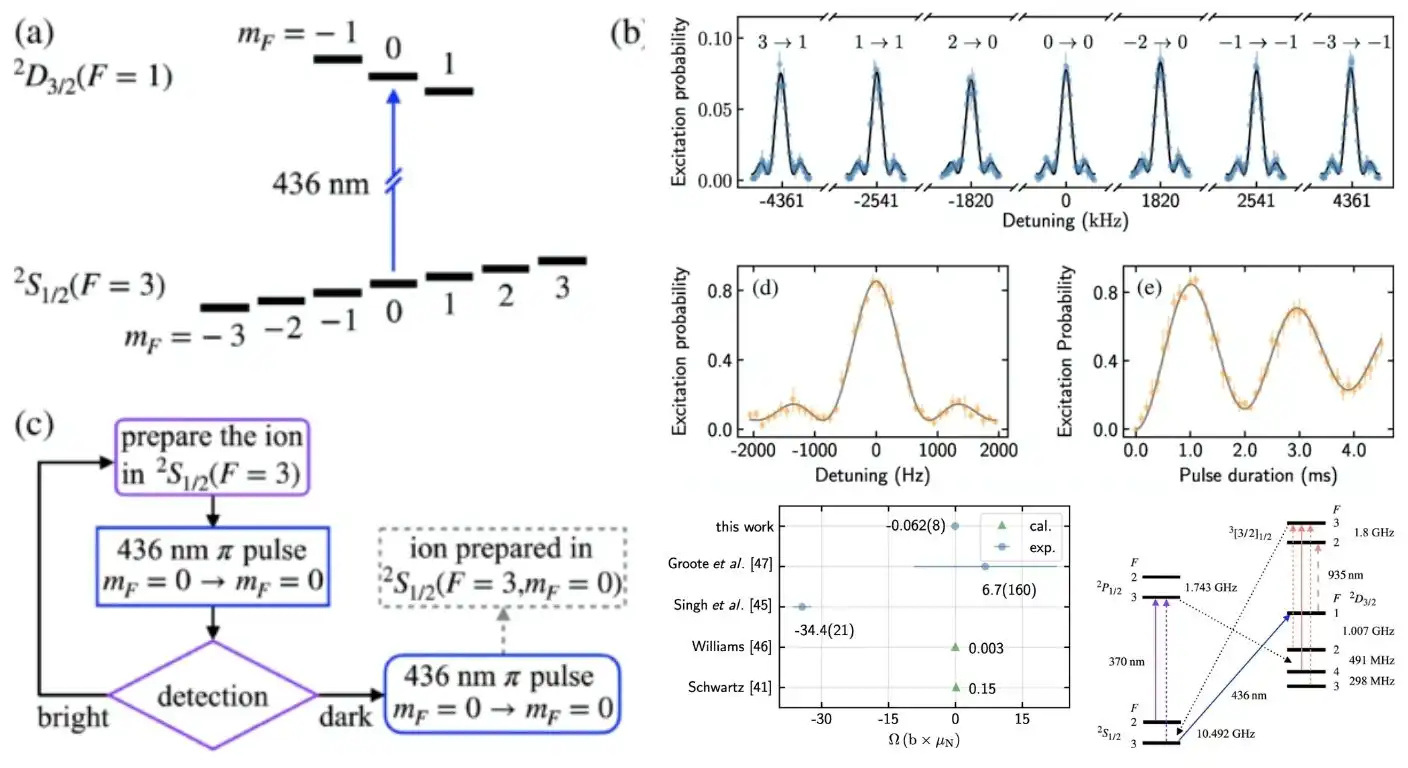
Now, a team of researchers has developed a new way to get a closer look at this fascinating ion. By trapping a single 173Yb+ ion and using a combination of lasers and microwaves, they were able to precisely measure the tiny energy shifts caused by the interaction between the atom’s nucleus and its surrounding electrons.
Think of the nucleus as a tiny, spinning magnet. The researchers used the electrons orbiting the nucleus as a “magnifying glass” to see how the magnetic field of that nucleus is distributed. By combining their precise measurements with advanced theoretical calculations, they obtained a new and detailed picture of the nucleus’s structure.
To confirm their findings, the team also performed the same measurements on a different atomic species, 171Yb+, which has a different nucleus but the same electron shell. This comparison helped them isolate the effects of the nuclear structure.
“Our measurements show that even very subtle properties of the atomic nucleus can be accessed through the surrounding electron cloud,” explained one of the researchers.
This new understanding is not just an academic exercise. It provides an important foundation for using complex ions such as 173Yb+ to build ultra-precise atomic clocks and to test fundamental laws of physics in new ways. By learning how to “read” the information encoded in the electron cloud, scientists are opening up a new window into the mysterious world of the atomic nucleus.
Source: Physical Review Letters (2026).