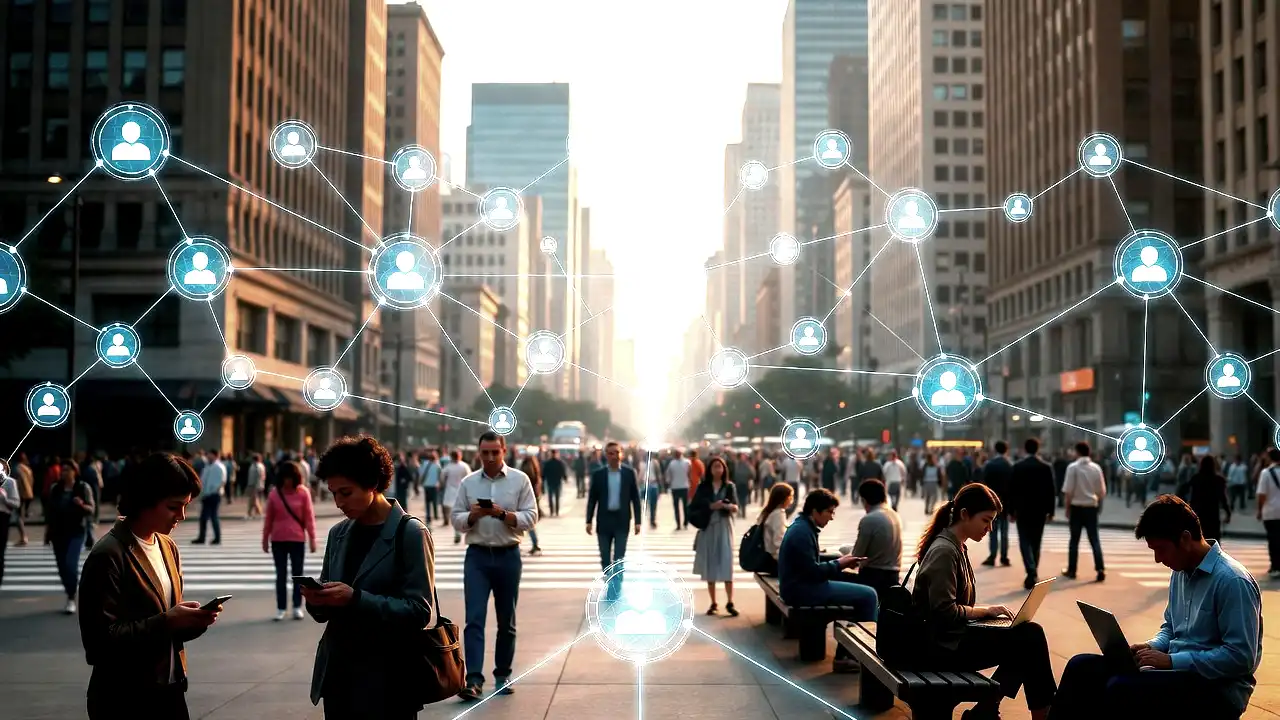
For most of human history, if you wanted to observe someone, you had to be there. You needed to watch them with your own eyes or rely on a witness. We lived our lives with a reasonable expectation of being unseen in public spaces. Today, that expectation is effectively dead. We have entered the age of “smart” surveillance. It is no longer just a camera on a wall recording grainy footage for later review. Now, t is an automated, intelligent, and relentless system that tracks our faces, maps our gaits, and monitors our interactions in rereal timeThis technology is being sold to us as the ultimate upgrade for public safety. But beneath the shiny, efficient surface, this shift raises profound moral questions that we are only just beginning to confront.
The Illusion of a Safer World
The primary sales pitch for smart surveillance is simple: a safer city is a monitored city. Proponents argue that if we can instantly identify a criminal in a crowd, we can stop crimes before they happen. They present us with a world where police can find missing children in minutes or catch dangerous offenders as they walk off a plane. This is an emotionally powerful argument. Who wouldn’t want to live in a world where the bad guys are caught instantly? But this vision of absolute safety comes with a hidden, massive cost. It assumes that the only way to be safe is to be seen. It prioritizes the enforcement of efficiency over a person’s fundamental right to move through the world without being tracked like an asset in a warehouse.
When Anonymity Becomes a Luxury
The most precious thing we are losing is our anonymity in public. Before smart surveillance, you could walk through a city square, visit a protest, or enter a clinic, and be just another face in the crowd. Your presence was fleeting and unrecorded. Now, every public step we take is digitized. Our faces are no longer just parts of our identity; they have become searchable data points. When you lose the ability to be anonymous, you lose the ability to act without fear of judgment, harassment, or retaliation. Anonymity is not about hiding crimes; it is about the freedom to explore, to disagree, and to evolve as a person without a permanent, machine-readable record trailing behind you.
The Algorithmic Judge and the Bias Problem
We are increasingly putting our trust in “smart” algorithms to tell us who is dangerous and who is not. This is where the moral implications become truly dangerous. These systems are not objective; they are mathematical reflections of the data they are fed. If a system is trained on historical arrest data, it will inevitably learn and amplify the biases inherent in that data. We see this play out time and again, where facial recognition tools show significantly higher error rates for women and people of color. When we use this technology to automate policing, we aren’t just using a new tool; we are automating prejudice and scaling it up to an industrial level. A biased human judge can be questioned, but a “biased” algorithm is often hidden behind a wall of corporate trade secrets.
The Creeping Normalization of Control
Smart surveillance rarely arrives with a bang. It arrives as a “pilot program,” a “security upgrade,” or a “convenience feature.” We see it first in airports, then in shopping malls, then in our local parks. Before we know it, we have created a society where being watched is the default setting. This normalization is a moral trap. Once these systems are integrated into the fabric of our cities, we don’t just lose the ability to choose; we lose the ability even to imagine a world without them. We are building the infrastructure for a society that demands constant transparency from its citizens, while its systems remain increasingly opaque.
Privacy as a Collective Good
We often make the mistake of treating privacy as a purely individual choice. We think, “If I’m not doing anything wrong, I don’t mind if they watch me.” But privacy is not just an individual preference; it is a collective good, like clean air or a functional democracy. If you monitor everyone, you change the nature of public life itself. People behave differently when they are being watched. They become more cautious, more conformist, and less likely to engage in the messy, vibrant, and unpredictable behavior that defines a free society. When we accept smart surveillance for ourselves, we are inadvertently lowering the threshold for what we consider acceptable for everyone else.
The Accountability Black Hole
Who is responsible when the system makes a mistake? If a smart camera identifies you as a suspect and you are detained because of a “match” that was actually an error, who is held accountable for that? Is it the company that wrote the code? The police department that bought the hardware? Or the city official who signed the contract? These systems create a massive accountability black hole. They operate on probabilities and “confidence scores,” not certainty. In a world of smart surveillance, the citizen is left to argue against the invisible, mathematical logic of a machine that never sleeps, never forgets, and is never truly sorry.
Conclusion
We are at a crossroads. We can continue down the path of least resistance, letting these systems quietly wrap our cities in a digital blanket of observation. Or, we can pause and ask the most important question: what kind of society do we actually want to live in? Smart surveillance might be the most efficient way to manage a city, but efficiency is a poor substitute for freedom. We must demand strict, legally binding guardrails. We need to decide which public spaces are truly public, and we must insist that our rights to anonymity and due process are not traded away for the illusion of total control. Once we cross the line into a fully monitored world, we won’t be able to turn back.