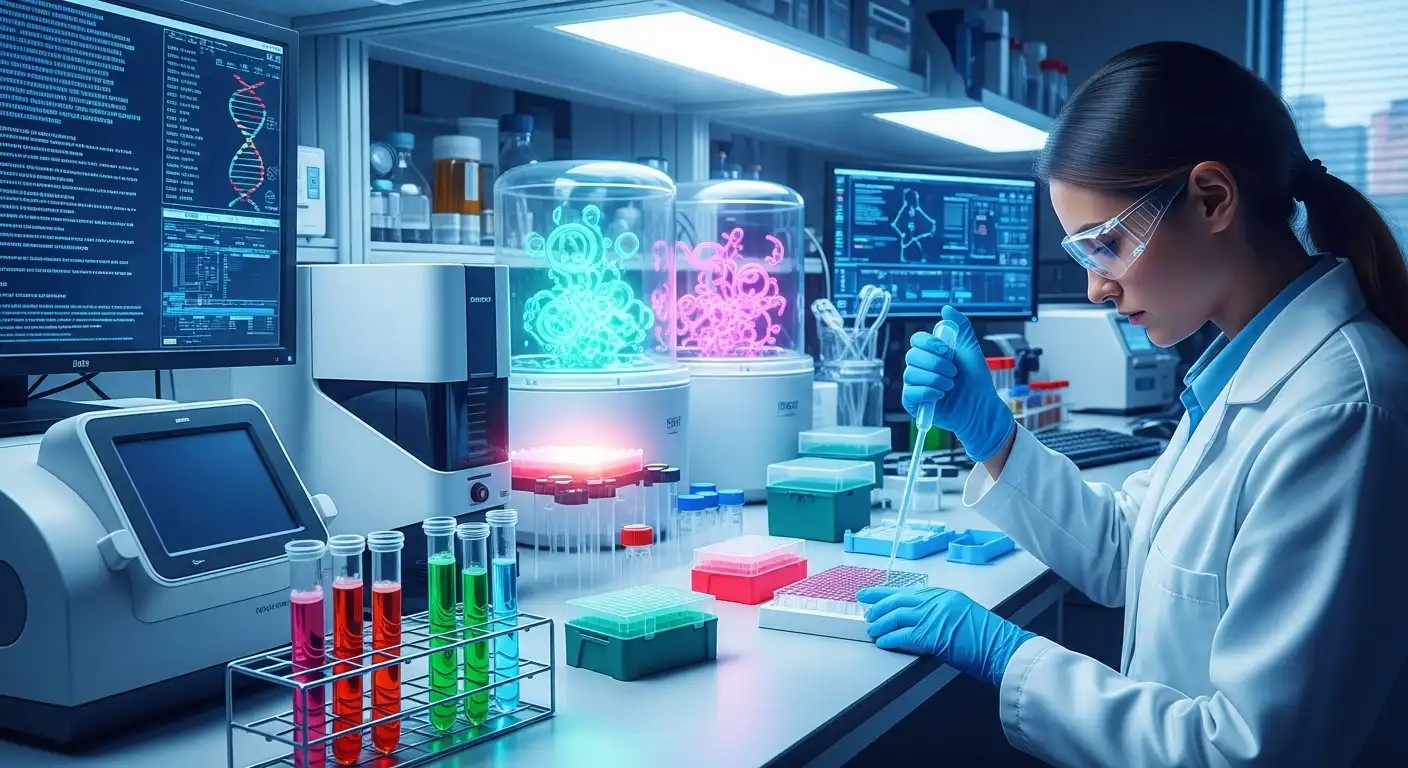
For billions of years, life on Earth has evolved through the slow, chaotic, and reactive process of natural selection. Evolution does not plan; it throws random mutations against the wall of survival to see what sticks. It is a messy, inefficient, yet undeniably powerful architect. However, in the 21st century, humanity is no longer content to be a mere spectator of this process. We have moved from reading the code of life—genomics—to writing it. This is the dawn of Synthetic Biology.
Synthetic biology, often abbreviated as SynBio, is not merely a branch of science; it is a discipline of engineering. It treats biology as the ultimate manufacturing platform. By viewing DNA sequences as software code and cells as programmable chassis, scientists are designing living systems that do not exist in nature to solve problems that nature never anticipated. From yeast that “brews” spider silk to bacteria that devour plastic waste, synthetic biology promises to transition our economy from one based on extraction (drilling and mining) to one based on creation (growing and brewing).
This comprehensive guide explores the principles of this revolutionary field, the technologies powering it, its world-changing applications, and the profound ethical landscapes we must navigate as we learn to design life itself.
The Engineering of Biology: Core Principles
To understand synthetic biology, one must unlearn the traditional view of biology as a descriptive science. In the past, biologists were like naturalists cataloging the parts of a car. Synthetic biologists are the mechanics and engineers building the car from scratch.
The Standardization of Life: BioBricks
The fundamental leap in SynBio is the application of engineering principles—standardization, modularity, and abstraction—to biological systems. In traditional genetic engineering, moving a gene from one organism to another was a bespoke, artisanal process. It was messy and difficult to replicate.
Synthetic biology introduced the concept of BioBricks. These are standardized DNA sequences—promoters, ribosome binding sites, coding sequences, and terminators—that can be snapped together like Lego blocks. Just as an electrical engineer does not need to know the physics of silicon to solder a resistor to a circuit board, a synthetic biologist can use these modular biological parts to build complex circuits without worrying about the underlying chemistry of every base pair. This modularity allows for rapid prototyping and scalability.
The Design-Build-Test-Learn (DBTL) Cycle
Synthetic biology operates on a workflow borrowed directly from industrial engineering:
- Design: Scientists use computer-aided design (CAD) tools specifically for biology to model a DNA sequence that should perform a desired function (e.g., producing a specific enzyme).
- Build: The DNA is not cut from an existing organism but is synthesized chemically in a lab (“printed”) and inserted into a host organism, usually a simplified bacterium or yeast cell known as a “chassis.”
- Test: The engineered organism is grown in a bioreactor to see if it produces the desired output or behaves as predicted.
- Learn: Data from the test is analyzed, often using machine learning, to identify failures and optimize the design for the next cycle.
The Toolbox: Technologies Driving the Revolution
The explosion of synthetic biology is driven by the convergence of three distinct technological curves: the plummeting cost of DNA sequencing, the rise of DNA synthesis, and the advent of gene editing.
DNA Synthesis: Printing the Code
For a long time, we could read DNA (sequencing) much faster than we could write it. That gap is closing. Companies can now print synthetic DNA strands with high accuracy. This allows researchers to email a genetic sequence to a foundry and receive a vial of custom-made DNA a few days later. This “cloud biology” model democratizes access to genetic tools, allowing startups to compete with pharmaceutical giants.
CRISPR-Cas9: The Word Processor
While synthesis allows us to write new code, CRISPR-Cas9 allows us to edit existing code with unprecedented precision. It acts as a “find and replace” tool for the genome. In synthetic biology, CRISPR is used to tune the metabolism of the host cell, silencing genes that divert energy away from the desired product and amplifying genes that support it.
Artificial Intelligence and Protein Design
Biology is complex. Predicting how a string of DNA will fold into a 3D protein is a computational nightmare. Enter AI. Tools like Google DeepMind’s AlphaFold have revolutionized the field by accurately predicting protein structures. Synthetic biologists are now using “Generative AI” not to write essays, but to hallucinate entirely new proteins that have never existed in nature—proteins designed specifically to bind to a toxin or catalyze a difficult chemical reaction.
The Bioeconomy: Applications Changing the World
The potential of synthetic biology is not hypothetical; it is already rewriting the rules of the global economy. We are entering the age of the Bioeconomy, where biology replaces petrochemicals and factory farming.
The Future of Medicine: Living Drugs
Synthetic biology is moving medicine from a regime of “treating symptoms” to “engineering cures.”
- CAR-T Cell Therapy: This involves extracting a patient’s T-cells (immune cells) and reprogramming them with synthetic DNA to recognize and attack specific cancer cells. The cells are essentially upgraded with new software and reintroduced into the body as “living drugs.”
- Smart Probiotics: Researchers are engineering bacteria that can live in the human gut and act as diagnostic sentinels. These bacteria can be programmed to detect biomarkers of inflammation or cancer and produce a visible signal (like changing the color of urine) or release a therapeutic molecule directly at the site of disease.
- On-Demand Vaccine Manufacturing: During the COVID-19 pandemic, the speed of mRNA vaccine development was a triumph of synthetic biology principles. In the future, portable “bio-foundries” could be deployed to remote areas or even Mars to synthesize vaccines and insulin on demand, eliminating the need for cold-chain logistics.
Cellular Agriculture: Food Without the Farm
The environmental toll of industrial livestock farming is unsustainable. Synthetic biology offers a path to meat and dairy that requires no animals.
- Precision Fermentation: Companies like Perfect Day use genetically engineered fungi to “brew” whey and casein proteins. These proteins are biologically identical to those found in cow’s milk but are produced in steel tanks. This allows for the creation of ice cream and cheese that tastes and melts exactly like dairy, with a fraction of the water and land use.
- Cultivated Meat: By taking a small sample of cells from an animal and feeding them nutrients in a bioreactor, we can grow muscle tissue—steak, chicken, pork—without slaughter. Synthetic biology is used to optimize the growth medium and scaffold, making the process affordable and scalable.
Bio-Manufacturing: Materials and Chemicals
We currently drill for oil to make plastics, nylon, and rubber. Synthetic biology allows us to grow these materials.
- Spider Silk: Spider silk is stronger than steel and lighter than Kevlar, but spiders cannot be farmed (they eat each other). Companies like Bolt Threads have engineered yeast to secrete spider silk proteins, which are then spun into fibers. This creates high-performance textiles that are fully biodegradable.
- The Scent of Extinction: We can now analyze the DNA from extinct flowers preserved in herbariums, synthesize the gene sequences responsible for their scent, and insert them into yeast. This allows us to smell flowers that have not bloomed on Earth for a century, creating unique fragrances for the perfume industry.
- Bio-Cement: Researchers are programming bacteria to produce calcium carbonate (limestone). When mixed with sand and aggregate, these bacteria can grow “bio-cement” bricks at ambient temperatures, avoiding the massive carbon emissions associated with traditional cement kilns.
Environmental Remediation
Nature has solutions to pollution, but they are often too slow. Synthetic biology hits the accelerator.
- Plastic-Eating Enzymes: In 2016, scientists discovered a bacterium that eats PET plastic. By using directed evolution and protein engineering, they have created super-enzymes that can break down plastic bottles into their base monomers in days rather than centuries. This paves the way for infinite recycling.
- Nitrogen Fixation: Cereal crops like corn and wheat require massive amounts of synthetic nitrogen fertilizer, which pollutes waterways. Legumes (beans) naturally fix nitrogen through a symbiotic relationship with bacteria. Synthetic biologists are working to engineer the roots of cereal crops to host these bacteria, potentially eliminating the need for synthetic fertilizers entirely.
DNA Data Storage: The Ultimate Archive
Humanity generates a staggering amount of digital data—zettabytes every year. Our current storage media (hard drives, magnetic tape) are bulky, energy-intensive, and degrade over a few decades. DNA, however, is nature’s hard drive. It is incredibly dense (all the world’s data could fit in a teaspoon of DNA) and stable for thousands of years.
Synthetic biologists are perfecting methods to translate binary code (0s and 1s) into genetic code (As, Cs, Ts, and Gs). In this system, you could synthesize a strand of DNA that encodes a movie or the Library of Congress. To “read” the file, you simply sequence the DNA. While currently too slow for everyday RAM, this technology promises to revolutionize archival “cold storage,” preserving human knowledge for millennia without electricity.
The Risks: Biosecurity and the Ethics of Creation
With the power to design life comes the responsibility to control it. The “dual-use” nature of synthetic biology—where the same tools used to cure disease can be used to create harm—is a primary concern for governments and security agencies.
The Democratization of Danger
As the cost of DNA synthesis drops, the barrier to entry lowers. “Garage biology” is becoming a reality. While this spurs innovation, it also raises the specter of bioterrorism. Theoretically, a bad actor could download the genetic sequence of a pathogen (like the 1918 Flu), synthesize the DNA, and boot up the virus.
To combat this, the industry has established strict screening protocols. DNA synthesis companies scan every order against a database of known pathogens. If someone tries to order a sequence that matches a dangerous virus, the order is flagged and investigated. However, as synthesis machines become smaller and decentralized, enforcing these checkpoints becomes harder.
Ecological Disruption and Gene Drives
What happens when a synthetic organism escapes the lab? Unlike a chemical spill, a biological “spill” can reproduce and evolve.
This concern is central to the debate over Gene Drives. A gene drive is a genetic system designed to spread a specific trait through a wild population rapidly, bypassing standard inheritance rules. Scientists have designed gene drives that could sterilize Anopheles mosquitoes, potentially wiping out malaria. However, releasing such a construct could have unforeseen consequences on the ecosystem. If the mosquito goes extinct, what happens to the birds that eat them? What if the gene drive jumps to a harmless species?
The “Playing God” Argument
Beyond safety, there are deep philosophical questions. Does reducing life to interchangeable parts devalue it? Are we commodifying nature in a way that is fundamentally unethical? As we move toward editing the human genome (germline editing) or creating synthetic embryos, society must draw lines between therapy (curing disease) and enhancement (designing “better” humans).
The Future: A Solarpunk Reality?
Despite the risks, the trajectory of synthetic biology points toward a more sustainable, integrated future. We are moving toward a Solarpunk reality—a vision of the future where high technology and nature coexist in harmony.
Imagine cities where the streetlights are powered not by electricity, but by bioluminescent trees. Imagine buildings that heal their own cracks using embedded fungal spores. Imagine a manufacturing sector that emits oxygen instead of carbon dioxide.
This transition requires more than just scientists. It requires policymakers to create adaptive regulations that ensure safety without stifling innovation. It requires artists and philosophers to help us understand our new relationship with nature. And it requires a public that is scientifically literate and engaged in the conversation about what we should build, not just what we can build.
Conclusion
Synthetic biology represents the industrial revolution of the 21st century. It is the convergence of the digital and the biological, granting us the ability to program matter itself. It offers the only viable path to sustaining a high-tech civilization on a planet with finite resources.
We are no longer just inhabitants of the biosphere; we are becoming its architects. The shift from evolution by natural selection to evolution by intelligent design is a profound threshold for our species. As we learn to write the code of life, we hold the potential to heal the planet and cure our deepest ailments, provided we wield the pen with wisdom, humility, and foresight. The future is being grown, not built.