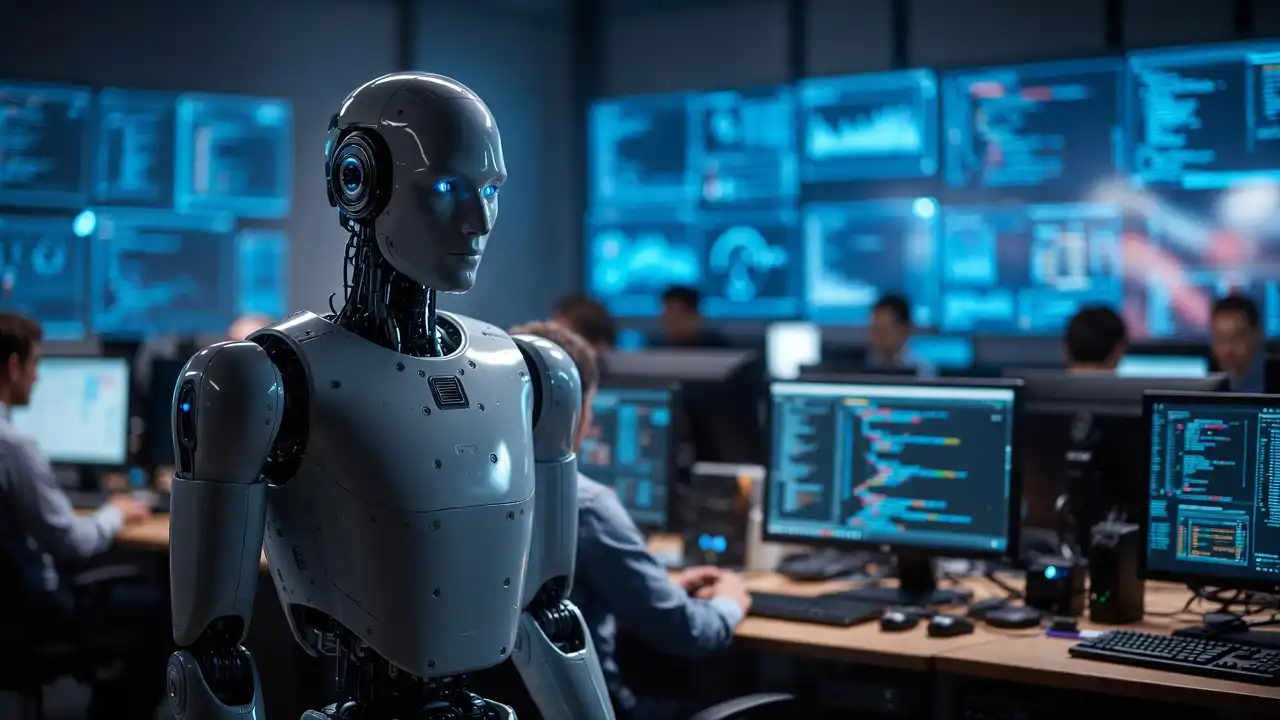
The stories we tell about the future of artificial intelligence are almost always about conflict. We picture a chess match: human versus machine, with our jobs, our creativity, and our very relevance on the line. We worry about being replaced, made obsolete by a thinking machine that can do everything we can, but better. This is a dramatic and compelling story, but it’s also the wrong one. The future isn’t a battle between them and us. It’s a partnership. The most powerful person in the coming decades won’t be a human or an AI, but a human skillfully augmented by AI.
Just Another Power Tool
We have been here before. Every time a transformative tool has been invented, we have worried that it will replace us. The calculator was supposed to destroy our ability to do math. The spreadsheet was supposed to eliminate the accountant. The word processor was supposed to devalue the writer. In every case, the opposite happened. These tools didn’t replace the professional; they amplified them. They automated the tedious grunt work—the manual calculations, the endless ledgers—freeing up the human to focus on higher-level tasks like strategy, interpretation, and creative problem-solving. AI is simply the next, most powerful tool in this long line.
An Exoskeleton for the Mind
Consider AI as a cognitive prosthetic, an exoskeleton for the brain. It has a perfect memory, can read a million documents in a minute, and can spot patterns in data that a human would never see. A doctor can use AI to analyze an MRI scan, not to replace her diagnosis, but to draw her attention to a tiny anomaly she might have missed. A lawyer can use AI to sift through decades of case law in seconds, allowing them to build a stronger argument. In these scenarios, the AI is handling the recall and analysis, while the human provides the crucial final layer of judgment, experience, and ethical consideration.
The Co-pilot in Creativity
The fear that AI will kill human creativity is perhaps the most misguided. No serious artist thinks a paintbrush makes the painting. AI is a new kind of paintbrush. It’s an incredibly powerful brainstorming partner, a co-pilot that can generate a dozen different concepts for a logo, a melody, or a story arc in the time it would take a human to sketch out one. The human artist is still the director, the curator, and the visionary. They are the one who chooses which idea has soul, which concept resonates, and how to refine the raw output of the machine into a piece of true art.
The Skill That Matters Most
This new reality demands a new skill set. The most valuable professionals will no longer be the ones who can simply execute tasks. They will be the ones who can effectively collaborate with their AI tools. The critical skill is learning to be a great manager of your AI assistant. It’s about asking the right questions, framing problems in a way the AI can understand, and critically evaluating the output. The person who masters this human-AI dialogue will be able to produce work at a scale and quality that their un-augmented peers simply cannot match.
Not a Replacement, but an Upgrade
We need to stop thinking of AI as a competitor and start seeing it as a collaborator. The future isn’t about defending our turf from an encroaching machine intelligence. It’s about learning how to integrate that intelligence to make ourselves better, faster, and smarter. This isn’t a threat to our humanity; it’s an opportunity to amplify it. The real divide in the future won’t be between humans and machines, but between the humans who embrace this new partnership and those who are left behind.