

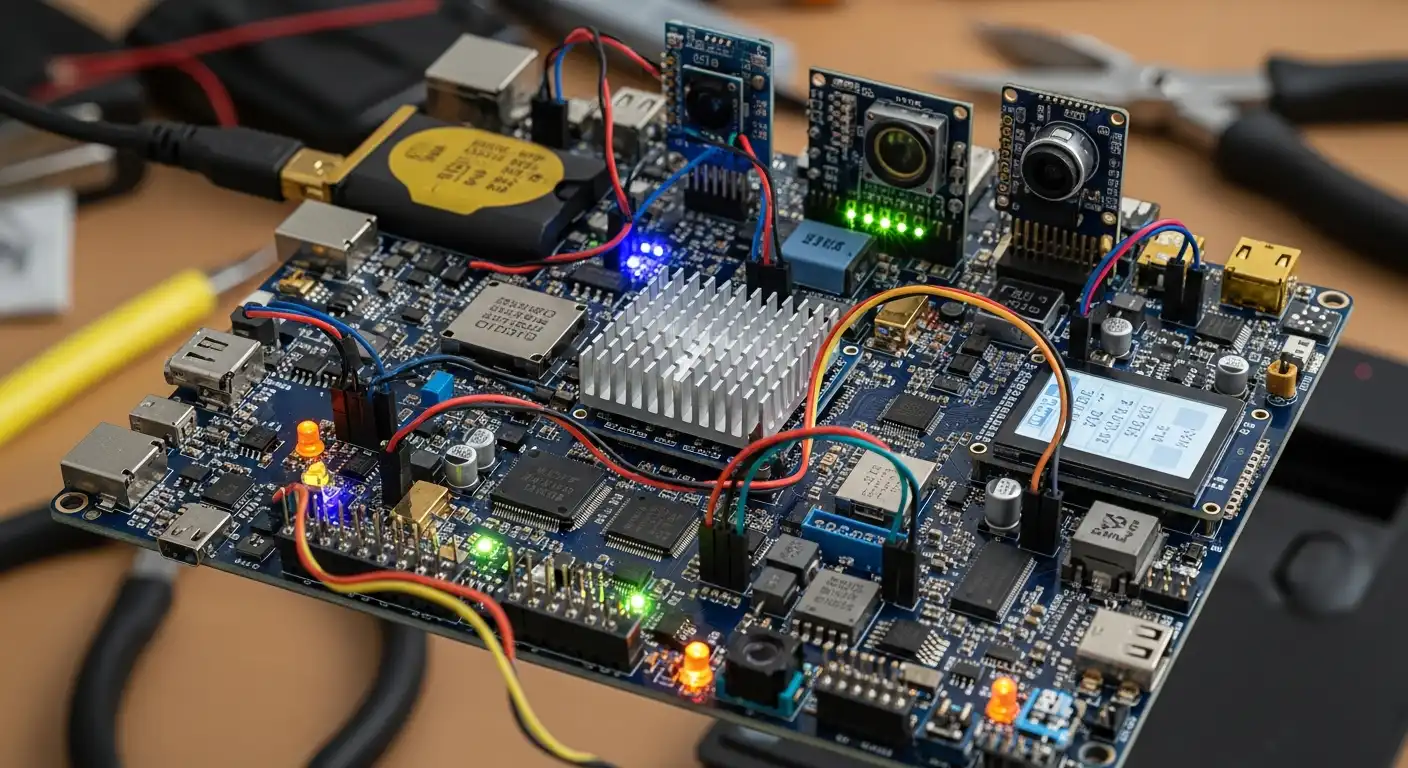
In the grand narrative of computing, the story has always been one of increasing power and shrinking size. We have journeyed from room-sized mainframes to desktop towers, from laptops to smartphones. Yet, for decades, a significant barrier remained. The ability to move beyond being a mere user of technology to becoming a creator of it was a privilege reserved for those with deep pockets or formal engineering degrees. The world of hardware hacking, embedded systems, and physical computing was an exclusive club, its doors guarded by high costs, complex programming environments, and a steep, intimidating learning curve.
Then, in 2012, a quiet revolution began in Cambridge, UK. It arrived not with the fanfare of a Silicon Valley product launch, but in a small, unassuming cardboard box. Inside was a tiny, credit-card-sized circuit board, stripped bare of any fancy casing, adorned with a collection of ports and a single, powerful microchip. It had a peculiar, almost whimsical name: the Raspberry Pi. Its price was even more peculiar: a mere $35. This was not just another gadget; it was a profound statement. It was a declaration that the power to create with technology should be accessible, affordable, and available to everyone, everywhere.
The Raspberry Pi was born from a simple, academic concern: the declining number of students applying to study computer science. But its impact has transcended the classroom to become a global phenomenon, the very symbol of the maker movement and a case study in the radical democratization of hardware. It has sold over 40 million units, making it the best-selling British computer of all time. It has powered everything from home automation systems and retro gaming consoles to scientific research stations in Antarctica and cubesats in low Earth orbit. This is the story of how a small charity with a modest goal accidentally created a pocket supercomputer for the masses, dismantling the barriers to hardware innovation and empowering a generation of tinkerers, hobbyists, educators, and entrepreneurs to build the future, one tiny, affordable computer at a time.
The Pre-Pi Problem: The Gated Community of Computing
To understand the revolutionary impact of the Raspberry Pi, we must first appreciate the world it was born into. Before 2012, the landscape of accessible computing for hobbyists and learners was fragmented, expensive, and often deeply frustrating.
The Decline in “Bedroom Coders”
The genesis of the Raspberry Pi Foundation can be traced to a specific problem observed at the University of Cambridge’s Computer Laboratory in the mid-2000s. The professors, including Eben Upton, who would become the face of the project, noticed a troubling trend.
The quality and quantity of applicants for their computer science program were declining. There was a clear reason for this phenomenon.
- The Golden Age of the 8-Bit Computer: In the 1980s, kids grew up with computers like the BBC Micro and the Commodore 64. These machines booted directly into a programming environment (like BASIC). To do anything, you had to learn to code. This created a generation of “bedroom coders” who learned programming through experimentation and play.
- The Rise of the Appliance Computer: By the 2000s, computers had become polished, locked-down appliances. PCs and Macs were designed for consumption—browsing the web, sending emails, and playing games. The inner workings were hidden behind layers of user-friendly abstraction, and the invitation to tinker was gone. Students arrived at university as sophisticated users of technology but with no practical programming experience.
The High Cost and Complexity of Embedded Systems
For those who wanted to venture into the world of physical computing and control hardware, the options were limited and often expensive. The world of embedded systems was a professional domain, not a hobbyist’s playground.
The barriers to entry for hardware experimentation were significant. The available tools were not designed for beginners.
- Expensive Development Boards: Professional-grade single-board computers (SBCs) existed, but they could cost hundreds or even thousands of dollars, making them far out of reach for students or hobbyists.
- The Microcontroller Alternative (Arduino): The Arduino platform, launched in 2005, was a huge step forward in making microcontrollers accessible. However, an Arduino is not a full computer. It is brilliant for simple, repetitive tasks (like blinking an LED or reading a sensor), but it doesn’t run a full operating system. It lacks the power to handle complex tasks like running a web server, processing video, or providing a graphical desktop environment.
- A Steep Learning Curve: Getting started often required a deep understanding of electronics, soldering skills, and proficiency in low-level programming languages like C or C++. There was no gentle, beginner-friendly on-ramp.
The Gap in the Market: A Computer, Not Just a Controller
This created a clear and significant gap in the market. There was a need for a device that bridged the world of simple microcontrollers and expensive professional SBCs.
The ideal device would need to possess a specific set of characteristics. This was the design brief that the Raspberry Pi was created to fill.
- It had to be a true computer: it needed to run a full operating system (like Linux), support modern programming languages (like Python), and connect to a standard keyboard, mouse, and monitor.
- It had to be cheap: The price had to be low enough that a child could buy it with their pocket money, or a school could afford to buy them by the dozen. The target price range of $25-$35 was not an accident; it was a core part of the mission.
- It had to be simple and robust: It needed to be forgiving of mistakes. A beginner should be able to plug it in, make it work, and not have to worry about “bricking” an expensive piece of hardware.
This was the challenge the founders of the Raspberry Pi Foundation set for themselves: to create a low-cost, high-performance computer that would bring the spirit of the BBC Micro into the 21st century.
The Genesis of the Pi: A Charity with a Grand Ambition
The Raspberry Pi was not the product of a venture-backed startup seeking a billion-dollar exit. A UK charitable foundation with a focused educational mission founded it. This non-profit’s origin story is absolutely central to its identity, design philosophy, and global success.
The Founders and the Foundation
In 2009, a group of academics and industry professionals at the University of Cambridge, including Eben Upton, Rob Mullins, Jack Lang, and Alan Mycroft, officially formed the Raspberry Pi Foundation. Their backgrounds spanned computer architecture, education, and entrepreneurship.
Their mission was simple and clearly defined, which guided all subsequent decisions.
- The Stated Goal: “To promote the study of computer science and related topics, especially at the school level, and to put the fun back into learning computing.”
- Non-Profit Ethos: As a charity, their primary metric of success was not profit, but impact. This allowed them to make decisions—like setting an incredibly low price point—that a for-profit company might have shied away from. It also gave them a powerful, authentic story that resonated with educators, volunteers, and the open-source community.
The Design Philosophy: Simplicity, Cost, and “Hackability”
The design process for the first Raspberry Pi was a masterclass in ruthless prioritization and clever engineering trade-offs. Every single component was chosen with the primary goals of low cost and educational value in mind.
This philosophy of “just enough” was key to hitting their audacious price target.
- Leveraging the Smartphone Revolution: The key technological insight was to use a system-on-a-chip (SoC) from Broadcom, originally designed for set-top boxes and mobile phones. The massive scale of the smartphone industry has driven the cost of these powerful, integrated chips down to just a few dollars. Eben Upton, who worked at Broadcom, was in the perfect position to make this happen.
- Bare-Bones by Design: The Pi was intentionally minimalist. It had no case, no built-in storage, and no included peripherals. It was just the board. This not only cut costs but also made the device more “hackable.” All the components and ports were exposed, inviting users to explore and understand how a computer is put together.
- The Magic of the GPIO: The most important feature for the maker community was the General-Purpose Input/Output (GPIO) header. This row of pins served as a direct bridge between the Pi’s software world and the physical world. It allowed a user to write a simple program to control LEDs, read sensors, spin motors, and interact with a universe of electronic components. This was the feature that transformed the Pi from a small PC into a true physical computing platform.
The Launch: Underestimating the Maker Tsunami
The Foundation initially envisioned a modest production run. They thought they might sell a few thousand units, mostly to educators and students in the UK. They launched the first product, the Raspberry Pi Model B, on February 29, 2012. The demand was utterly unprecedented.
The launch day was a moment of pure, chaotic, internet-breaking success. It revealed a pent-up demand that was far larger than anyone had anticipated.
- The Crash of the Retailers: The websites of the two licensed manufacturers, Element 14 and RS Components, buckled under the traffic. They received hundreds of thousands of pre-orders within hours.
- The Maker Movement’s Embrace: While the Pi was designed for the classroom, it was the global community of adult hobbyists, tinkerers, and “makers” that drove the initial tidal wave of demand. They immediately saw the Pi not just as a learning tool, but as the perfect, affordable brain for their own creative projects.
The Raspberry Pi Foundation had set out to solve a problem in computer science education. In doing so, they had accidentally created the defining hardware platform for a global cultural movement.
Deconstructing the Pocket Supercomputer: Anatomy of a Raspberry Pi
To a novice, a Raspberry Pi board can look like a complex and intimidating miniature city of circuits. But its design is remarkably logical and accessible once you understand the key landmarks. The elegance of the Pi lies in how it packs the core components of a full computer into such a small and affordable package.
The Core Components (What Makes it a Computer)
At its heart, a Raspberry Pi has the same fundamental building blocks as the desktop or laptop computer you are using right now, just miniaturized.
Let’s break down the essential components that define every Raspberry Pi model.
- The System-on-a-Chip (SoC): This is the brain of the operation. The SoC (e.g., from the Broadcom BCM2xxx series) is a single microchip that integrates several key components. This integration is what makes the Pi’s small size and low cost possible.
- CPU (Central Processing Unit): The main processor that runs the operating system and user programs. Pi CPUs have evolved from a single-core 700MHz processor in the first model to quad-core, 1.8GHz+ 64-bit processors in modern versions, rivaling the power of entry-level laptops.
- GPU (Graphics Processing Unit): This handles all graphics, from rendering the desktop environment to playing high-definition video, and even 3D graphics.
- RAM (Random Access Memory): This is the computer’s short-term memory. It has grown from just 256MB in the original Pi to as much as 8GB in current models, enabling much more powerful multitasking and demanding applications.
- Storage (The SD Card): Unlike a traditional computer with a hard drive or SSD, the Raspberry Pi has no onboard storage. It uses a microSD card for everything—the operating system, applications, and user files. This is a brilliant cost-saving measure and also makes the system incredibly flexible. You can completely change the Pi’s function simply by swapping out the SD card.
- Connectivity Ports: This is how the Pi talks to the outside world.
- Video Out: An HDMI port allows you to connect it to any modern TV or computer monitor.
- USB Ports: For connecting your keyboard, mouse, and other peripherals, such as webcams or external hard drives.
- Ethernet Port: For a wired internet connection. Most models also include built-in Wi-Fi and Bluetooth.
- Audio Jack: A standard 3.5mm jack for connecting headphones or speakers.
- Power In: A micro-USB or USB-C port to provide power.
The “Secret Sauce”: The GPIO Header
While the components above make it a great small computer, the GPIO header is what makes it a Raspberry Pi. This is its superpower, the feature that elevates it from a passive consumption device to an active creation tool.
The GPIO header is a direct gateway to the world of electronics and physical computing.
- What it is: A row of 40 pins that are directly connected to the Pi’s processor. These pins can be controlled by software.
- What it does: A programmer can write a simple script (usually in Python) to turn these pins “on” or “off” (output), or to “read” whether they are receiving a voltage (input).
- The Possibilities: This simple capability unlocks a near-infinite range of projects. You can connect LEDs, buttons, sensors (for temperature, motion, light, etc.), motors, displays, and thousands of other electronic components. It’s how a Pi can become a weather station, a robot, a security camera, or the controller for a 3D printer.
The Software Ecosystem: Raspbian (Raspberry Pi OS) and NOOBS
The hardware is only half the story. The Raspberry Pi’s success is equally dependent on its mature, user-friendly, and completely open-source software ecosystem.
The Foundation has invested heavily in making the software experience as painless as possible for beginners.
- Raspberry Pi OS (formerly Raspbian): The official operating system, a customized version of the popular Linux distribution, Debian. It comes pre-loaded with a full suite of software, including a web browser, office tools, and, most importantly, a complete set of programming tools like Python, Scratch, and Java.
- NOOBS (New Out of the Box Software): To make the initial setup even easier, the Foundation created NOOBS. It’s an installer that a user can copy to a blank SD card. When the Pi is first booted, NOOBS provides a simple menu that allows the user to install Raspberry Pi OS and other alternative operating systems easily. This removed the intimidating step of having to “flash” an OS image, a major barrier for novices.
This combination of powerful yet simple hardware and a rich yet accessible software ecosystem created a platform that was uniquely capable of serving both the absolute beginner and the seasoned expert.
The Pi in the Wild: A Universe of Use Cases
The true measure of the Raspberry Pi’s success is not in the number of units sold, but in the staggering diversity and ingenuity of the projects it has enabled. It has become a universal building block for digital creation, used in ways its creators never could have imagined.
The Core Educational Mission: Reinvigorating the Classroom
The Pi’s primary mission has always been education, and it has had a profound impact on how computer science is taught worldwide.
It has brought hands-on, tangible computing back into a curriculum that had become overly theoretical.
- Code Clubs and CoderDojos: The Pi became the centerpiece of a global network of after-school coding clubs, allowing kids to learn programming by making games, animations, and simple electronic projects.
- The Digital Making Curriculum: The Raspberry Pi Foundation develops a huge library of free, high-quality educational resources, lesson plans, and project guides for teachers and students, covering everything from basic programming to AI and machine learning.
- Astro Pi: Coding in Space: In a stunningly inspirational project, the Foundation partners with the European Space Agency (ESA) to run the Astro Pi competition. Students write code that is sent to the International Space Station to run on two specially cased Raspberry Pis, allowing them to conduct experiments in space.
The Hobbyist and Maker Revolution
For the global maker movement, the Raspberry Pi was a dream come true. It provided a powerful, Linux-based brain for their projects at an unbeatable price point.
The Pi is the engine behind some of the most popular and creative hobbyist projects.
- Retro Gaming Consoles: Using software like RetroPie or Lakka, a Raspberry Pi can be easily transformed into an emulation station capable of playing thousands of classic video games from old consoles like the NES, Sega Genesis, and PlayStation.
- Home Automation Hubs: The Pi is the perfect platform for building a DIY “smart home” hub. Using open-source software like Home Assistant, users can connect and control smart lights, thermostats, and sensors, creating sophisticated automation routines without relying on expensive, proprietary systems.
- Network-Level Ad Blockers (Pi-hole): One of the most popular “killer apps” for the Pi is Pi-hole. It’s a piece of software that turns the Pi into a DNS sinkhole for your entire home network, blocking ads on every device without requiring any client-side software.
The Unforeseen Industrial and Scientific Applications
Perhaps the most surprising aspect of the Pi’s journey has been its widespread adoption in professional, industrial, and scientific settings. Its low cost, small size, and reliability have made it the ideal solution for a huge range of niche problems.
The Pi has proven to be far more than just a toy for tinkerers. It’s a serious tool for innovation.
- Industrial IoT and Factory Automation: Companies use thousands of Raspberry Pis as low-cost controllers and data loggers on factory floors, monitoring machinery and feeding data into larger industrial control systems.
- Digital Signage and Kiosks: The Pi’s ability to drive an HD display makes it perfect for powering digital menu boards in restaurants, information kiosks in museums, and advertising displays.
- Scientific Research: Researchers on tight budgets have used Raspberry Pis to build custom scientific equipment for a fraction of the cost of commercial alternatives. They have been used in wildlife camera traps, environmental monitoring stations in the rainforest, and even in particle physics experiments.
This incredible range of applications, from a child’s first coding project to a critical component on a factory floor, is a testament to the power of a truly open, affordable, and versatile computing platform.
The Business of Pi: A Tale of Two Companies
The story of how the Raspberry Pi is produced and sold is as unique and innovative as the product itself. The entire operation is a masterclass in strategic partnership, lean operations, and mission-driven commerce. It is run through a unique dual structure: a non-profit foundation and a for-profit commercial subsidiary.
The Foundation and the Trading Company
The Raspberry Pi ecosystem is governed by two legally distinct but tightly linked entities. This structure allows them to pursue their charitable goals while operating with the efficiency and agility of a commercial hardware company.
Understanding this dual structure is key to understanding their success.
- The Raspberry Pi Foundation: the charity. Its mission is purely educational. It develops the free educational resources, runs the Code Clubs, and engages in outreach to schools and teachers. It is funded by donations and by the profits from the trading company.
- Raspberry Pi (Trading) Ltd.: This is the for-profit subsidiary responsible for all the engineering and commercial activities. This is the entity that designs the hardware, manages the manufacturing partnerships, and handles the global distribution and sales of the Raspberry Pi computers. The profits generated by this company are donated to the Foundation to support its charitable work.
A Lean, Licensing-Based Business Model
Raspberry Pi (Trading) Ltd. does not own any factories. Instead, it operates on a licensing model, a strategy that has allowed it to scale to tens of millions of units with an incredibly lean internal team.
This capital-light approach was essential for a project that started with very little funding.
- Manufacturing Partners: The Pi is manufactured and sold by a small number of licensed partners, primarily RS Components, OKdo, and Element 14 (Farnell). These are massive, global electronics distributors with their own manufacturing facilities and distribution networks.
- The Benefits of the Model: This arrangement offloads the immense complexity and capital cost of manufacturing and logistics. Raspberry Pi provides the design and the brand, and the partners handle the rest. This allows the core Raspberry Pi team to stay small and focused on what they do best: engineering and software development.
The Power of Community and Open Source
The Raspberry Pi’s greatest business asset is not something that appears on a balance sheet: it is its massive, passionate, and highly engaged global community. The Foundation has masterfully nurtured this community, which in turn creates enormous value for the platform.
The community is a force multiplier that provides free support, innovation, and marketing.
- The Raspberry Pi Forums: The official forums are an incredibly active and helpful resource, with hundreds of thousands of members who answer questions, share projects, and provide technical support to newcomers. This significantly reduces the Foundation’s support burden.
- A Universe of Third-Party Content: The community creates a vast amount of content—YouTube tutorials, blog posts, project guides, and books—that constantly showcases new and exciting ways to use the Pi. This serves as an incredibly powerful and authentic marketing engine.
- The Open-Source Ethos: The Pi is built on a foundation of open-source software (Linux and a host of other tools). This aligns perfectly with the values of the developer and maker communities and encourages them to contribute to the ecosystem.
This unique combination of a charitable mission, a lean business model, and a vibrant community has created a sustainable and highly scalable engine for democratizing technology.
The Pi’s Impact and Legacy: A Paradigm Shift in Computing
The legacy of the Raspberry Pi extends far beyond the 40+ million units it has sold. It has fundamentally changed our relationship with technology, inspiring a new generation of creators and permanently altering the landscape of computing, education, and hardware innovation.
The Democratization of Hardware Creation
The most profound impact of the Raspberry Pi is that it has radically lowered the barrier to entry for hardware innovation. It has taken the power to create custom computing devices out of the exclusive domain of large corporations and put it into the hands of individuals.
The Pi has made the “Internet of Things” (IoT) a reality for everyone, not just for big tech companies.
- The Age of the “Weekend Inventor”: For the first time, a hobbyist with a good idea and a spare weekend can build a functional prototype of a new smart device for less than the cost of a new video game.
- A Platform for Prototyping: The Pi has become the default platform for early-stage hardware startups. It allows them to quickly and cheaply develop and test their ideas before investing in expensive custom-designed hardware.
Forging a New Generation of Engineers and Developers
The Pi has successfully achieved its original mission on a scale its founders could never have dreamed of. It has made computer science tangible, fun, and accessible again, inspiring millions of young people around the world to pursue careers in technology.
It has put the “fun back into computing” for an entire generation.
- From Consumer to Creator: The Pi has been a key driver in shifting young people’s mindset from passive consumers of technology to active creators. It teaches them that the technology in their pockets is not magic; it is something they can understand, control, and build upon.
- A Pipeline of Talent: The students who started with a Raspberry Pi in an after-school Code Club a decade ago are now computer science graduates and junior engineers entering the workforce, bringing with them a practical, hands-on understanding of computing that was previously missing.
Spawning a New Ecosystem and a Competitive Market
The Raspberry Pi’s phenomenal success did not go unnoticed. It created and legitimized the market for low-cost single-board computers, spawning a host of competitors and a massive ecosystem of third-party products.
The Pi’s success has lifted the entire industry, creating more choice for consumers.
- The Rise of Competitors: The market is now filled with a wide range of “Pi-like” boards from companies like Asus (Tinker Board), Hardkernel (ODROID), and Nvidia (Jetson Nano), each offering different features and performance characteristics. This competition drives innovation and keeps prices low.
- The Cottage Industry of Accessories: An enormous industry has sprung up around the Raspberry Pi, selling everything from cases and power supplies to specialized “HATs” (Hardware Attached on Top)—add-on boards that plug into the GPIO header to provide new functionality, such as motor control or high-quality audio.
Challenges and the Future: What’s Next for the Pocket Supercomputer?
Despite its incredible success, the Raspberry Pi’s journey is not without its challenges. As it evolves from a niche hobbyist board to a mature computing platform, it faces new pressures and expectations.
The Ongoing Supply Chain Crisis
In recent years, the single biggest challenge for the Raspberry Pi has been the global semiconductor shortage and supply chain disruptions. The very success that created massive demand has made it incredibly difficult for the company to produce enough boards to meet it.
This has been a source of immense frustration for the community and a major business challenge.
- From Abundance to Scarcity: For years, Pis were cheap and readily available. The shortages have led to stockouts, price gouging from scalpers, and long waiting lists, temporarily undermining the Pi’s core value proposition of accessibility.
- Prioritizing Industrial Customers: To manage the crisis, Raspberry Pi (Trading) has had to prioritize its industrial and commercial customers over individual hobbyists. This difficult but necessary business decision has caused some friction with its core community.
The Pressure to Move Upmarket
As each new generation of the Raspberry Pi becomes more powerful, it inches closer to the territory of traditional desktop and laptop computers. This creates both an opportunity and a challenge.
The Pi must balance the needs of its beginner audience with the demands of more advanced users.
- The Raspberry Pi 400: This product, a complete PC built into a compact keyboard, is a clear signal of their ambition to create a true, low-cost desktop computer replacement.
- Maintaining Simplicity: As the hardware becomes more complex and the software more feature-rich, there is a risk of losing the beautiful simplicity that made the original Pi so successful. The Foundation must continue to focus on maintaining a gentle on-ramp for absolute beginners.
The Next Frontier: Microcontrollers and AI
The Raspberry Pi ecosystem is not standing still. The company is actively expanding its product line to address new areas of the computing landscape.
Two recent product launches indicate the platform’s future direction.
- The Raspberry Pi Pico: This is a tiny, $4 microcontroller, not a full computer. It is designed to compete directly with the Arduino, providing a low-cost, low-power solution for simple embedded tasks. The Pico is powered by a custom-designed silicon chip, the RP2040, marking Raspberry Pi’s first foray into designing its own processors.
- AI at the Edge: As artificial intelligence and machine learning become more prevalent, there is a growing demand for low-cost hardware that can run AI models “at the edge” (i.e., on the device itself, without connecting to the cloud). The increasing processing power of the main Raspberry Pi line, along with the development of AI accelerator HATs, is positioning the Pi as a key platform for hobbyist and educational AI development.
Conclusion
The Raspberry Pi is one of the most important technology stories of the 21st century. It is a powerful reminder that the most profound innovations are not always the most complex or the most expensive. With a clear, mission-driven focus on accessibility, a series of brilliant engineering trade-offs, and a deep respect for its community, the Raspberry Pi Foundation achieved what many billion-dollar corporations could not: they built a computer for the people.
They took the intimidating, exclusive world of hardware engineering and threw the doors wide open. They proved that if you give people powerful, affordable, and open tools, they will respond with a tidal wave of creativity that can change the world. The Raspberry Pi is more than just a piece of hardware; it is a catalyst, a blank canvas, and an open invitation. It is the pocket supercomputer that has empowered a generation to stop just using technology and start building it, ensuring that the future of computing will be created not just in the corporate labs of Silicon Valley, but also in the classrooms, workshops, and bedrooms of tinkerers and dreamers all over the world.






