By 2050, the global population is projected to reach nearly 10 billion. According to the Food and Agriculture Organization (FAO) of the United Nations, feeding this booming population will require a 70% increase in food production. This presents a staggering challenge. Traditional agriculture is already at its limits; it consumes 70% of the world’s accessible fresh water, occupies nearly 40% of the Earth’s land surface, and is a significant contributor to greenhouse gas emissions. Furthermore, as climate change accelerates, arable land is shrinking due to desertification, soil erosion, and unpredictable weather patterns.
The solution may not lie in clearing more forests for farmland, but rather in looking upward. Vertical farming—the practice of growing crops in vertically stacked layers in controlled indoor environments—represents a paradigm shift in how humanity approaches food production. It is the convergence of agriculture and technology, transforming farming from a labor-intensive, weather-dependent practice into a data-driven, precision industry.
This comprehensive guide examines the technology underpinning vertical farms, their environmental and economic implications, and why this method is poised to redefine the future of agriculture.
The Evolution of Controlled Environment Agriculture (CEA)
Vertical farming is a subset of Controlled Environment Agriculture (CEA). While greenhouses have existed for centuries, modern vertical farming pushes environmental control to its limits. It removes the variables of nature entirely. In these facilities, there are no seasons, no droughts, no cloudy days, and no pests.
From Soil to Solution: Hydroponics and Aeroponics
The foundation of vertical farming technology lies in soilless cultivation. Soil is heavy, brings the risk of soil-borne diseases, and is difficult to manage indoors. Vertical farms utilize three primary methods to nourish plants:
- Hydroponics: This is the most common technique. Plants are grown with their roots submerged in a nutrient-rich water solution. The chemistry of the water is continuously monitored and adjusted to ensure optimal uptake of minerals such as nitrogen, phosphorus, and potassium.
- Aeroponics: Popularized by NASA for growing food in space, aeroponics involves suspending plant roots in the air and misting them with a nutrient solution. This method uses significantly less water than hydroponics and allows for maximum oxygenation of the roots, which can accelerate growth rates.
- Aquaponics is a closed-loop ecosystem that mimics natural processes. Fish are raised in tanks, and their waste produces ammonia. Bacteria convert ammonia into nitrates, which serve as a fertilizer for plants. The plants, in turn, filter and clean the water, which is recirculated back to the fish. While more complex to manage, it produces two yields: produce and protein (fish).
The Technology Stack: The Brains Behind the Farm
A modern vertical farm resembles less a farm and more a high-tech manufacturing plant or a server room. The success of these facilities relies on a sophisticated “tech stack” that manages every millisecond of the plant’s life.
The New Sun: Advanced LED Lighting Systems
The most critical component of vertical farming is light. For decades, the high cost and inefficiency of artificial lighting made indoor farming economically unviable. The revolution was driven by the advent of high-efficiency Light-Emitting Diodes (LEDs).
Unlike the sun, which blasts a full spectrum of radiation (much of which plants don’t use), LEDs can be tuned to emit specific wavelengths. This is known as a “light recipe.”
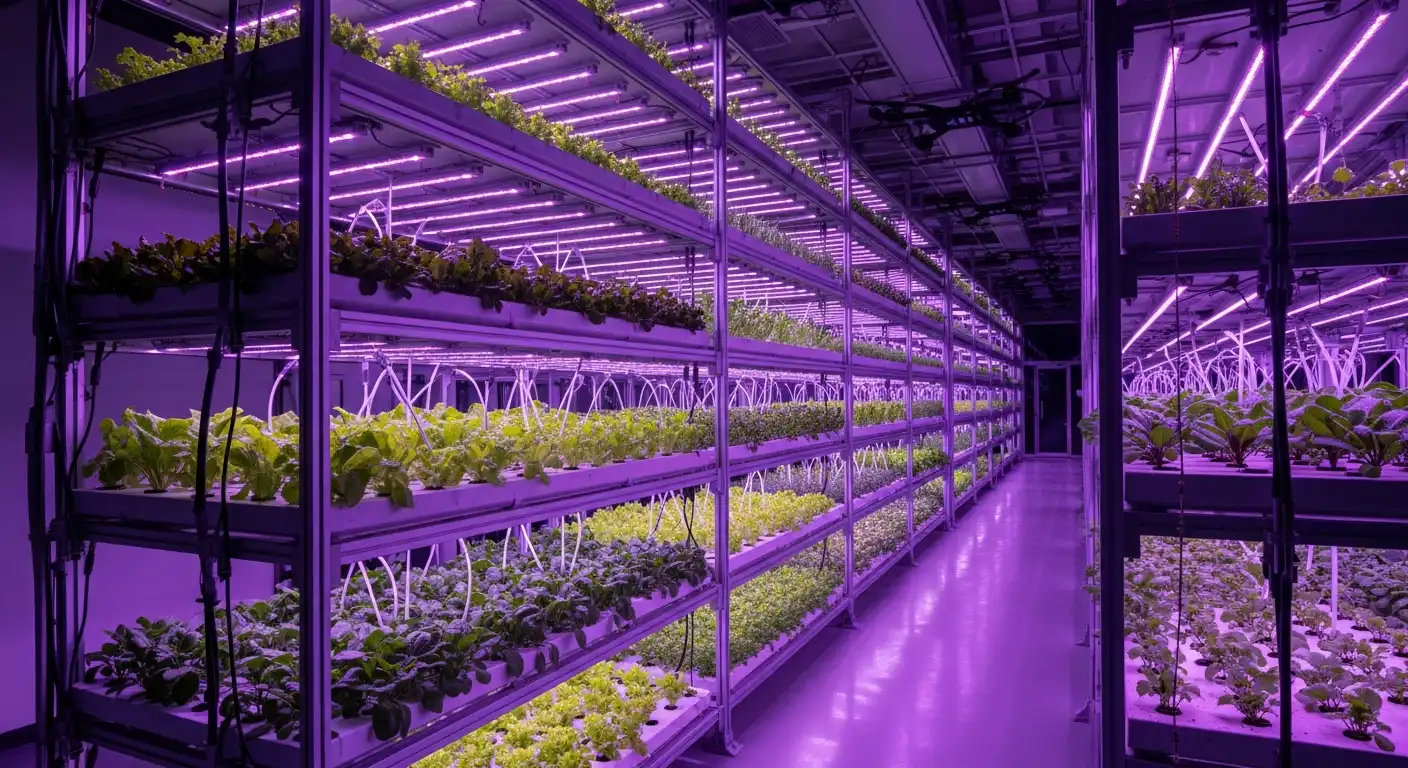
- Red and Blue Spectra: Chlorophyll absorbs light most efficiently in the red and blue parts of the spectrum. Red light drives photosynthesis and stem growth, while blue light regulates plant shape and leaf thickness. Early vertical farms often appeared purple because they used only these two colors to conserve energy.
- Full Spectrum and IR/UV: Modern research suggests that while plants can grow on red and blue alone, they thrive with a broader spectrum. Infrared (IR) radiation can induce flowering, whereas ultraviolet (UV) stress can induce plants to produce more antioxidants and flavor compounds as a defense mechanism.
Smart lighting systems now adjust dynamically. They can mimic sunrise and sunset to wake plants and gently put them to sleep, or they can run 18-hour “days” to accelerate the harvest cycle.
IoT and the Sensor Network
In a vertical farm, the farmer is often a data scientist. Thousands of Internet of Things (IoT) sensors are embedded throughout the growing trays and the facility. They monitor a vast array of data points:
- Ambient Conditions: Temperature, relative humidity, and CO2 levels.
- Root Zone Metrics: Water pH, electrical conductivity (nutrient density), and dissolved oxygen levels.
- Visual Data: High-resolution cameras capture time-lapse imagery of plant growth.
This constant stream of data allows for “Precision Agriculture.” If a specific section of the farm is running 0.5 degrees above the set temperature, the HVAC system adjusts immediately. If the pH in Zone B decreases, the nutrient doser automatically corrects it.
Artificial Intelligence and Machine Learning
Collecting data is useless without analysis. This is where Artificial Intelligence (AI) and Machine Learning (ML) become relevant. These algorithms analyze historical harvest data in conjunction with environmental variables to optimize yields.
For example, an AI might learn that basil grows 10% faster when the temperature is lowered by 2 degrees during the “night” cycle, or that increasing blue-light intensity for the final three days before harvest improves lettuce crunchiness. Over time, the system “learns” how to grow the perfect plant, creating a feedback loop of continuous improvement that no human farmer could replicate in a field.
Robotics and Automation
To make vertical farming economically competitive, labor costs must be minimized. Robotics handles the heavy lifting.
- Seeding and Transplanting: Automated arms place seeds into substrate plugs with sub-millimeter precision.
- Harvesting: Computer vision-guided blades harvest crops at the exact moment of peak ripeness.
- Logistics: Autonomous Mobile Robots (AMRs) transport plant trays from germination zones to growth zones and, ultimately, to processing areas, reducing the risk of human-introduced pathogens.
The Advantages of Vertical Agriculture
Why invest billions in high-tech buildings to grow salad? The benefits of vertical farming address some of the most critical issues facing the modern world.
Unmatched Water Efficiency
Traditional agriculture is a thirsty industry. Growing a head of lettuce in a field in California might require dozens of gallons of water, much of which is lost to evaporation or runoff. Vertical farms, which use recirculating hydroponic systems, consume up to 95% less water than traditional farming. The water is captured, filtered, and reused. In a world where water scarcity is becoming a geopolitical crisis, this efficiency is revolutionary.
Yield and Land Use
Vertical farming decouples food production from land availability. By stacking layers, a vertical farm can produce 10-20 times the yield per acre compared with an open field. Furthermore, because the environment is controlled, production is continuous. There is no “harvest season.” A vertical farm can operate year-round, potentially resulting in hundreds of harvest cycles annually. This allows growth to occur in dense urban environments, deserts, or tundra, thereby reclaiming natural land for reforestation and biodiversity.
Food Security and Localization
The COVID-19 pandemic exposed the fragility of global supply chains. Cities are “food deserts” that rely on trucking produce thousands of miles. Vertical farms can be built directly inside or near major metropolitan hubs. This “Hyper-Local” production model drastically reduces “food miles”—the distance food travels from farm to fork. This not only reduces transportation-related emissions but also ensures that consumers receive produce harvested hours rather than weeks ago, thereby preserving higher nutritional value.
Chemical-Free Produce
Because the environment is sealed, there are no pests. This eliminates the need for herbicides and pesticides. Consumers are increasingly wary of chemical residues on their food. Vertical farming offers a cleaner, safer product that doesn’t contribute to the agricultural runoff that pollutes rivers and oceans.
The Economic and Technical Challenges
Despite the promise, the vertical farming industry has faced volatility. Several high-profile startups have declared bankruptcy or downsized. It is vital to understand the remaining hurdles.
The Energy Equation
The Achilles’ heel of vertical farming is energy consumption. In nature, sunlight is free. In a vertical farm, every photon of light and every degree of climate control must be paid for. The HVAC systems required to dehumidify the air (plants transpire large amounts of water) and to cool the heat generated by LEDs are substantial energy consumers.
Critics argue that if a coal-fired power plant powers a vertical farm, the vertical farm is not environmentally sustainable. For vertical farming to be truly sustainable, it must be paired with renewable energy sources like wind, solar, or nuclear power.
High Capital Expenditure (CAPEX)
Building a vertical farm is expensive. It requires real estate, sophisticated HVAC systems, thousands of LED fixtures, and custom software. The initial investment is significantly higher than that required to purchase farmland and a tractor. This high barrier to entry forces companies to focus on high-margin crops to see a return on investment (ROI).
The “Salad Trap”: Crop Variety Limitations
Currently, the vast majority of vertical farms grow leafy greens, herbs, and microgreens. Why? They grow fast, have high water content, and the entire biomass is edible. Growing staple crops such as wheat, corn, rice, and soy indoors is currently biologically and economically impossible. These crops require too much energy and space relative to their market value. Until technology advances to make the cultivation of strawberries, tomatoes, and eventually root vegetables profitable, vertical farming remains a niche—albeit a large one—within the broader agricultural landscape.
The Future Landscape: Integration and Innovation
The future of vertical farming isn’t about replacing traditional agriculture; it’s about integration and technological evolution.
Genetics and Breeding for Indoors
For 10,000 years, humans have bred crops to survive outdoors—to resist drought, wind, and pests. We haven’t bred crops to thrive indoors. Geneticists are now developing seeds specifically for vertical farms. These plants don’t need to be drought-resistant or have tough skins. Instead, they can be bred for flavor, nutrition, and compact architecture. We might see “dwarf” varieties of cherry tomato plants or wheat that are optimized for stacked trays.
Integration with Smart Cities
Urban planners are looking at vertical farming as a utility, similar to electricity or waste management. Future skyscrapers could have “agri-floors” integrated into their design. Supermarkets might have mini-farms in the aisles (a trend already starting in Europe and the US). Waste heat from data centers could be piped into vertical farms to maintain temperatures, creating a symbiotic industrial ecosystem.
Distributed Farming Networks
The industry is moving away from massive “gigafactories” toward distributed networks. Instead of one massive warehouse serving three states, companies might deploy hundreds of shipping-container-sized farms located behind restaurants, schools, and hospitals. These modular units, controlled remotely by a central AI, reduce logistics costs to near zero.
Beyond Earth: The Final Frontier
Vertical farming technology is the precursor to extra-terrestrial colonization. If humans are to live on Mars or the Moon, we cannot rely on resupply missions from Earth. NASA and private space agencies are heavily investing in CEA technologies. Solving the energy and efficiency challenges of growing food in a harsh environment like Mars will yield innovations that make farming on Earth even more efficient.
The Role of Policy and Regulation
For vertical farming to scale, it requires a supportive regulatory framework. Currently, many agricultural subsidies are tied to land acreage, which disadvantages soilless farmers. Governments need to recognize CEA as a vital component of national food security. Incentives for renewable energy use, grants for urban retrofitting, and standardized organic certification for hydroponic produce (a topic currently under debate) will accelerate adoption.
Conclusion
Vertical farming represents one of the most exciting technological leaps in human history. It is a testament to our ability to innovate in the face of existential threats. While it is not a silver bullet that will solve world hunger overnight, it is a critical tool in the arsenal of sustainable development.
By decoupling food production from the variability of weather and the constraints of arable land, vertical farming offers a vision of a future in which fresh, nutritious food is grown locally, efficiently, and sustainably. As energy costs stabilize and technology matures, the “farms” of the future will rise into the skylines of our cities, glowing with the purple hum of LEDs, promising a greener harvest for a crowded planet. The seeds of this revolution have been planted; now, we watch them grow.