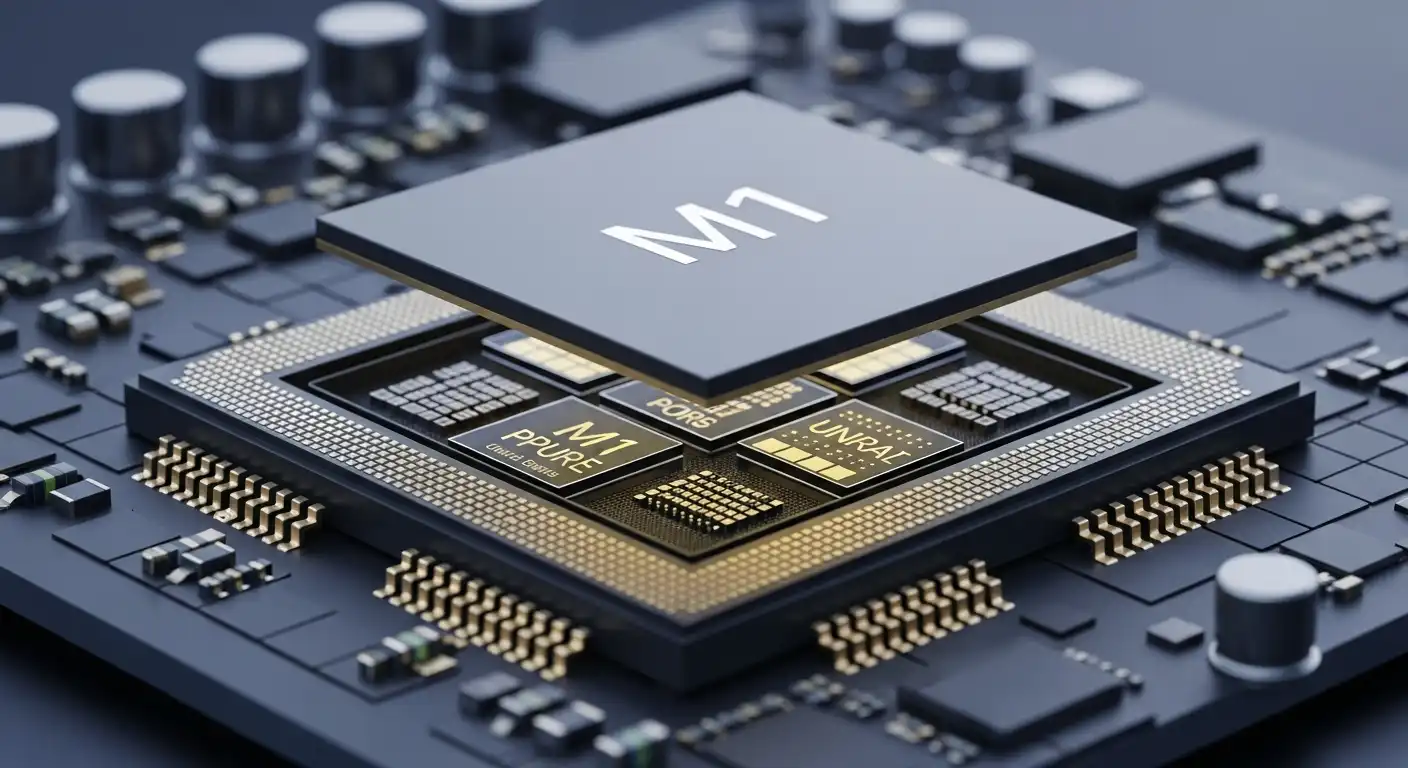
For decades, buying a laptop involved a painful compromise. You could have a powerful machine that handles heavy tasks, but it would be bulky, hot, and the battery would drain if you looked at it wrong. Alternatively, you could have a thin, lightweight machine with great battery life, but it would struggle to handle anything more demanding than sending an email: power or portability. Pick one. We accepted this as a fundamental law of computing. Then, in 2020, Apple introduced the M1 chip and showed us that the law was meant to be broken.
A Bold Breakup with Intel
For 15 years, Apple’s computers ran on Intel processors. It was a safe, predictable partnership. The decision to ditch a giant like Intel and design their own chips from scratch was one of the biggest gambles in modern tech history. It was a declaration that the incremental, year-over-year improvements we had gotten used to were no longer good enough. Apple wanted to take a giant leap, and the only way to do that was to control every single component, right down to the silicon.
The End of the Great Compromise
The true genius of the M-series chips isn’t just their speed. It’s that they are fast and incredibly efficient. This is the magic trick. Before the M1, performance and power consumption were a see-saw. If you wanted more speed, you had to draw more electricity, which generated more heat and drained your battery. The M-series chips threw out that rulebook. They delivered desktop-class performance while sipping power. It’s like having a car that has the acceleration of a Ferrari and the fuel economy of a Prius.
The ‘System on a Chip’ Secret Sauce
How did they do it? The secret is a design philosophy called “System on a Chip” (SoC). In a traditional computer, the processor (CPU), graphics card (GPU), and memory (RAM) are separate components that must communicate with each other. This creates bottlenecks and wastes energy. Apple put everything onto a single, unified piece of silicon. The CPU, GPU, and RAM are all neighbors in the same house, sharing information almost instantly. This tight integration is the key to their incredible performance and efficiency.
Power Without the Pain
This technical magic translates into a real-world experience that is nothing short of revolutionary. The best example is the fanless MacBook Air. For the first time, you could buy a thin, light, completely silent laptop that could edit multiple streams of 4K video without breaking a sweat. This was a task that used to bring high-end desktop computers to their knees. Now, a student could do it on their lap in a library. After hours of work, they would still have more than half their battery remaining. This wasn’t just an improvement; it was a redefinition of what a “base model” computer could do.
A Shockwave Through the Industry
The arrival of the M1 sent a shockwave through the entire PC industry. For the first time in years, Intel and Microsoft weren’t competing with incremental gains; they were competing with a revolutionary leap. It forced the entire industry to wake up and start taking efficiency seriously. The conversation is no longer just about raw clock speeds; it’s about performance per watt. Apple’s revolution didn’t just make MacBooks better; it lit a fire under the whole market, and consumers of all kinds will benefit from that for years to come.