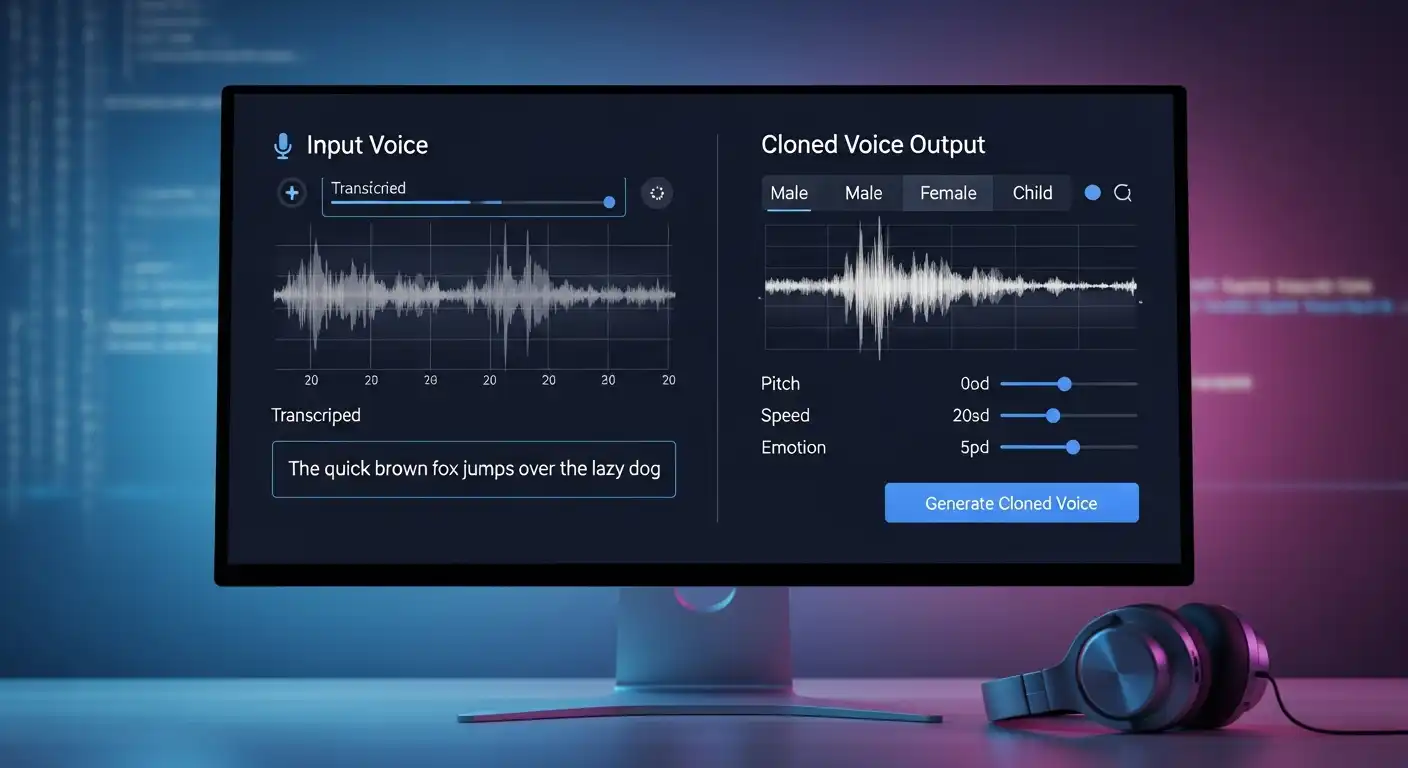
For the last two decades, our relationship with technology has been primarily tactile and visual, mediated through glowing screens, keyboards, and mice. We have learned to swipe, type, and tap our way through the digital world. But a profound and fundamental shift is underway. We are moving from a world we see to a world that listens. The primary interface for human-computer interaction is rapidly evolving from the fingertip to the spoken word, heralding the dawn of the voice-first era. This transformation will be reaching a critical stage of maturity, moving far beyond the simple commands we issue to our smart speakers today.
We are on the cusp of a new frontier: Audio Intelligence. This is the next generation of voice technology, a sophisticated fusion of artificial intelligence, machine learning, and advanced sensor technology that not only hears our words but also understands their context, intent, emotion, and the subtle nuances surrounding us. It’s the difference between a device that can “play a song” and one that can detect the sound of a baby crying in the background, recognize the stressed tone in a parent’s voice, and proactively suggest a soothing lullaby playlist. This comprehensive guide will explore this sonic revolution in its entirety, from the core technologies driving this change to the industry-altering applications, the profound ethical challenges, and the strategic roadmap for businesses looking to thrive in the audible future.
The Evolution of Voice: From Simple Commands to Deep Understanding
To appreciate the quantum leap that Audio Intelligence represents, we must first trace the journey of voice technology. Its evolution is a story of a slow, decades-long crawl followed by a sudden, explosive sprint, driven by exponential advancements in computing power and artificial intelligence. This history sets the stage for why the next few years will be so transformative.
A Brief History: From Dictation Machines to Digital Assistants
The dream of speaking to our machines is not a new one. It has been a staple of science fiction for nearly a century. Several key milestones have marked the journey from that dream to a functional reality, each building upon the last to create the foundation we stand on today.
The following points highlight the major phases in the development of voice recognition technology.
Each stage represented a significant improvement in accuracy and usability, but also revealed new limitations to overcome.
- The Early Days (1950s-1970s): The journey began in research labs like Bell Labs, where systems like “Audrey” were developed to recognize digits spoken by a single voice. These early systems were extremely limited, often recognizing only a handful of words from a specific, pre-registered speaker.
- The Rise of Dictation (1980s-1990s): The introduction of Hidden Markov Models (HMMs) marked a breakthrough, enabling the development of the first commercially viable speech-to-text dictation software. However, these systems were slow, required users to speak unnaturally (with.. distinct.. pauses.. between.. words), and demanded extensive user training.
- Integrated Voice Commands (2000s): Voice recognition began to appear in more consumer products, particularly in car navigation systems and early mobile phones for basic tasks like “Call Mom.” While more convenient, these systems were still rigid, command-and-control-based, and struggled with background noise and accents.
- The Dawn of the Digital Assistant (2010s): The launch of Apple’s Siri in 2011 marked a paradigm shift. Powered by the cloud and early machine learning, it introduced the concept of a “conversational” assistant to the masses. This was quickly followed by Google Assistant, Amazon Alexa, and Microsoft Cortana, which brought voice interaction into our homes via smart speakers, making it a central feature of the smartphone experience.
The Limitations of Yesteryear’s Voice Recognition
While the digital assistants of the 2010s represented a significant step forward, they still operated under considerable constraints. Our interactions were often frustrating, characterized by misunderstandings and the need to use precise, formulaic commands. These limitations are precisely what the new wave of technology is designed to solve.
The shortcomings of previous systems highlight the need for a more intelligent and context-aware approach.
These challenges have been the primary focus of AI research in the voice domain for the past decade.
- Lack of Contextual Awareness: Early assistants treated each command as an isolated event. They couldn’t remember the previous turn in a conversation, making follow-up questions impossible without restating the entire context.
- Poor Handling of Ambiguity: Human language is inherently ambiguous. Early systems struggled to differentiate between “play the song ‘Happy'” and “play a happy song,” lacking the Natural Language Understanding (NLU) to grasp the user’s true intent.
- Struggles with Natural Speech: They performed poorly in noisy environments, had difficulty understanding simultaneous speech from multiple speakers, and were notoriously inaccurate when dealing with strong accents, regional dialects, and complex or specialized terminology.
- Purely Reactive Nature: These systems were passive listeners. They only ever acted in response to a direct command or “wake word.” They could not understand the broader environment or act proactively in response to ambient cues.
Defining the Leap to Audio Intelligence
Audio Intelligence is the evolution from this reactive, command-based model to a proactive, context-aware one. It is a holistic approach that analyzes the entire audio stream, not just the spoken words, to derive a much deeper level of meaning and insight.
It represents the shift from speech-to-text to “audio-to-meaning.”
This is achieved by layering multiple streams of analysis onto basic transcription.
- Beyond Transcription: While accurate speech-to-text is the foundation, Audio Intelligence adds other layers. It seeks to answer not just what was said, but also:
- Who said it? (Voice Biometrics and Speaker Diarization)
- How did they say it? (Emotion and Sentiment Analysis)
- What was the intent? (Advanced Natural Language Understanding)
- What was happening in the background? (Sound Event Detection)
- Proactive and Ambient: The ultimate goal is to create systems that can understand the environment and the user’s state so well that they can offer assistance proactively, without waiting for a command. This is the core principle of “ambient computing,” where technology recedes into the background, providing seamless and intelligent support.
The Technological Pillars Powering the Sonic Boom
This leap to Audio Intelligence is not a single invention, but the result of the convergence of several powerful technologies that have reached a critical point of maturity and scalability. These technological pillars form the engine that is driving the sonic revolution forward.
Advanced AI and Deep Neural Networks
At the heart of modern voice recognition is a subfield of artificial intelligence known as deep learning, which utilizes complex, multi-layered “deep neural networks” modeled after the human brain. These models have become exponentially more powerful and accurate in recent years.
These sophisticated models are responsible for the dramatic improvements in accuracy that we now take for granted.
They have moved the industry from 95% accuracy (which is still frustratingly wrong 1 in 20 times) to over 99% accuracy in many conditions.
- Transformer Models: Architectures like the Transformer model (the “T” in GPT) have been revolutionary. They are exceptionally good at understanding relationships between words in a sequence, allowing them to grasp context and nuance in ways previous models could not.
- End-to-End Models: Instead of having separate acoustic and language models, newer end-to-end models are trained on raw audio and output text directly. This simplifies the process and enables the models to learn more complex patterns, thereby improving their performance in accents, jargon, and noisy environments.
Natural Language Processing (NLP) and Understanding (NLU)
If the neural network is the ear, then NLP and NLU are the brain. These AI disciplines focus on enabling computers to understand, interpret, and generate human language in ways that are both meaningful and useful.
NLU is the key that unlocks true conversational AI, moving beyond simple keyword matching to grasp genuine intent.
This technology allows for more fluid, natural, and forgiving interactions.
- Intent Recognition: NLU models are trained to identify the user’s goal, or “intent”, from their utterances. For example, it understands that “I’m freezing in here,” “Turn up the heat,” and “What’s the thermostat set to?” are all related to the intent of controlling the climate.
- Entity Extraction: The models can also identify and extract key pieces of information or “entities” from a sentence, such as names, dates, locations, or product names, which are essential for fulfilling a request.
- Conversational Memory: Advanced NLU enables “multi-turn” conversations. The system can now remember the context from previous interactions, allowing users to ask follow-up questions naturally, such as “Who directed it?” after requesting information about a movie.
The Role of Edge AI and On-Device Processing
For years, most advanced voice processing has occurred in the cloud, introducing latency and privacy concerns. The development of smaller, more efficient AI models and powerful, dedicated AI chips now enables a significant amount of processing to occur directly on the device.
This shift to “the edge” is critical for improving responsiveness, reliability, and user trust. A hybrid approach of edge and cloud processing will be the standard.
- Reduced Latency: Processing data locally eliminates the round-trip to the cloud, resulting in near-instantaneous responses, which is crucial for applications such as real-time translation or vehicle control.
- Enhanced Privacy and Security: Sensitive audio data, such as private conversations or biometric voiceprints, can be processed and analyzed on the device without ever being sent to a third-party server, greatly enhancing user privacy.
- Improved Reliability: On-device processing ensures that core voice functions continue to work even if the internet connection is slow or unavailable.
Massive Datasets and Transfer Learning
The performance of any AI model is heavily dependent on the quality and quantity of the data it is trained on. The explosion of voice-enabled devices has generated an unprecedented amount of audio data, which has been used to train increasingly accurate and robust models.
Techniques like transfer learning are accelerating this process and making the technology more accessible.
This allows models to be adapted for specialized tasks with much less data.
- The Data Flywheel: Companies with large user bases (like Amazon, Google, and Apple) benefit from a “data flywheel.” More users create more data, which is used to improve the models, which attracts more users, and so on.
- Transfer Learning: This powerful technique involves taking a massive, pre-trained “foundation model” (trained on a general corpora language corpus) and then fine-tuning it on a smaller, specific dataset. This allows a company to create a highly accurate custom model for medical terminology or legal jargon, for example, without needing to collect millions of hours of audio themselves.
Audio Intelligence in Action: Transforming Industries
The true impact of this technology is measured by its practical applications in the real world. Audio Intelligence will be seamlessly integrated into the core processes of virtually every major industry, driving efficiency, enhancing customer experiences, and creating entirely new business models.
Healthcare: The Voice-Enabled Clinical Future
The healthcare industry is ripe for a voice-driven transformation. Administrative tasks burden physicians, and Audio Intelligence offers a powerful solution to alleviate this, allowing them to focus more on patient care.
The goal is to create a more efficient and human-centered healthcare experience for both clinicians and patients.
This is achieved by automating documentation and providing intelligent clinical support.
- Ambient Clinical Scribing: This is the killer app for healthcare. Microphones in the exam room will capture the natural conversation between a doctor and patient. The AI will then automatically transcribe the conversation, identify and extract key medical information (symptoms, diagnoses, prescriptions), and populate the electronic health record (EHR) in real-time, all without the doctor having to touch a keyboard. This drastically reduces “pajama time” (the hours doctors spend on documentation after work) and reduces physician burnout.
- Voice-Based Diagnostics: Researchers are developing AI models that can detect early signs of diseases from subtle changes in a person’s voice. This technology will be used to help screen for conditions such as Parkinson’s disease, Alzheimer’s, depression, and certain cardiovascular issues by analyzing vocal biomarkers, including pitch, jitter, and shimmer.
- Patient Support and Monitoring: Voice assistants in hospital rooms and at home will help patients manage their medication schedules, answer common questions, and control their environment (lights, bed, TV) with their voices. For elderly patients at home, voice-based systems can monitor for signs of distress and provide a simple, hands-free way to call for help.
Automotive: The Truly Conversational Co-Pilot
The car is a perfect environment for voice interaction, as it allows the driver to keep their hands on the wheel and their eyes on the road. The automotive voice assistants will be a world away from the clunky systems of the past.
They will function as intelligent, proactive co-pilots that enhance safety, convenience, and the in-cabin experience.
The car will become a personalized, voice-controlled mobile environment.
- Natural Vehicle Control: Drivers will be able to control nearly every aspect of the vehicle using natural, conversational language. Instead of a rigid command like “Set temperature to 72 degrees,” a driver could say, “I’m feeling a bit cold,” and the car’s AI would understand the intent and adjust the climate accordingly, perhaps even activating the heated seats.
- Multi-Modal Integration: Voice will be deeply integrated with other in-car systems. A driver could say, “Find me a good Italian restaurant with parking near the office,” and the system would not only find options but also display them on the navigation screen, check for an available parking spot in real-time, and make a reservation, all through a seamless conversational flow.
- In-Car Commerce and Services: The voice assistant will serve as a portal for on-the-go commerce. Drivers will be able to securely pay for gas, order and pay for coffee, or add items to their grocery list, all with simple voice commands, authenticated by their unique voiceprint.
Retail and E-commerce: The Rise of Voice Commerce (“v-commerce”)
Voice is creating a new, frictionless channel for shopping, both online and in physical stores. As consumers become more comfortable interacting with voice assistants, v-commerce is poised for explosive growth.
The key is to create a shopping experience that is faster, more convenient, and more personalized than traditional web or app-based shopping.
Voice will become a primary channel for product discovery and reordering.
- Conversational Product Discovery: Instead of typing keywords into a search bar, shoppers will be able to describe what they are looking for in a conversational example, “I need a new pair of waterproof running shoes for trail running that have good arch support.” The AI assistant will ask clarifying questions to narrow down the options and provide personalized recommendations based on the user’s past purchases and preferences.
- Frictionless Reordering: Voice is perfectly suited for reordering common household items. A simple command, such as “Alexa, reorder my usual brand of coffee pods,” can complete a transaction in seconds, bypassing the need to open an app or website.
- In-Store Voice Assistants: In physical retail stores, voice-enabled kiosks or mobile apps will help shoppers quickly locate products, check prices, and get information about specific items, improving the in-store experience and freeing up human staff to handle more complex customer needs.
Financial Services: Secure and Seamless Voice Banking
Trust and security are paramount in the financial industry. Audio Intelligence, particularly through biometrics, offers a way to enhance security while also making banking more convenient and accessible.
Your voice will become a secure key to your financial life.
This will enable a new generation of personalized, conversational financial services.
- Voice Biometric Authentication: A person’s voice is as unique as their fingerprint. Most major banks are expected to utilize voice biometrics to authenticate customers over the phone and in mobile applications. This is more secure than knowledge-based questions (like your mother’s maiden name) and much faster, seamlessly verifying the user’s identity within the first few seconds of a natural conversation.
- Fraud Detection: AI can analyze the audio of a call to a bank’s contact center for subtle signs of fraud. It can detect vocal stress patterns indicating the user is under duress, identify the use of deepfake audio, and flag calls originating from unusual locations, helping prevent account takeovers.
- Conversational Financial Management: Users will be able to manage their finances through conversation. They will be able to ask their banking app questions, such as, “How much did I spend on groceries last month?” or “Can I afford to buy a new car?” The AI will provide intelligent insights and personalized advice based on their spending habits and financial goals.
Customer Service and the Contact Center
The contact center is the epicenter of the Audio Intelligence revolution. AI is transforming this industry from a cost center focused on efficiency to a value center that enhances the customer experience.
The goal is to resolve customer issues faster and more effectively while also improving the agent’s job.
AI will handle routine tasks, empowering agents to focus on complex, empathetic interactions.
- Real-Time Agent Assist: While an agent is on a call with a customer, an AI “co-pilot” will listen in in real-time. It will automatically transcribe the call, identify the customer’s intent, and display relevant information (such as account details or knowledge base articles) on the agent’s screen, so they have everything they need at their fingertips without putting the customer on hold.
- Sentiment Analysis and Escalation: The AI can analyze the tone and sentiment of the customer’s voice to identify potential issues. Suppose it detects that a customer is becoming angry or frustrated. In that case, it can proactively suggest solutions to the agent or even recommend escalating the call to a supervisor, helping to de-escalate difficult situations and improve customer satisfaction.
- Automated Post-Call Summarization: After a call ends, the AI generates a concise summary of the conversation, identifies any required follow-up actions, and logs them in the CRM system. This saves agents several minutes per call, allowing them to move to the next customer more quickly.
Beyond Words: The Nuances of Audio Intelligence
The true power of Audio Intelligence lies in its ability to extract meaning from the non-verbal aspects of sound. This is where the technology moves from simple recognition to a form of digital perception that more closely mirrors human understanding.
Emotion AI: Understanding Sentiment and Tone
Emotion AI, also known as affective computing, is the science of teaching machines to recognize, interpret, and simulate human emotions. In the context of audio, this involves analyzing vocal patterns to determine the speaker’s emotional state.
This technology adds a layer of empathy to human-computer interaction.
It allows systems to respond not just to what you say, but to how you feel.
- How it Works: The AI analyzes various “paralinguistic” cues in your voice, including:
- Pitch and Intonation: The rise and fall of your voice.
- Pace and Rhythm: How quickly or slowly you speak.
- Volume and Loudness: The energy in your voice.
- Jitter and Shimmer: Micro-variations in frequency and amplitude that can indicate stress or excitement.
- Applications: In customer service, it can identify frustrated customers. In mental health applications, it could help monitor for signs of depression or anxiety. In-car assistants could detect a drowsy or angry driver and suggest taking a break.
Voice Biometrics: Your Voice as the Ultimate Password
Voice biometrics is a technology that identifies a person based on the unique characteristics of their voice. It’s a powerful form of authentication because it relies on something you are (your unique vocal tract) and something you know (a passphrase), effectively providing factor authentication in a single step.
This provides a secure and frictionless way to verify identity.
It eliminates the need to remember complex passwords or answer security questions.
- Physiological and Behavioral Traits: Voiceprints are created by analyzing more than 100 physiological and behavioral characteristics. Physical traits are determined by the unique size and shape of a person’s vocal tract, while behavioral traits include their unique accent, pace, and pronunciation.
- Liveness Detection: To prevent spoofing attacks using recordings, modern systems employ “liveness detection.” They can ask the user to repeat a random phrase or analyze subtle vocal artifacts to ensure the speaker is a live human being and not a recording or a deepfake.
Sound Event Detection: Understanding the Environment
This fascinating subfield of Audio Intelligence focuses on teaching AI to recognize and classify non-speech sounds in the environment. This provides technology with a broader understanding of the context in which a conversation is taking place.
It allows a device to understand what is happening around the user, not just what the user is saying.
This is a key component of creating truly proactive and helpful ambient computing experiences.
- Examples of Detectable Events: AI models can be trained to recognize a wide range of sounds, such as a smoke alarm beeping, a window breaking, a dog barking, a baby crying, a person coughing, or water running.
- Practical Applications: A smart home security system could send an alert when a door al window breaks when you’re not home. A home assistant could ask if everything is okay if it hears a loud fall, followed by silence. A smart speaker could automatically pause the music and turn on the lights if it detects the sound of a smoke alarm.
Navigating the Labyrinth: Ethics, Privacy, and Security Challenges
The power of Audio Intelligence comes with immense responsibility. As we deploy devices that are perpetually listening and capable of analyzing our most intimate conversations and emotional states, we must confront a host of complex ethical, privacy, and security challenges head-on.
The Privacy Paradox: The “Always-On” Dilemma
The very nature of ambient computing requires devices to be “always-on” and listening for a wake word or other acoustic cues. This creates a fundamental tension with the user’s right to privacy.
Building and maintaining user trust is the single most important factor for the long-term success of this technology.
Users need clear, transparent controls over their data and how it is used.
- Data Minimization and On-Device Processing: A key strategy is to minimize the amount of data that leaves the device. As discussed, processing as much data as possible on the edge reduces the risk of data interception or misuse.
- Clear and Transparent Policies: Companies must be crystal clear about what data they collect, why they collect it, how long they store it, and who has access to it. Users should have easy access to their voice data and the ability to delete it at any time.
Algorithmic Bias: Ensuring Fairness and Inclusivity
AI models are only as good as the data on which they are trained. If the training data is not diverse and representative of the global population, the resulting models will be biased and perform poorly for certain groups of people.
An unbiased voice AI is an inclusive voice AI.
Failing to address bias will exclude large segments of the population from the benefits of this technology.
- Sources of Bias: Early voice recognition systems were notoriously less accurate for female voices and for individuals with non-mainstream accents or dialects because they were primarily trained on data from a limited demographic (often, North American male voices).
- Mitigation Strategies: Combating bias requires a concerted effort to collect more diverse training data from people of all ages, genders, ethnicities, and linguistic backgrounds. It also involves rigorous testing and auditing of models to identify and correct performance disparities across different demographic groups.
The Threat of Deepfake Audio and Voice Cloning
The same AI technology that powers helpful voice assistants can also be used for malicious purposes. The rise of “deepfake” audio, in which a person’s voice is used to create highly realistic, synthetic clones, poses a serious security threat.
This technology could be used to authorize fraudulent transactions, spread misinformation, or impersonate individuals for social engineering attacks.
Developing robust defenses against this threat is a critical area of research.
- The Risk: A criminal could use a few seconds of a CEO’s voice from a public speech to create a deepfake that calls the finance department and authorizes a fraudulent wire transfer. The potential for social and political manipulation through the creation of fake audio clips of public figures is also immense.
- The Defense: The security industry is developing AI-powered detection systems that can analyze the subtle artifacts and inconsistencies in audio to determine if it is synthetic. This is an ongoing cat-and-mouse game, with both the generation and detection technologies constantly evolving.
Conclusion
As we look, it is clear that voice recognition and Audio Intelligence are not just incremental improvements; they represent a fundamental re-imagining of our relationship with technology. We are moving away from the cold, hard logic of digital commands and toward a more fluid, natural, and human-centric form of interaction. The friction between human intent and digital action is dissolving, replaced by the effortless power of conversation.
This sonic revolution will reshape industries, redefine user experiences, and create opportunities we can only just begin to imagine. But it also demands a new level of responsibility. The companies and developers who succeed will be those who not only master the technology but also earn users’ trust by championing privacy, ensuring fairness, and building safeguards against misuse. The future is not just about creating technology that can hear us; it’s about creating technology that listens, understands, and ultimately works in harmony with us to create a smarter, more accessible, and more connected world. The age of the screen is not over, but the age of the voice has truly begun.