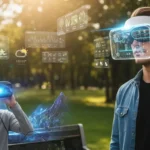
For the past three decades, the internet has been a largely two-dimensional experience, a world of flat screens, web pages, and scrollable feeds. We are now standing at the very beginning of a profound, generational shift towards a new computing paradigm—a persistent, shared, 3D virtual space where we will no longer just be looking at the internet, but will be inside of it. This is the promise of the metaverse technologies. It is a concept that has been catapulted from the pages of science fiction into the boardrooms of the world’s largest companies, sparking a tidal wave of investment, innovation, and intense debate.
While the full, photorealistic, and interoperable metaverse of our collective imagination is still years, if not decades, away, the foundational technologies that will build it are here today, and they are already creating a universe of tangible and lucrative new market opportunities. The metaverse is not a single product or a single virtual world; it is a convergence of powerful technologies—including virtual and augmented reality (VR/AR), artificial intelligence (AI), blockchain, and real-time 3D engines. This technological convergence is not just about creating new games or social spaces; it is a catalyst for a fundamental reshaping of commerce, work, entertainment, and human interaction itself. For businesses, creators, and entrepreneurs, this is not a distant, futuristic trend to be watched from the sidelines. It is the next digital frontier, and the pioneers who are staking their claim today are poised to lead the multi-trillion-dollar economy of tomorrow.
Deconstructing the Dream: The Core Technologies Powering the Metaverse
Before we can explore market opportunities, we must first deconstruct the complex technological stack that makes the metaverse possible. The metaverse is not a singular invention but a symphony of interconnected technologies, each playing a critical role in building this new, immersive version of the internet.
Understanding these foundational pillars is key to identifying where the real value and business opportunities lie.
The Immersive Gateways: Virtual Reality (VR) and Augmented Reality (AR)
These are the technologies that will provide our primary interface to the metaverse, the “windows” or “doorways” through which we will step into these new digital worlds. They are often grouped under the umbrella of Extended Reality (XR).
VR and AR are two sides of the same immersive coin, one focused on total immersion and the other on blending the digital and physical.
- Virtual Reality (VR): VR uses a headset (such as the Meta Quest 3 or the Apple Vision Pro) to replace a user’s view of the physical world with a computer-generated 3D virtual environment. It provides a feeling of “presence,” of truly being in another place. This is the technology for fully immersive experiences, from gaming and social platforms to virtual training simulations.
- Augmented Reality (AR): AR, on the other hand, does not replace the real world; it overlays digital information and virtual objects onto it. This can be experienced through a smartphone’s camera (like in Pokémon GO) or, more powerfully, through a pair of transparent smart glasses. AR is about enhancing our reality, not escaping it. It is the technology for providing contextual, real-time information, from seeing navigation arrows on the street in front of you to viewing a virtual piece of furniture in your living room before you buy it.
The World-Building Engines: Real-Time 3D and Game Engines
The rich, dynamic, and interactive 3D worlds of the metaverse need to be built and rendered in real-time. The foundational software for this task has come from the video game industry.
Real-time 3D engines are the “digital physics” and rendering platforms that create the immersive environments we will inhabit.
- Key Players (Unreal Engine and Unity): Epic Games’ Unreal Engine and Unity are the two dominant game engines that have become the de facto world-building platforms for the metaverse. They provide a comprehensive suite of tools for creating photorealistic graphics, simulating physics, handling animations, and managing real-time interactions for millions of users. Their expertise in creating high-fidelity, interactive entertainment is now being applied to a huge range of enterprise and industrial applications.
The Economic and Ownership Layer: Blockchain, NFTs, and Cryptocurrencies
A true metaverse, as envisioned by its proponents, will not be a collection of closed, proprietary worlds controlled by a single company. It will be an open, interoperable, and user-owned economy. The key enabling technology for this vision is blockchain.
Blockchain provides the decentralized, trustless infrastructure for digital ownership, identity, and commerce in the metaverse.
- Non-Fungible Tokens (NFTs): An NFT is a unique, non-interchangeable unit of data stored on a blockchain. In the context of the metaverse, NFTs are the digital deeds of ownership. They can represent a unique virtual item (like a piece of digital art, a rare in-game item, or a designer avatar skin), a piece of virtual real estate, or even a ticket to a virtual event. Because the ownership is recorded on a public, decentralized ledger, it is verifiable and cannot be controlled or taken away by a single platform owner.
- Cryptocurrencies: Cryptocurrencies (such as Ethereum or platform-specific tokens) will likely serve as the native currency of the metaverse, enabling seamless, peer-to-peer transactions without traditional financial intermediaries.
- Decentralized Identity: Blockchain-based identity systems will allow users to have a single, self-sovereign digital identity (their avatar, reputation, and assets) that they can carry with them as they move between virtual worlds, breaking down the “walled gardens” of the current internet.
The Intelligence Layer: Artificial Intelligence (AI)
Artificial intelligence will be the pervasive, animating force that brings the metaverse to life, making its worlds more intelligent, responsive, and personalized.
AI will play a multitude of critical roles, from world creation to user interaction.
- World Creation and Asset Generation: Building vast and detailed 3D worlds is an incredibly labor-intensive process. Generative AI is already being used to dramatically accelerate this process. AI can be used to generate vast landscapes procedurally, create textures and 3D models from simple text prompts, and even write the code for simple interactive objects.
- Non-Player Characters (NPCs) and Virtual Beings: The metaverse will be populated by a host of AI-powered virtual beings, from helpful customer service avatars and intelligent guides to complex, believable characters inhabiting immersive stories and games. Large language models (LLMs) will allow users to have natural, unscripted conversations with these NPCs.
- Personalization and Spatial Understanding: AI will personalize a user’s experience in the metaverse, much like it personalizes our social media feeds today. On the AR side, the AI that powers computer vision and spatial mapping enables a device to understand the physical world around it and place digital objects realistically within that space.
The Connectivity and Infrastructure Layer: 5G and Edge Computing
For the metaverse to function at scale, it will require network infrastructure with unprecedented bandwidth and ultra-low latency. The persistent, real-time rendering of a shared virtual world for millions of users is an immense computational and networking challenge.
5G and edge computing are the key infrastructure upgrades that will make the metaverse accessible and responsive.
- 5G for High-Bandwidth, Low-Latency Mobile Access: 5G’s massive bandwidth will be essential for streaming the high-fidelity data of the metaverse to mobile XR devices. More importantly, its ultra-low latency is critical for ensuring that the virtual world responds instantly to a user’s actions, which is essential for a comfortable and immersive experience.
- Edge Computing for Real-Time Processing: Sending all the data from millions of users in a virtual world back to a centralized cloud for processing and then back to the users creates too much latency. Edge computing moves processing closer to users, to small data centers at the “edge” of the network (such as at the base of a 5G cell tower). This is what will enable the real-time, low-latency interactions required for a shared, persistent metaverse.
The New Gold Rush: Mapping the Market Opportunities of the Metaverse Technologies
The convergence of these technologies is not just creating a new place; it is creating an entirely new economy. Analysts from major financial institutions such as Goldman Sachs, Morgan Stanley, and Citi have projected that the metaverse economy could be worth between $8 trillion and $13 trillion by 2030. This is not a niche market; it is the next great economic frontier.
The opportunities span a vast and diverse landscape, from building the core infrastructure to creating the experiences and services that will define this new world.
The Virtual Goods and Direct-to-Avatar (D2A) Economy
One of the most immediate and tangible market opportunities is in the creation and sale of virtual goods for our digital identities, or avatars. In the metaverse, our avatar is our personal expression of self, and just as we spend money on clothes and accessories in the real world, we will spend money to customize our digital selves.
This has given rise to a new “Direct-to-Avatar” (D2A) economy.
- Digital Fashion and “Skins”: This is already a multi-billion dollar market in the gaming world, where players spend real money on “skins” to customize their in-game characters. Luxury fashion brands like Gucci, Balenciaga, and Louis Vuitton have already made major forays into this space, creating and selling virtual-only clothing and accessories for avatars on platforms like Roblox and Fortnite. For these brands, it is a new, high-margin revenue stream and a powerful way to build brand loyalty with a younger, digitally native audience.
- The NFT Marketplace for Unique Virtual Assets: NFTs are turbocharging this market by introducing true, verifiable ownership and scarcity. A user can buy a limited-edition virtual sneaker as an NFT, and because its ownership is recorded on the blockchain, they can be sure of its authenticity and rarity. They can then “wear” it in a virtual world, display it in a virtual gallery, or even resell it on a secondary marketplace, creating a true, liquid market for digital assets. Platforms like OpenSea and Rarible have become the “eBay of NFTs.”
The Rise of Immersive Commerce (“vCommerce”)
The metaverse will fundamentally change how we shop. E-commerce today is a flat, transactional experience of scrolling through 2D images and clicking “add to cart.” Immersive commerce, or “vCommerce,” will transform this into a social, experiential, and highly personalized journey.
Retailers are experimenting with a new generation of virtual and augmented shopping experiences.
- Virtual Showrooms and Stores: Brands can create persistent, photorealistic virtual stores where customers can browse 3D models of their products, interact with AI-powered sales assistants, and even socialize with other shoppers. A car company like BMW or Audi could create a virtual showroom where a customer can explore a new car in full 3D, customize every feature, and even take it for a virtual test drive, all from the comfort of their home.
- AR-Powered “Try Before You Buy”: Augmented reality is already a powerful tool for vCommerce. Furniture retailers like IKEA have AR apps that let you place a true-to-scale virtual sofa model in your living room to see how it fits. Beauty brands like Sephora use AR to let you virtually “try on” different lipstick shades. This use of AR dramatically increases consumer confidence and reduces product returns.
- Live Shopping and Social Commerce: The metaverse will blend entertainment and commerce. A brand could host a live virtual fashion show where attendees can instantly buy the outfits they see on the virtual runway. A popular influencer could host a live shopping event in a virtual world, demonstrating products to their followers in a shared, social space.
The Reinvention of Work, Training, and Collaboration
The future of work is hybrid and distributed, and the metaverse will provide the tools for a new level of “co-presence” and collaboration that is impossible with today’s 2D video conferencing.
The “enterprise metaverse” is focused on using immersive technologies to improve productivity, training, and collaboration.
- Immersive Corporate Training and Simulation: This is one of the most mature and high-ROI use cases for VR today. Companies are using VR to create highly realistic and safe training simulations for complex, high-stakes tasks. Surgeons can practice a complex procedure in a virtual operating room. Airline pilots can train for emergency scenarios in a VR flight simulator. Factory workers can learn how to operate heavy machinery in a safe, virtual environment. Companies like Walmart have used VR to train millions of employees on everything from customer service to new technology.
- Collaborative Design and Engineering (The “Industrial Metaverse”): The industrial metaverse focuses on creating persistent, real-time 3D digital twins of factories, products, and infrastructure. A globally distributed team of engineers, wearing VR or AR headsets, could “meet” inside a full-scale digital twin of a new car engine or a new building. They could walk around it, deconstruct it, run simulations, and make design changes collaboratively in a shared, immersive space. Companies like NVIDIA (with its Omniverse platform) and Siemens are leaders in this space.
- Virtual Meetings and Collaborative Workspaces: While the idea of spending 8 hours a day in a VR headset is still a long way off for most, platforms like Meta’s Horizon Workrooms and Microsoft Mesh are pioneering the use of VR for more engaging and collaborative remote meetings, workshops, and brainstorming sessions, aiming to restore the sense of shared presence and non-verbal cues that are lost on a Zoom call.
The Next Generation of Entertainment, Events, and Social Experiences
The metaverse will create entirely new formats for entertainment and social interaction that are more immersive, interactive, and participatory than anything that has come before.
This is about moving from being a passive audience to being an active participant in the experience.
- Immersive Gaming: Gaming is the “Trojan horse” for the metaverse; the hat is pioneering the core technologies and user behaviors. Metaverse-native games focus on linear narratives and on persistent, user-driven worlds where players can create their own experiences, build their own economies, and socialize. Platforms like Roblox and Fortnite are early examples, evolving from simple games into vast social platforms.
- Virtual Concerts and Live Events: The music industry is embracing the metaverse as a new venue. Artists like Travis Scott and Ariana Grande have held massive, visually spectacular virtual concerts inside Fortnite, attracting tens of millions of attendees. The metaverse enables experiences that are impossible in the real world, offering artists a new way to connect with a global fanbase and generate revenue from virtual merchandise.
- Immersive Storytelling and “Virtual Beings”: The future of film and entertainment will be interactive. Instead of just watching a story, you will be able to step inside of it and become a character. This will also see the rise of “virtual beings” or “virtual influencers”—AI-powered digital characters with their own personalities and social media followings, who will star in their own content and even endorse products.
The Virtual Real Estate and Land Development Market
In persistent virtual worlds, just as in the physical world, location matters. This has given rise to a speculative but fascinating market for virtual real estate.
Users and companies are buying up digital “land” on popular metaverse platforms, expecting it to become valuable in the future.
- The Land Rush in Decentraland and The Sandbox: Platforms like Decentraland and The Sandbox, which are built on the Ethereum blockchain, have sold millions of dollars’ worth of virtual land parcels as NFTs. Owners of this land can build whatever they want on it—a virtual art gallery, a store, a casino, or a venue for events—and can then monetize their creations.
- Virtual HQs and Brand Experiences: Major brands and companies, from Samsung to JPMorgan Chase, have purchased virtual land and built virtual headquarters or brand “experiences” in these worlds. For them, it is a way to experiment with the new medium, engage with the early adopter community, and signal that they are a forward-thinking, innovative brand.
The Pioneers and Players: Navigating the Emerging Metaverse Ecosystem
The race to build the metaverse is a new great game, involving a complex and shifting ecosystem of players, from established tech giants to nimble startups and decentralized communities.
Understanding the key players and their strategies is crucial for navigating this new landscape.
The Incumbent Tech Giants (The “Walled Garden” Builders)
The world’s largest technology companies are investing tens of billions of dollars to build their own metaverse platforms, each hoping to become the dominant “walled garden” of this new era.
- Meta (Facebook): Meta has made the most aggressive and high-profile bet on the metaverse, rebranding the company and investing billions of dollars annually through its Reality Labs division. Its strategy is to build an end-to-end ecosystem by controlling the hardware (Quest VR headsets), the core social platform (Horizon Worlds), and the operating system.
- Apple: Apple’s long-awaited entry into the market with its ultra-premium “spatial computing” device, the Vision Pro, represents a different approach. Apple is not focused on cartoonish virtual worlds but on seamlessly blending digital content with the real world through a high-fidelity augmented reality experience that emphasizes productivity and entertainment.
- Microsoft: Focused squarely on the enterprise metaverse. Its strategy is built around its HoloLens AR headset, its Microsoft Mesh platform for collaborative immersive experiences, and its deep integration with its existing suite of enterprise software, like Teams and Dynamics 365.
- NVIDIA: NVIDIA is positioning itself as the “plumber” of the metaverse, providing the core hardware (its powerful GPUs) and the core software platform (Omniverse, for building industrial digital twins) that will power others’ creations.
The Gaming and 3D Engine Leaders (The “World Builders”)
The companies that have spent decades building the tools for interactive 3D entertainment are now at the center of the metaverse creation story.
- Epic Games (Fortnite, Unreal Engine): Epic’s CEO, Tim Sweeney, is one of the most vocal proponents of an open, interoperable metaverse. While Fortnite is a massive, self-contained social world, Epic is also the creator of the Unreal Engine, one of the key world-building tools for the entire industry.
- Unity: Unity is the other dominant 3D engine, with a particularly strong position in mobile gaming and the enterprise XR market.
The Web3 and Decentralized Players (The “Open Metaverse” Champions)
A powerful counter-movement is pushing for a vision of the metaverse that is not controlled by a few tech giants, but is built on the open, decentralized, and user-owned principles of Web3.
- Decentraland and The Sandbox: As mentioned, they are the leading examples of blockchain-based virtual worlds. Users own the land and assets as NFTs, and the platform’s governance is managed by a Decentralized Autonomous Organization (DAO).
- The Crypto and NFT Ecosystem: The entire ecosystem of crypto wallets (like MetaMask), NFT marketplaces (like OpenSea), and blockchain infrastructure providers is an essential building block of the open metaverse economy.
The Road Ahead: Navigating the Hurdles on the Path to the Metaverse
For all the hype and excitement, it is critical to maintain a realistic perspective. The full, seamless, and interoperable metaverse is a thing of the future-thing. There are immense technical, social, and ethical hurdles that must be overcome on the long road ahead.
The pioneers in this space must be prepared to navigate a landscape filled with both opportunity and significant challenges.
The Technical and Hardware Challenges
The hardware required for a truly compelling and comfortable immersive experience is still in its early stages. Current VR headsets can be bulky, have limited battery life, and can cause motion sickness for some users. The dream of a pair of lightweight, all-day wearable AR glasses that look just like normal eyeglasses is still many years away.
The Interoperability Dilemma: Walled Gardens vs. an Open World
This is one of the biggest and most important battles for the future of the metaverse. Will the metaverse be a collection of disconnected, proprietary “walled gardens” (like the current social media landscape), where you cannot take your identity or assets from Meta’s world to Apple’s? Or will it be a truly open and interoperable network, like the early internet, where a common set of standards allows users and their assets to move freely between different worlds? This is a battle between the tech giants that want to control their ecosystems and the Web3 proponents who are pushing for an open standard.
The Content Creation Bottleneck
Building high-quality, engaging, and persistent 3D content is still incredibly difficult, time-consuming, and expensive. While generative AI will help, there is a massive need for a new generation of 3D artists, designers, and “world builders.” Creating compelling content that will make people want to spend significant time in the metaverse is a major challenge.
The Unanswered Questions of Governance, Safety, and Ethics
The metaverse will bring with it a host of complex new social and ethical challenges that we are only just beginning to grapple with.
- Moderation and Safety: How do we moderate behavior and prevent harassment, hate speech, and abuse in a 3D, immersive environment?
- Data Privacy: Immersive technologies, especially those with eye-tracking, will be able to collect an unprecedented amount of intimate biometric data about users. How do we protect this data and ensure it is used ethically?
- The “Metaverse Divide”: Who will have access to this new digital frontier? There is a major risk that the high cost of hardware and high-speed internet will create a new and more profound “digital divide,” leaving a significant portion of the global population behind.
- Jurisdiction and Law: If a crime is committed between the avatars of two people from different countries in a virtual world that is hosted on a server in a third country, whose laws apply?
Conclusion
The metaverse is not a fad. It is the logical and evolutionary next step in the half-century-long journey of human-computer interaction. It represents the gradual and inevitable dissolution of the boundary between our physical and digital lives. While the full, cinematic vision may still be the stuff of science fiction, the foundational technologies are real, the early worlds are being built, and the first waves of market opportunity are already here.
For businesses, the metaverse is a blank canvas. It is a new continent of opportunity waiting to be explored, a chance to reinvent how we connect with customers, collaborate as colleagues, and experience the world. The journey will be a long one, filled with hype cycles, technological hurdles, and profound societal questions. But the direction of travel is undeniable. The companies, creators, and entrepreneurs who learn the language, experiment with the tools, and build for this new, immersive frontier today will be the ones who own the commanding heights of the next-generation internet. The next digital world is being built, one polygon, one line of code, and one new idea at a time. The time to stake a claim is now.