Throughout the digital age, our interaction with the vast, powerful world of computation has been a story of clumsy translation. We have been forced to communicate our complex thoughts and intentions through a series of crude intermediaries. We learned to type on a keyboard, to click with a mouse, to tap and swipe on a touchscreen, and, most recently, to speak to a disembodied voice in a smart speaker. Each of these Human-Computer Interfaces (HCIs) was a revolutionary step in its time, progressively making our interaction with technology more intuitive and accessible. But they are all, at their core, just proxies. They are translators for the one, true, high-bandwidth interface that has remained tantalizingly out of reach: the human brain itself.
We are now standing at the very beginning of the next —and perhaps final —HCI revolution. This is the era of neural technologies and the rise of the Brain-Computer Interface (BCI). This is not the stuff of science fiction; it is a rapidly accelerating field of scientific and engineering endeavor in which breakthroughs in neuroscience, materials science, and artificial intelligence are converging to create a direct communication pathway between the human brain and the digital world. While the initial focus of this technology has been on restoring function to those with paralysis or neurological disorders, the long-term vision is far broader. It is about creating an interface so seamless, so intuitive, and so high-bandwidth that it could fundamentally dissolve the boundary between human thought and digital computation. This is a journey that will not only redefine our relationship with technology but could also reshape the very definition of what it means to be human.
A Brief History of Translation: The Long Road to the Brain-Computer Interface
To understand the profound leap that neural interfaces represent, it is essential to trace the evolutionary path of HCI. This journey has been a constant quest to reduce friction and increase bandwidth between the human user and the machine.
Each generation of HCI has brought us closer to a more natural and intuitive form of interaction, paving the way for the ultimate interface.
The Era of Explicit Commands: The Keyboard and the Command Line
The first generation of computing was a world of experts. Interaction was done through punched cards or a command-line interface, where the user had to learn a rigid, unforgiving syntax of text-based commands to get the computer to do anything. The keyboard was the primary input device, and the interaction was a slow, deliberate, and highly structured conversation.
The Graphical User Interface (GUI): The Revolution of Metaphor
The HCI revolution began in earnest at Xerox PARC and was famously commercialized by Apple with the Macintosh. The GUI, with its visual metaphors of a desktop, folders, files, and a trash can, combined with the invention of the mouse for direct manipulation, was a game-changer. It transformed the computer from a tool for specialists into a tool for everyone. For the first time, users could interact with the machine in a more intuitive, visual, and exploratory way.
The Age of Touch and Mobility: The Interface Becomes the Device
The launch of the iPhone in 2007 ushered in the next paradigm shift. The multi-touch screen, with its intuitive gestures—tapping, swiping, and pinching —dissolved the boundary between the user and the interface. The interface was no longer a separate device like a mouse; it was the computer’s own surface. This, combined with the power of mobility, made computing a constant, ambient part of our lives.
The Conversational Interface: The Rise of Voice and AI
The most recent shift has been towards a more natural and hands-free form of interaction: voice. Powered by massive advances in AI and natural language processing, voice assistants like Amazon’s Alexa, Google Assistant, and Apple’s Siri have brought conversational AI into our homes and pockets. We can now simply speak our intent, and the machine understands. This represents another major step in reducing interaction friction, moving from structured commands to natural language.
The Unspoken Limitation: The Output Bottleneck
Each of these steps has been revolutionary, but they all share a common, fundamental limitation. They are all, ultimately, dependent on the human peripheral nervous system. Whether we are typing, clicking, or speaking, we are translating the high-speed, parallel processing of our brain into the slow, serial, and low-bandwidth actions of our muscles. The human brain can think at a rate of terabits per second, but the fastest typist can only output a few hundred bits per second. This is the great “output bottleneck,” the final barrier that neural interfaces are designed to shatter.
Deconstructing the Brain-Computer Interface: The Technologies of Thought
A Brain-Computer Interface (BCI), also known as a Brain-Machine Interface (BMI), is a system that acquires, analyzes, and translates brain signals into commands to control an external device, without relying on the normal output pathways of peripheral nerves and muscles.
BCIs are a complex convergence of neuroscience, hardware engineering, and sophisticated machine learning. The technology can be broadly categorized based on how it “reads” the brain’s signals.
Reading the Brain: The Spectrum of Neural Signal Acquisition
The core of any BCI is its ability to detect the faint electrical or metabolic signals generated by the brain’s activity. The methods for doing so exist on a spectrum, with a fundamental trade-off between invasiveness and signal quality.
The closer you get to the neurons, the clearer the signal, but the higher the risk and complexity.
Non-Invasive BCIs (Reading from the Outside)
These techniques measure brain activity from outside the skull, without any need for surgery. They are safe, relatively inexpensive, and the primary method used for most research and consumer applications today.
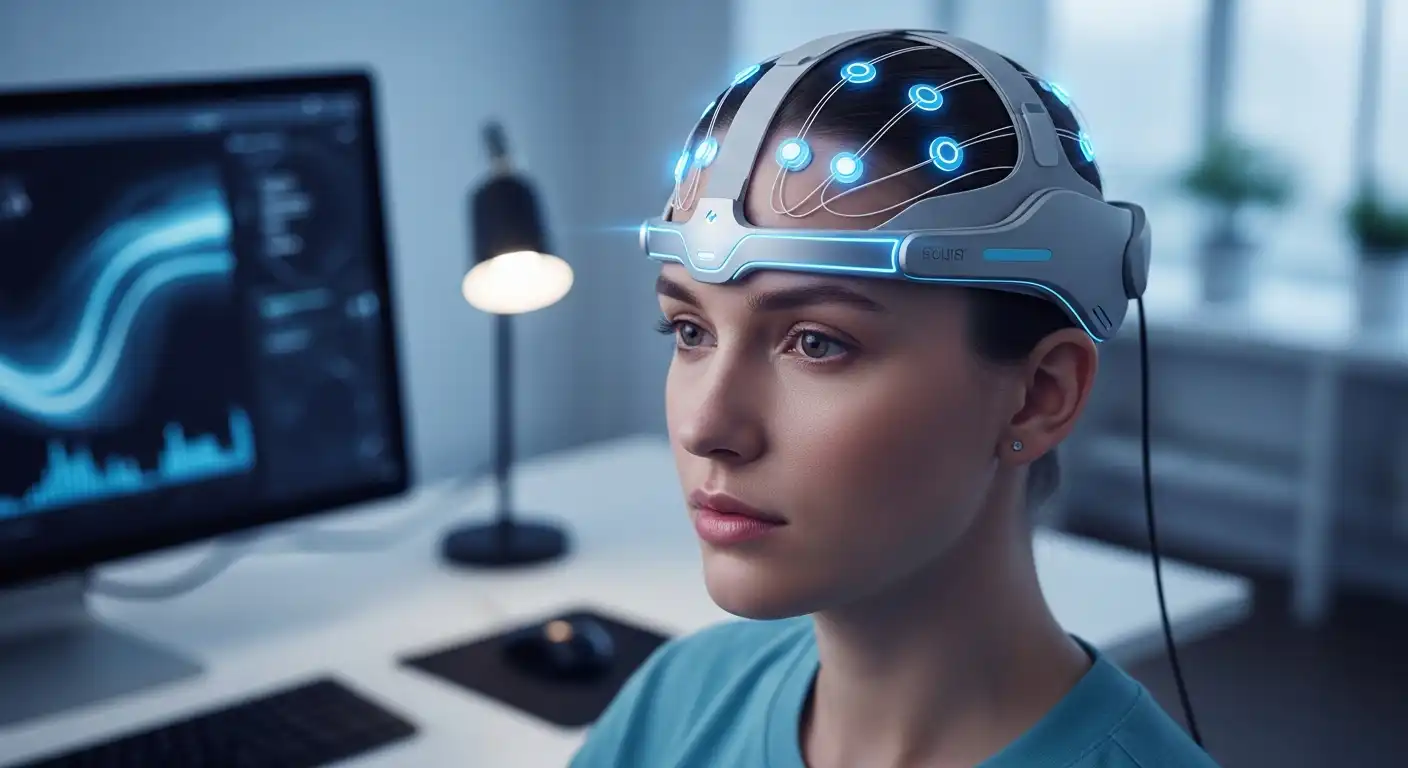
- Electroencephalography (EEG): the most common non-invasive BCI technology. An EEG system uses a cap or headset fitted with a series of small electrodes that are placed on the scalp. These electrodes detect the tiny electrical voltages generated by the synchronized activity of large populations of neurons in the brain’s cortex. The Pros: EEG is safe, portable, and has a very high temporal resolution (it can detect changes in brain activity on a millisecond timescale). The Cons: The signal is “smeared” and distorted by the skull, making it difficult to pinpoint the exact location of the activity (poor spatial resolution). It is also very susceptible to “noise” from muscle activity, like blinking or clenching one’s jaw.
- Functional Near-Infrared Spectroscopy (fNIRS): an optical imaging technique that measures changes in brain blood oxygenation. It works by shining near-infrared light through the skull and measuring how much is reflected. Active areas of the brain require more oxygenated blood, which has a distinct light-absorption profile. The Pros: It is safe, portable, and more robust to motion artifacts than EEG. The Cons: It has a much lower temporal resolution than EEG, as it measures the relatively slow process of blood flow rather than the direct electrical activity of neurons.
Invasive BCIs (Reading from the Inside)
These techniques require a surgical procedure to place electrodes directly on or inside the brain. While this carries significant risk and is currently only used for medical applications in patients with severe disabilities, it provides a signal of incomparably higher quality.
- Electrocorticography (ECoG): ECoG involves placing a thin grid or strip of electrodes directly on the brain surface, beneath the skull but outside the brain tissue itself. This bypasses the skull’s signal-distorting effects, providing a much clearer and more localized signal than EEG.
- Microelectrode Arrays (Intracortical Recording): This is the most invasive and highest-fidelity technique. It involves implanting a tiny array of microelectrodes (such as the “Utah Array”) directly into the brain’s cortex. These electrodes are small enough to record the “spiking” activity of individual neurons or small, local populations of neurons. This provides an incredibly rich and detailed signal that is the “gold standard” for high-performance, real-time control of complex devices.
The Brain’s Language: Decoding Neural Signals with AI
Acquiring the brain signal is only the first step. The raw signal is incredibly complex and noisy. The “magic” of a BCI lies in sophisticated decoding algorithms, almost always based on machine learning and artificial intelligence, that translate noisy neural patterns into a user’s intent.
This is a process of finding the signal in the noise and learning the unique language of an individual’s brain.
- The Co-adaptive Learning Process: A modern BCI does not come pre-programmed to understand a user’s thoughts. It is a co-adaptive system where both the user and the machine learn together. The user learns to generate consistent and distinct neural patterns associated with a specific mental task (e.g., imagining moving their left hand), and the machine learning algorithm learns to recognize and classify these patterns.
- Supervised Learning and Calibration: The process typically begins with a calibration or training phase. A user is asked to repeatedly imagine a series of movements while the BCI records their brain activity. This labeled data is then used to train a supervised machine learning model (such as a support vector machine or a neural network) to create a “decoder” that maps specific neural patterns to intended commands.
- The Power of Deep Learning: As BCI technology has advanced, researchers are increasingly using deep learning and recurrent neural networks (RNNs) to build more powerful and robust decoders. These models can learn more complex, time-varying patterns in neural data, leading to faster, more accurate control.
The Restorative Revolution: How Neural Technologies Are Rebuilding Lives
The most profound and immediate impact of BCI technology is in medicine. For individuals who have lost the ability to move, speak, or interact with the world due to paralysis, stroke, or neurodegenerative diseases like ALS, BCIs are not just an assistive technology; they are a source of restored hope, autonomy, and connection.
This is where the sci-fi promise of neural interfaces is becoming a life-changing clinical reality today.
Restoring Movement: The Power of Thought-Controlled Prosthetics and FES
For individuals with spinal cord injuries or amputations, BCIs are enabling a new generation of neural prosthetics that can be controlled with a level of dexterity that was once thought impossible.
This is about bypassing damaged neural pathways and creating a direct, artificial link between the brain and a limb or device.
- Controlling Advanced Robotic Arms: The most dramatic demonstrations have come from research programs like BrainGate. In these studies, a person with tetraplegia has a microelectrode array implanted in the motor cortex of their brain (the area that controls movement). By simply imagining moving their own arm and hand, they can learn to control a sophisticated, multi-jointed robotic arm to perform complex tasks like drinking from a cup, eating a piece of chocolate, or even giving a fist bump.
- Functional Electrical Stimulation (FES): An even more advanced approach goes beyond controlling a robotic limb to reanimating the person’s own paralyzed limb. In an FES system, the BCI decodes the person’s intended movement from their brain activity. These commands are then sent to a series of electrodes placed on the surface of their paralyzed limb. These electrodes deliver small electrical impulses that stimulate the muscles in the correct sequence to produce the desired movement. In 2023, a landmark study showed that a paralyzed man could walk again naturally using a wireless “digital bridge” that connected a BCI in his brain to a stimulator on his spinal cord.
Restoring Communication: Giving a Voice to the Voiceless
For individuals with “locked-in syndrome” or severe paralysis from conditions like ALS or a brainstem stroke, who are fully conscious but unable to speak or move, BCIs are providing a new and powerful channel for communication.
This is about translating the “inner voice” of thought directly into speech or text.
- “Point-and-Click” Spelling: Early communication BCIs allowed users to control a cursor on a screen by imagining movements. They could then slowly spell out words by selecting letters on a virtual keyboard.
- The Breakthrough of “Mental Handwriting”: A recent and major breakthrough has come from researchers at Stanford University. They developed a BCI that can decode neural signals associated with the intention to write. A participant in the study achieved a typing speed of 90 characters per minute with over 99% accuracy by simply imagining writing the letters with a pen. This speed is competitive with able-bodied typing on a smartphone.
- Direct Speech Synthesis: The ultimate goal is to move beyond text and to synthesize audible speech directly from the neural signals associated with the intent to speak. Researchers are making rapid progress in this area, using BCIs to decode intended phonemes (the basic sounds of speech) from brain activity, then using a speech synthesizer to convert them into audible words.
Restoring Sensation: Closing the Loop with Bi-Directional BCIs
The first generation of BCIs were one-way streets; they could “read” from the brain but could not “write” back to it. The next frontier is the bi-directional BCI, which can both read motor intent and write sensory information back into the brain.
This “closing of the loop” is essential for creating a true sense of embodiment and for restoring the sense of touch.
- How it Works: In addition to the recording electrodes in the motor cortex, a bi-directional system also has stimulating electrodes implanted in the somatosensory cortex (the brain region that processes touch). When a sensor-equipped prosthetic hand touches an object, the pressure and texture information from the sensors is translated into a pattern of electrical stimulation that is delivered back to the brain.
- The Feeling of Touch: This allows the user not only to control the prosthetic hand but also to feel what it is touching. This sensory feedback is a game-changer. It allows the user to modulate their grip strength—to hold a delicate object without crushing it—and provides a profound psychological sense that the prosthetic limb is a true part of their own body.
Treating Neurological and Psychiatric Disorders
The potential of neural technologies in healthcare extends beyond restoring motor function. By directly modulating the activity of specific brain circuits, neural interfaces are emerging as a powerful new tool for treating a range of neurological and psychiatric disorders.
This is about using targeted neural stimulation to “re-tune” dysfunctional brain circuits.
- Deep Brain Stimulation (DBS): DBS is an established and effective therapy that involves implanting electrodes deep within the brain to treat motor symptoms of disorders such as Parkinson’s disease and essential tremor. The next generation of DBS systems is becoming “smart” or “adaptive.” They use sensing electrodes to monitor the brain’s pathological rhythms in real time and deliver stimulation only when needed, providing a more personalized and effective therapy with fewer side effects.
- Treating Depression and Epilepsy: Researchers are exploring the use of adaptive DBS and other neural stimulation techniques to treat severe, treatment-resistant depression, obsessive-compulsive disorder (OCD), and to predict and prevent epileptic seizures before they occur.
The Augmentative Horizon: The Fusion of Human and Machine Intelligence
While the restorative applications are the immediate and most ethically clear-cut use case for neural technologies, the long-term vision for many in the field is human augmentation. This is the more controversial but also potentially more transformative goal: using BCIs not just to repair, but to enhance human capabilities, creating a seamless symbiosis between human and artificial intelligence.
This is the frontier where the HCI becomes a true brain-computer symbiosis, blurring the line between the tool and the user.
The High-Bandwidth Interface: The “Neural Lace” and the Future of Work
The long-term sci-fi vision, famously articulated by figures like Elon Musk with his company Neuralink, is to create a high-bandwidth, whole-brain interface—a “neural lace” that could enable a level of human-AI integration that is difficult to comprehend.
While this is still a very distant prospect, the potential implications for knowledge work and creativity are profound.
- “Thinking” at the Speed of Search: Imagine being able to access the sum of human knowledge from the internet not by typing a query into a search box, but as a direct extension of your own thought process.
- The Future of Design and Creativity: An architect could design a building simply by imagining its form and structure, with their thoughts translated directly into a CAD model. A musician could compose a symphony by thinking the melody and the harmonies, with the BCI translating it directly into a musical score.
- Seamless Telepathic Communication: At its most extreme, a whole-brain interface could enable direct, thought-to-thought communication between individuals —a kind of “consensual telepathy.”
The Commercial Race for Non-Invasive Augmentation
While the high-bandwidth, invasive BCI for augmentation is a long way off, a fierce commercial race is already underway to build non-invasive, consumer-grade neural interfaces for a range of everyday applications.
These devices, which are mostly based on advanced EEG, are the first wave of “neuro-tech” for the mass market.
- Gaming and Immersive Entertainment: The most immediate consumer market is gaming. A BCI could serve as an additional input channel, enabling a player to trigger an action in a game simply by focusing their attention or entering a state of mental calm. It could also be used to create biofeedback games in which the game world adapts in response to the player’s emotional or cognitive state.
- “Neuro-Wearables” for Wellness and Productivity: A new generation of “neuro-wearable” devices is emerging, promising to monitor our cognitive states and help us improve our focus, meditation, and sleep. Headbands that use EEG to provide real-time feedback during meditation are an early example.
- The Next Generation of Computing Interfaces: Companies like Meta (through its acquisition of CTRL-labs) are developing non-invasive, wristband-based neural interfaces. These devices do not read the brain directly; instead, they use electromyography (EMG) to detect the electrical signals from motor neurons in the brain to the muscles of the hand. By decoding these signals, the device can detect the intention to move a finger or make a gesture, even if the movement is imperceptible. This could be the “mouse and keyboard” for the next generation of augmented reality glasses, allowing users to control a virtual interface with subtle, private, and effortless hand gestures.
The Colossal Challenges: Navigating the Technical and Ethical Minefield
The journey to a future of ubiquitous neural interfaces is fraught with some of the most profound technical and ethical challenges humanity has ever faced. The brain’s complexity is staggering, and the societal implications of directly interfacing with it are even more so.
Successfully navigating this minefield will require not just engineering brilliance but also a deep, ongoing public dialogue guided by a strong ethical compass.
The Monumental Technical Hurdles
Before we can even begin to address the ethical questions fully, a series of monumental engineering and scientific challenges must be overcome.
- The Durability of Implants (The “Foreign Body” Problem): For invasive BCIs, the biggest technical challenge is the long-term stability of the implant. The brain is a dynamic, living environment, and it treats an implanted electrode as a foreign body. Over time, the brain’s immune response can lead to the formation of scar tissue (gliosis) around the electrodes, degrading signal quality and eventually rendering the device useless. Creating new, more biocompatible materials and flexible electrodes that can move with the brain is a major area of research.
- The Scaling Problem: The human brain has 86 billion neurons. Our current highest-density microelectrode arrays can record from, at best, a few thousand neurons simultaneously. To achieve the dream of a high-bandwidth, whole-brain interface, we will need to figure out how to safely record from millions, or even billions, of neurons —a scaling challenge of almost unimaginable magnitude.
- The “Writing to the Brain” Challenge: While we have become relatively good at “reading” the brain, our ability to “write” information back into it with any degree of precision remains incredibly rudimentary. To create a true, two-way interface that can, for example, upload knowledge or create a sensory experience, we will need a much deeper understanding of the neural code and the technology to stimulate vast numbers of individual neurons with precise spatial and temporal patterns.
- The Power and Bandwidth Conundrum: An implanted BCI needs to be powered and transmit its data out of the body. Doing this wirelessly, safely, and at a high data rate without heating the surrounding brain tissue is a major engineering challenge.
The Profound Ethical, Social, and Security Questions
As we develop technology to access the human mind directly, we are forced to confront a series of profound ethical questions that go to the very core of our identity, privacy, and autonomy. These are not questions for scientists alone; they are questions for all of society.
- The Sanctity of Mental Privacy: The brain is the final frontier of privacy. If a BCI can read our intentions, what is to stop it from reading our unspoken thoughts, our emotions, or our subconscious biases? The potential for a new and terrifying form of corporate or government surveillance is immense. We will need to develop a new legal and ethical framework of “neuro-rights” to protect the sanctity of our mental world.
- The Threat of “Brain-Hacking”: A neural interface can also serve as a new attack vector. A malicious actor who could hack into a BCI could potentially steal a person’s thoughts, manipulate their perceptions, or even cause physical harm by controlling their prosthetic limbs or neural stimulators. The cybersecurity of these devices is of paramount importance.
- The Question of Agency and Autonomy: As BCIs become more sophisticated and begin using AI to “assist” or even predict our intentions, this raises complex questions about human agency. If a BCI-powered algorithm decides for you based on a prediction of what you were about to think, who is truly in control? Where does the user’s will end, and the machine’s will begin?
- The “Neuro-Divide” and the Future of Inequality: Like any powerful and expensive new technology, there is a significant risk that augmentative neural interfaces will be available only to the wealthy. This could create a new and terrifying form of biological inequality, a “neuro-divide” between the enhanced and the un-enhanced that could cleave society in two. Ensuring that the benefits of this technology are distributed equitably is one of the most significant societal challenges we will face.
- The Definition of “Self”: As the interface between our biological brain and the digital world becomes ever more seamless, it will challenge our very definition of self. If a significant part of your memory, your knowledge, and your cognitive processing is happening outside of your biological brain, where is the boundary of “you”?
The Road Ahead: A Call for Responsible Innovation
The development of neural technologies is not a technological race that any single company or country can win. It is a profound human endeavor that requires a new model of open, transparent, and responsible innovation.
The path forward must be collaborative, involving not just scientists and engineers but also ethicists, sociologists, policymakers, and a broad, inclusive public.
The Need for a Proactive Ethical and Regulatory Framework
We cannot wait until the technology is fully mature to start thinking about the rules of the road. We need a proactive, global conversation now about the ethical guidelines and regulatory frameworks that will govern the development and use of neural technologies. Initiatives such as the Neurorights Foundation and the OECD’s work on responsible innovation in neurotechnology are crucial first steps.
The Importance of Interdisciplinary Collaboration
Solving the immense challenges of this field will require deep collaboration across a wide range of disciplines. Neuroscientists, materials scientists, electrical engineers, machine learning experts, cybersecurity specialists, clinicians, and ethicists must all work together.
A Focus on Restorative Applications First
The clearest and most ethically sound path forward in the near term is to focus the immense power of this technology on the restorative applications that can heal the sick and help the disabled. This not only represents a massive unmet medical need but also provides the safest and most compelling context for developing and refining the core technology.
Conclusion
The journey of the human-computer interface has been a relentless quest for a more intimate, intuitive, and high-bandwidth conversation between humanity and its most powerful creation. We have moved from the rigid syntax of the command line to the intuitive touch of the smartphone, each step bringing us closer to a world where technology becomes an invisible, seamless extension of our will. The rise of neural interfaces is the final and most profound step on this journey. It is the promise of an interface that is no longer an external translator but a direct, symbiotic partner in thought itself.
The road to this future is long and paved with some of the most difficult technical and ethical challenges we have ever faced. But the potential is undeniable. In the near term, it is the potential to restore movement, speech, and sensation to those who have lost them, a goal of almost unparalleled humanistic importance. In the long term, it is the potential to augment our intelligence, our creativity, and our ability to solve the world’s most complex problems. The conversation between mind and machine is just beginning, and its ultimate language will be written in the very neural code of thought itself.