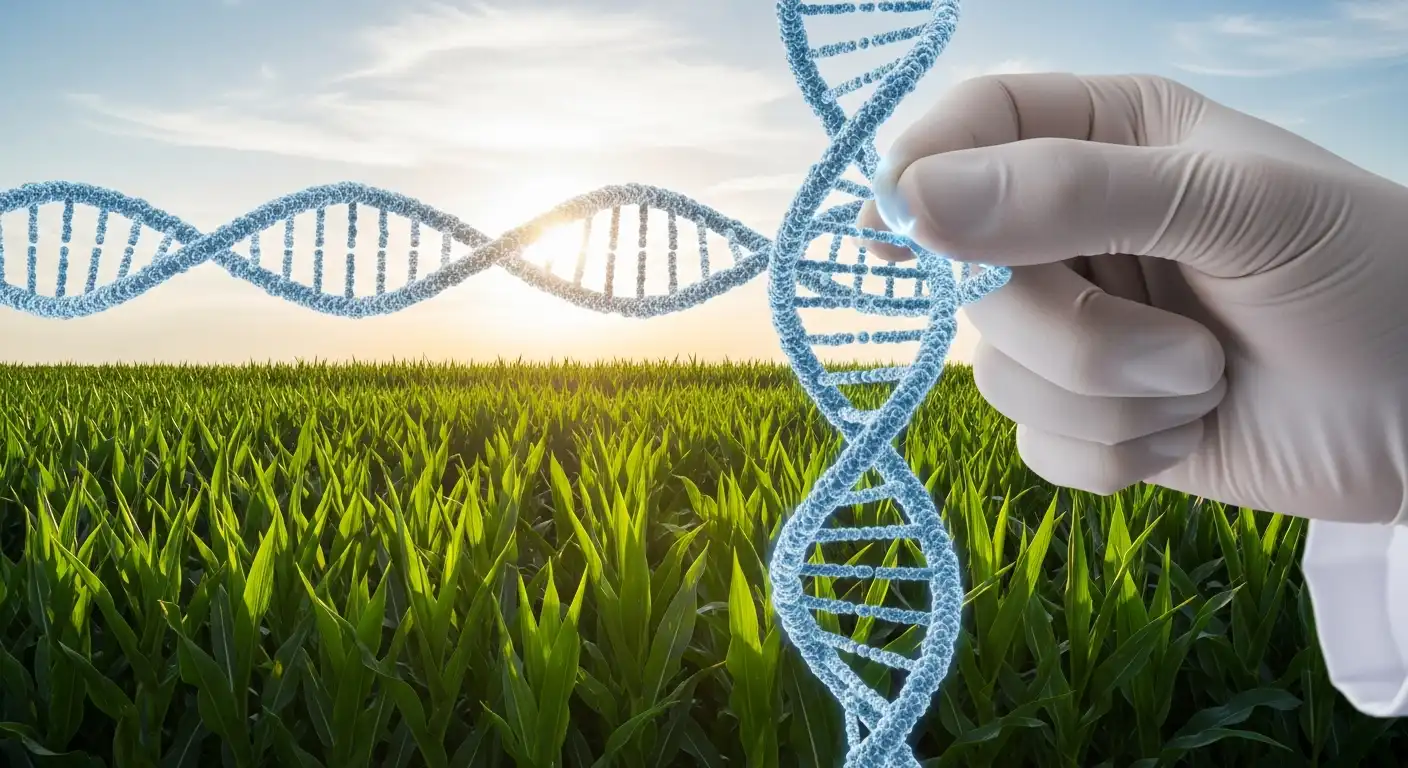
By 2050, the global population is projected to reach nearly 10 billion. Simultaneously, climate change is rewriting the rules of farming, bringing severe droughts, new pests, and unpredictable weather patterns that threaten crop yields. The pressure to produce more food on less land, with fewer resources, has never been higher.
In the quest to solve this Malthusian equation, science has turned to the very building blocks of life: DNA. For decades, the debate around food technology has been dominated by one acronym: GMO (Genetically Modified Organism). To many, it represents the pinnacle of scientific achievement; to others, it is “Frankenfood.”
However, a new technology has emerged that is fundamentally changing the conversation. CRISPR-Cas9, a gene-editing tool often described as “molecular scissors,” offers a way to improve crops that is faster, cheaper, and arguably more precise than traditional genetic modification. But for the average consumer, the distinction is blurry. Is CRISPR just GMO 2.0? Or is it something entirely different?
This comprehensive guide explores the science of CRISPR in agriculture, examines how it differs mechanistically and legally from traditional GMOs, and analyzes its implications for the future of the food system.
The Evolution of Crop Improvement
To understand the nuance between CRISPR and GMOs, we must first contextualize them within the history of agriculture. Humans have been genetically modifying food for over 10,000 years. The corn (maize) we eat today bears little resemblance to teosinte, the grassy weed from which it was bred by indigenous peoples in Mexico.
Selective Breeding and Hybridization
Traditional breeding involves selecting parents with desirable traits—such as a larger ear of corn or a sweeter apple—and crossing them. This process is effective but slow and imprecise. When you cross two plants, you are mixing tens of thousands of genes, hoping the desired trait is passed down without carrying along “genetic baggage” (undesirable traits).
Mutagenesis
In the mid-20th century, scientists began using “mutagenesis.” This involved exposing seeds to radiation or chemicals to induce random mutations, hoping for a lucky break that resulted in a better crop. Thousands of crop varieties we consume today, including the Ruby Red grapefruit and pasta wheat varieties, were created in this way. These are generally considered “conventional” breeding, despite the artificial induction of mutations.
This history sets the stage for the subsequent targeted technologies: Transgenics (GMOs) and Gene Editing (CRISPR).
Understanding GMOs: The Era of Transgenics
The term “GMO” is regulatory and cultural, but scientifically, it usually refers to transgenic organisms. The technology, which gained prominence in the 1990s, involves taking a specific gene from one species and inserting it into the DNA of another species.
The Mechanism of Transgenics
Traditional genetic modification is a “cut and paste” operation. Scientists identify a gene in an organism (e.g., a bacterium) that confers a valuable trait (e.g., resistance to a specific pest). Using a “gene gun” or a carrier bacterium such as Agrobacterium tumefaciens, they introduce foreign DNA into the plant genome.
The Defining Characteristic: Foreign DNA
The key differentiator of a traditional GMO is the presence of foreign DNA.
- Bt Corn: Scientists inserted a gene from the soil bacterium Bacillus thuringiensis (Bt) into corn. This gene produces a protein toxic to certain worms but safe for humans. The corn effectively produces its own pesticide.
- Roundup Ready Soybeans: A gene was inserted that enables the plant to survive exposure to glyphosate, a potent herbicide. This allows farmers to spray fields to control weeds without harming crops.
The Limitations of GMOs
While revolutionary, the creation of transgenic GMOs is incredibly expensive and time-consuming. Because gene insertion is somewhat random, it requires years of testing to ensure that the plant is healthy and safe. Furthermore, because it introduces “foreign” DNA, it faces immense regulatory hurdles and public skepticism. Bringing a single GMO trait to market can cost over $100 million and take a decade.
Enter CRISPR: The Molecular Word Processor
CRISPR (Clustered Regularly Interspaced Short Palindromic Repeats) represents a paradigm shift. If traditional breeding is a sledgehammer and GMO technology is a scalpel, CRISPR is a laser-guided nano-tweezer.
How CRISPR Works
CRISPR-Cas9 acts as a search-and-edit tool. It consists of two parts:
- Cas9: An enzyme that acts as a pair of molecular scissors, capable of cutting DNA.
- Guide RNA: A programmable strip of genetic code that leads Cas9 to a precise location in the genome.
When introduced into a plant cell, the system locates the specific DNA sequence that controls a trait (e.g., susceptibility to mildew) and makes a cut. The cell then rushes to repair the cut. Scientists can direct this repair process to disable a gene (knock-out) or tweak it slightly.
The “Find and Replace” Function
The most distinctive feature of CRISPR in agriculture is that it typically does not involve the introduction of foreign DNA. Instead of inserting a gene from a bacterium, scientists use CRISPR to silence an existing gene or introduce a small mutation, mimicking natural processes.
For example, if a wheat plant has a gene that makes it susceptible to a fungus, CRISPR can simply turn that gene “off.” No DNA from a jellyfish or bacteria is added. The result is an organism that could have evolved naturally over hundreds of years of evolution or selective breeding; CRISPR achieved it in a single generation.
The Core Differences: CRISPR vs. GMOs
While both technologies involve altering the genome, the differences in mechanism, precision, and regulation are profound.
Transgenic vs. Cisgenic/Subgenic
- GMO (Transgenic): Involves the introduction of genetic material from a different species (e.g., a fish gene into a strawberry).
- CRISPR (Cisgenic/Subgenic): Usually involves editing the organism’s own DNA or inserting DNA from a sexually compatible plant (a relative). It is rewriting the existing code rather than adding a new chapter from a different book.
Precision and Off-Target Effects
- GMO: Traditional insertion methods are relatively random. The foreign gene lands where it lands, which can sometimes disrupt other functions.
- CRISPR: It is programmable. Scientists target a specific nucleotide sequence. While “off-target” cuts (cuts made in the wrong place) were an early concern, the technology has advanced rapidly and is now exceptionally accurate.
Accessibility and Cost
- GMO: Due to the complexity and regulation, only massive conglomerates (like Bayer/Monsanto, Syngenta) could afford to develop GMOs. This led to a consolidation of power in the seed industry.
- CRISPR is inexpensive and easy to use. University labs and small startups are developing CRISPR crops. This “democratization” of gene editing means we are seeing niche crops (such as cacao, coffee, and berries) being improved, not just commodity crops such as corn and soy.
Real-World Applications: What CRISPR is Growing
CRISPR is currently being used to solve problems that traditional GMOs ignored.
The Non-Browning Mushroom
One of the first CRISPR foods to bypass USDA regulation was a white button mushroom developed by Yinong Yang at Penn State. By using CRISPR to disable the gene encoding the enzyme polyphenol oxidase, the mushroom resists browning upon slicing. This reduces food waste and extends shelf life without adding any foreign additives.
High-GABA Tomatoes
In Japan, a CRISPR-edited tomato is already commercially available. It was edited to contain high levels of Gamma-Aminobutyric Acid (GABA), a compound believed to aid relaxation and lower blood pressure. This represents a shift toward “functional foods”—crops designed for consumer health benefits rather than just farmer convenience.
Disease-Resistant Cacao
Most of the world’s chocolate comes from West Africa, where cacao trees are being decimated by a virus causing “swollen shoot disease.” CRISPR is being used to bolster the cacao tree’s immune system, potentially saving the chocolate industry from collapse.
Climate-Resilient Wheat
Wheat is notoriously difficult to engineer due to its massive, complex genome. CRISPR has allowed scientists to edit wheat to be more drought-tolerant and resistant to powdery mildew, a fungal disease that destroys yield.
The Regulatory Landscape: A Global Patchwork
The scientific distinction between CRISPR and GMOs is clear, but the legal distinction remains contested, as how governments classify these crops determines their commercial viability
The United States: Product vs. Process
The U.S. Department of Agriculture (USDA) generally takes a “product-based” approach. They look at the result. If the CRISPR-edited crop does not contain foreign DNA (i.e., it holds no plant pest risk) and simulates a change that could have happened in nature, it is not regulated as a GMO. This “light-touch” regulation has unleashed a wave of innovation in the U.S.
The European Union: The Precautionary Principle
For years, the EU held a “process-based” view. In a controversial 2018 ruling, the European Court of Justice declared that gene-edited crops are GMOs because the process involves genetic engineering. This effectively banned CRISPR crops in Europe by subjecting them to the same expensive testing as transgenic GMOs.
However, this is changing. As of 2024, the European Commission is advancing legislation to create a separate category for “New Genomic Techniques” (NGTs). If a crop is “Category 1” (equivalent to conventional breeding), it may be exempted from strict GMO labeling and testing. This shift acknowledges that treating CRISPR like 1990s-era GMOs is scientifically outdated and economically damaging.
China and Adoption
China has aggressively invested in CRISPR research. While initially cautious about commercial release, they recently approved guidelines for gene-edited crops that are more streamlined than their GMO regulations, signaling a move toward mass adoption to ensure national food security.
The Environmental Impact: Sustainability Through Editing
Critics of industrial agriculture often conflate biotechnology with monocultures and chemical use. However, CRISPR holds the potential to make farming more sustainable.
Reducing Chemical Dependence
The first wave of GMOs (Roundup Ready) encouraged the use of herbicides. CRISPR is flipping the script. By breeding crops with natural resistance to pests and fungi, farmers can apply fewer pesticides and fungicides. This protects pollinators, soil health, and local waterways.
Nitrogen Fixation
One of the “holy grails” of ag-tech is self-fertilizing crops. Legumes (beans) naturally pull nitrogen from the air. Cereal crops (corn, wheat) do not; they require synthetic nitrogen fertilizer, which has a massive carbon footprint. Scientists are using CRISPR to engineer the soil microbiome or plants themselves to fix nitrogen, which would substantially reduce greenhouse gas emissions from agriculture.
Shelf Life and Waste
Food waste accounts for roughly 8-10% of global greenhouse gas emissions. By editing produce to ripen more slowly or resist bruising (like the CRISPR potato), we can ensure more food reaches the plate rather than the landfill.
Public Perception: Winning the “Frankenfood” War
Science does not happen in a vacuum. For CRISPR to succeed where GMOs have struggled, the industry must earn consumer trust.
The Legacy of Mistrust
The anti-GMO movement was fueled by a lack of transparency and the perception that GMOs benefited corporations (via patents) rather than consumers. Because CRISPR can produce consumer-facing benefits—better-tasting strawberries, gluten-reduced wheat, healthier oils—it has the potential to reframe the narrative.
The Labeling Debate
Should CRISPR foods be labeled? In the U.S., the “Bioengineered” disclosure law requires labeling of foods that contain detectable foreign genetic material. Because many CRISPR crops contain no foreign material, they may be exempt from regulation.
Proponents argue that labeling “non-foreign” edits demonizes a safe technology. Critics argue that consumers have a “right to know” how their food was produced, regardless of the biological details. Transparency will be crucial. If the industry is seen as hiding CRISPR, it risks a backlash.
The Democratization of Seeds
Perhaps the most profound difference between the GMO era and the CRISPR era is who holds the keys.
The high cost of GMO regulation meant that only “blockbuster” crops (corn, soy, cotton, canola) were worth the investment. This left “orphan crops”—cassava, millet, cowpea—behind, despite them being staples for millions in developing nations.
Because CRISPR is relatively inexpensive, non-profits and smaller research institutes are using it to improve these orphan crops. The Innovative Genomics Institute (founded by CRISPR co-discoverer Jennifer Doudna) is working on CRISPR-edited cassava to prevent cyanide poisoning and resist disease. This technology has the potential to uplift subsistence farmers in Africa and Asia in a way that corporate-owned GMOs never did.
Challenges and Ethical Considerations
Despite the optimism, CRISPR is not a panacea and is not without risk.
Off-Target Effects
Although precise, CRISPR can occasionally cut DNA at unintended sites. While this is unlikely to create a “monster,” it could negatively affect the plant’s yield or health. Rigorous screening is required to ensure the edits are clean.
Biodiversity
If we create a “perfect” CRISPR wheat that resists disease and drought, every farmer may plant it. This leads to genetic uniformity. If a new super-bug evolves that can kill that specific variety, the entire global harvest could be at risk. Maintaining genetic diversity in seed banks remains vital.
Intellectual Property Wars
The patent landscape for CRISPR is a messy legal battle between the Broad Institute (MIT/Harvard) and the University of California, Berkeley. Uncertainty over who owns the rights to the technology can stifle innovation, making it hard for smaller startups to license the tools they need.
Conclusion
The distinction between CRISPR and GMOs is more than just semantics; it is a distinction between the bludgeon and the scalpel. While GMOs rely on introducing foreign DNA to achieve traits that nature couldn’t easily produce, CRISPR optimizes the genetic potential that already exists within the plant.
As we face a future defined by climate volatility and population growth, we cannot afford to discard tools based on fear or outdated definitions. CRISPR offers a pathway to an agriculture that is more resilient, less reliant on chemicals, and more accessible to the developing world.
The question is no longer whether we can edit the food supply, but how we govern it. If we can navigate the regulatory mazes and communicate the benefits clearly to the public, CRISPR represents not just the next step in agriculture, but a necessary leap toward a sustainable food future.