Key Points
- Scientists used the mathematics of string theory to explain the branching patterns of biological networks.
- The new theory explains why structures such as tree branches, blood vessels, and neurons appear similar.
- The math, originally developed for theoretical physics, accurately predicts 3D structures in nature.
- This is the first time string theory has been successfully applied to real biological systems.
For over a hundred years, scientists have been puzzled by a simple question: why do things like tree branches, blood vessels, and even the neurons in our brains all have a similar branching structure? The old theory was that nature is just being as efficient as possible, using the least amount of material to accomplish the task. However, that idea never quite matched reality.
Now, a team of physicists has found a surprising answer in one of the most exotic corners of science: string theory.
The researchers, led by a team at Rensselaer Polytechnic Institute, realized that previous scientists had considered these structures in two dimensions, as in a wiring diagram. However, in the real world, these are 3D objects with surfaces that must connect smoothly.
It turns out that the same complex math that physicists developed to understand vibrating strings in higher dimensions also perfectly describes how nature builds these branching networks. “There seems to be a universal rule governing the formation of biological networks,” said lead researcher Xiangyi Meng. “This optimization rule is purely geometric.”
For example, old models couldn’t explain why trees and neurons often have three- or four-way splits. They also couldn’t account for the small, dead-end “sprouts” that are common in these structures.
String theory’s math, however, predicts both of these features. It shows that these sprouts are the most efficient way for a neuron to reach out and connect with its neighbors, or for a plant root to explore the soil for nutrients.
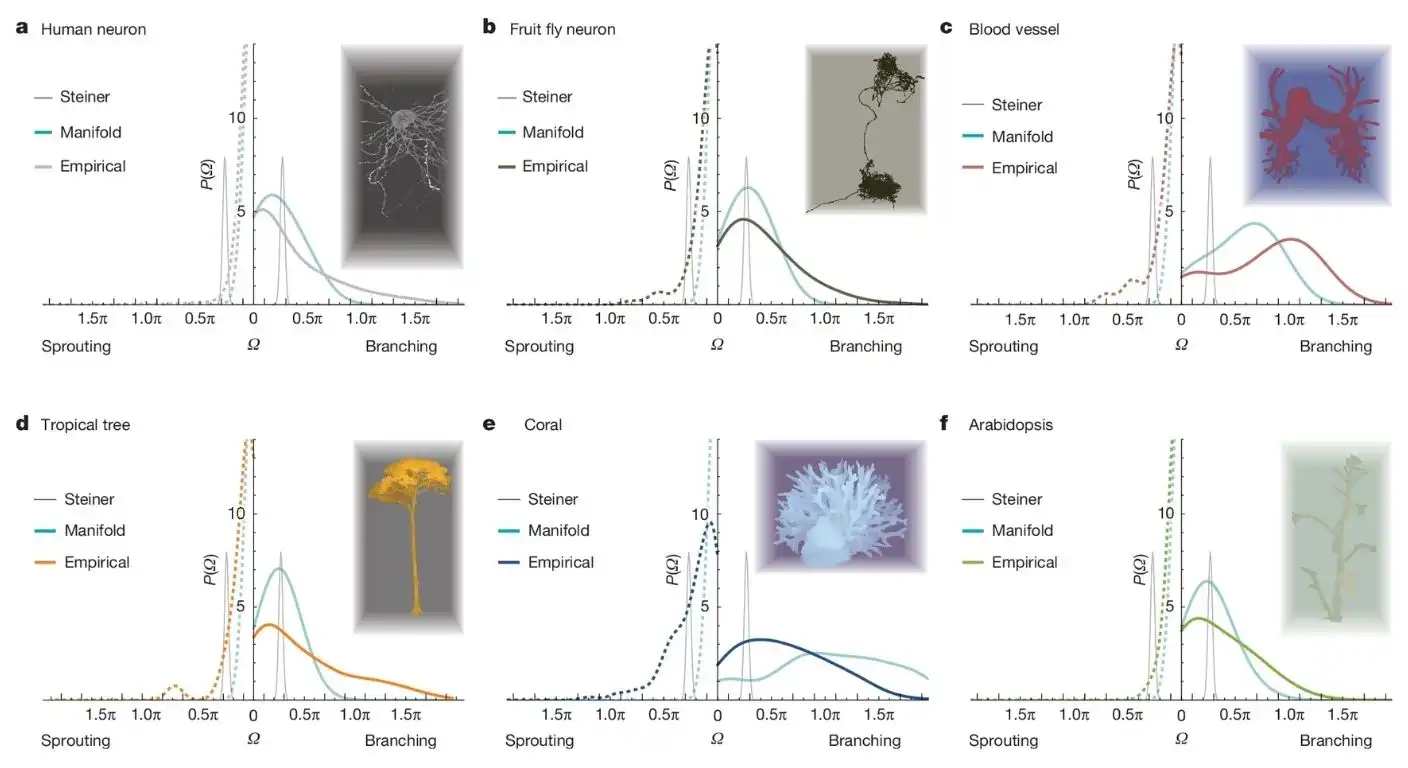
The team tested their idea against 3D scans of six different types of networks, from human neurons to tropical trees, and the results were a perfect match. This is the first time string theory has been used to successfully describe a real biological structure. While the theory itself remains unproven as a description of the universe, its mathematical tools are proving highly useful for understanding the world around us.
Source: Nature (2026).