Key Points
- Researchers have developed a new method, WISE, for running AI on small, battery-powered devices.
- The method uses “in-physics analog computing,” where radio waves perform part of the AI calculation.
- A base station broadcasts the AI model’s weights, and a simple device mixes them with its own data.
- The technology could be used in drones, cameras, and other smart sensors.
Researchers at Duke University have developed a novel way to run powerful artificial intelligence on small, battery-powered devices like drones and sensors. The new method, called Wireless Smart Edge networks (WISE), uses radio waves to perform much of the heavy lifting, which could solve a major bottleneck in the field of edge computing.
The problem with running AI on small devices is that the hardware is tiny, but the AI models are huge. Engineers typically face two undesirable options: they can try to cram the entire AI model onto the device, which drains the battery and requires a lot of memory, or they can send all the data to the cloud for processing, which is slow and can be a security risk.
The Duke team proposes a third option, which they call “in-physics analog computing.” Instead of sending a stream of ones and zeros back and forth, the radio waves themselves are used to perform a key part of the AI calculation.
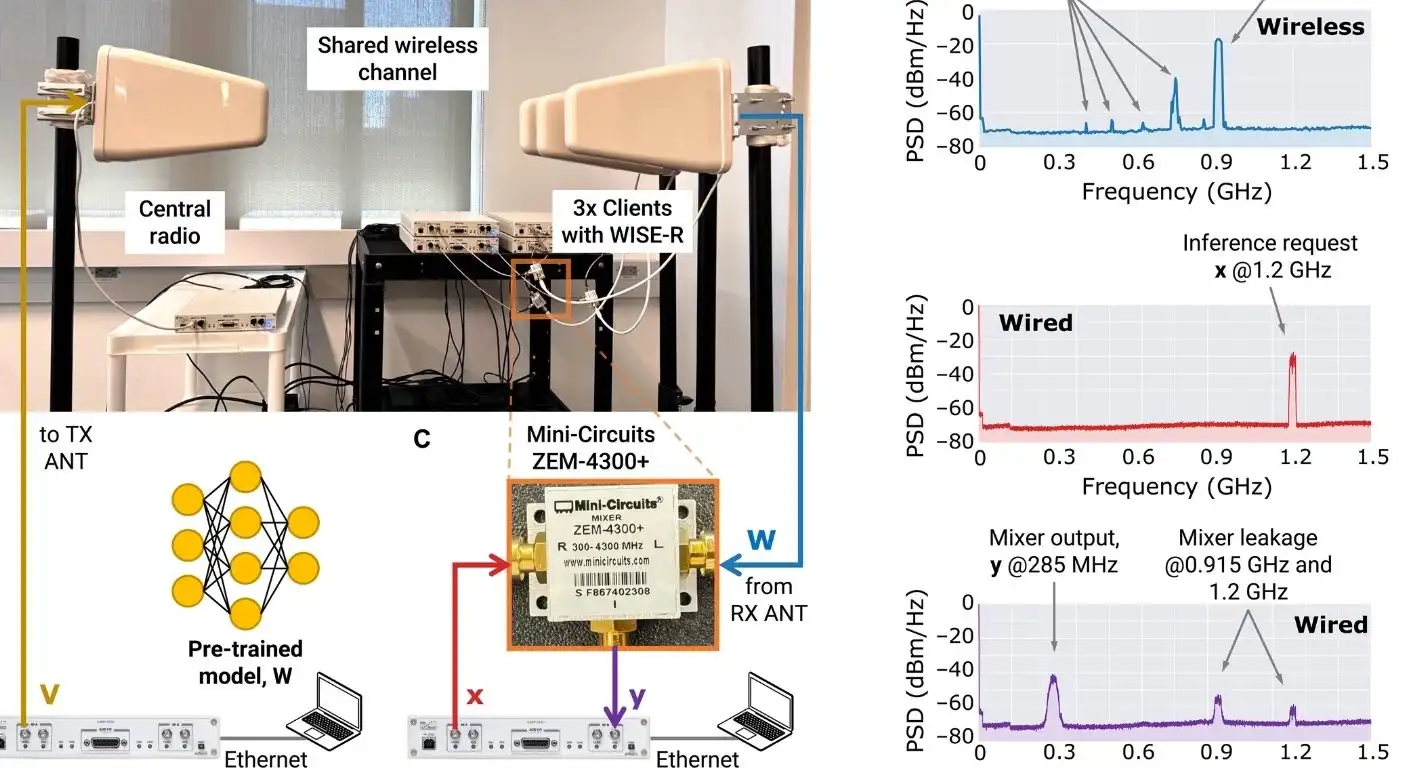
Here’s how it works: a nearby base station stores the full AI model and broadcasts a radio signal that contains the model’s “weights”—the numbers needed to do the math.
When that signal reaches a device, a simple piece of hardware mixes it with the device’s own data, such as a camera feed. This mixing process naturally performs a crucial step in most AI models, without needing a powerful digital processor.
“We’re taking advantage of computations that common, miniaturized electronics already give us,” said Tingjun Chen, the lead researcher on the project.
Because the device doesn’t have to store the entire model or run it digitally, it saves substantial energy and memory. This could be transformative for a range of applications, from smart traffic sensors to autonomous drones, enabling them to run much more advanced AI models than they can today.
Source: Science Advances (2026).