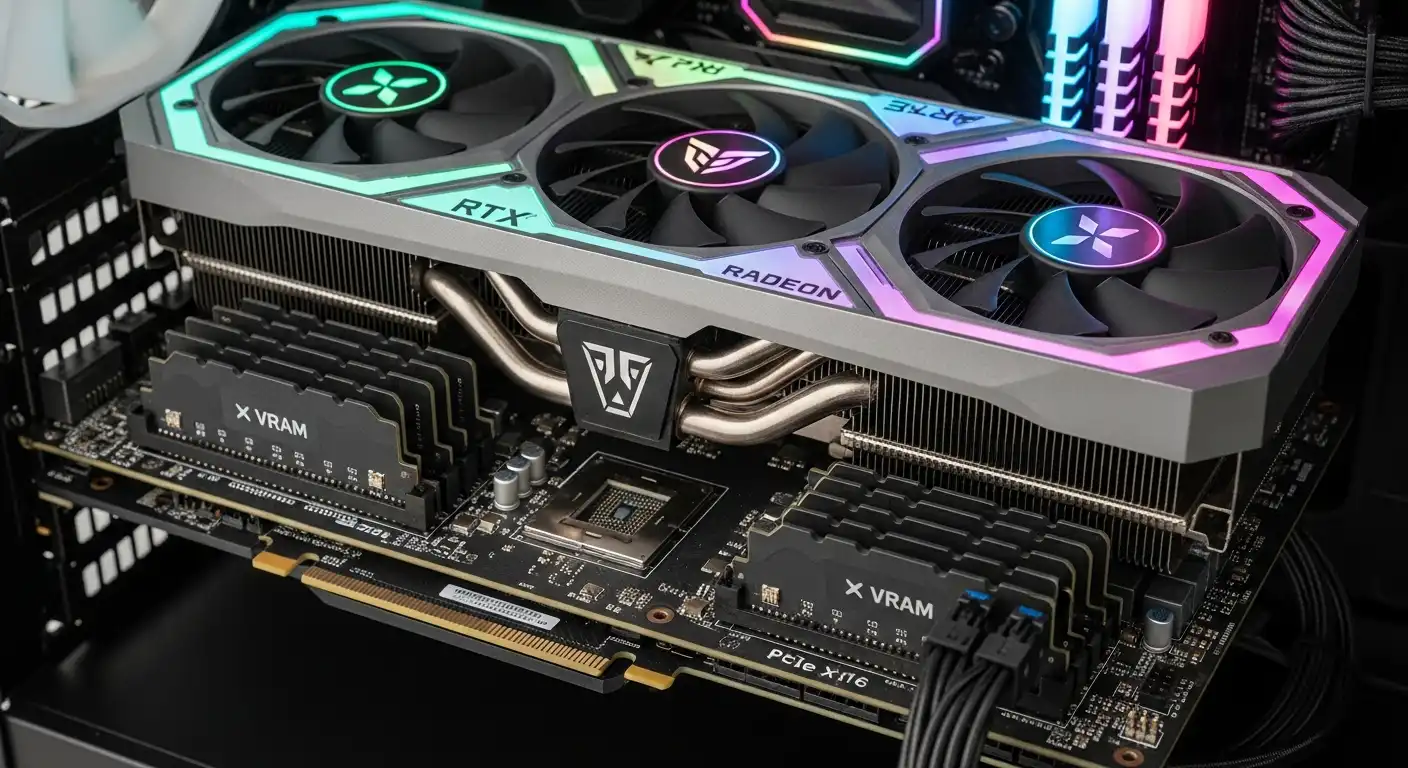
Thirty years ago, the Graphics Processing Unit (GPU) was a humble, specialized component with one simple job: to help your computer draw the basic shapes and colors you saw on the screen. It was a co-processor, a sidekick to the mighty CPU. Today, that sidekick has become a superhero. The GPU is now one of the most powerful and important pieces of silicon on the planet. Its evolution from a simple 2D sprite-pusher to a photorealistic rendering engine is the secret story behind almost every visual marvel of the modern world.
The First Great Leap: The 3D Revolution
The first major moment for the GPU occurred in the mid-1990s with the advent of 3D gaming. Suddenly, computers didn’t just have to draw flat shapes; they had to create entire three-dimensional worlds. This required a mind-boggling amount of repetitive mathematical calculations—figuring out the position of every triangle, the angle of every light source, and the texture of every surface. The CPU, a generalist, was terrible at this kind of work. The GPU, a specialist, was born for it. This was the moment the GPU emerged from the shadows and became the engine of the video game revolution.
The Age of the Shader
For years, 3D graphics were defined by a fixed set of rules. A programmer could tell the GPU to “draw a shiny metal sphere,” and the GPU knew how to do it. The next great leap was to give the artists direct control. This was the age of the “programmable shader.” Suddenly, a programmer could write a tiny piece of custom code that told the GPU exactly how a surface should look and behave. This unlocked a new world of artistic creativity. It’s the reason modern games have realistic water that ripples, skin that has subtle variations in tone, and fire that flickers and casts dynamic shadows.
The Parallel Processing Powerhouse
Here’s the secret to the GPU’s power: it’s a master of doing a million simple things at once. This is called parallel processing. A CPU is like a single, brilliant chef who can cook one complex meal perfectly. A GPU is like a thousand line cooks, all chopping carrots simultaneously. For a long time, we only used this parallel power for graphics. Then, someone had a brilliant idea: what if we could use that army of line cooks for things other than graphics? This marked the birth of “general-purpose GPU computing,” and it transformed the field.
The Engine of the AI Revolution
It turns out that the kind of math required to train a modern AI is very similar to the math required to render 3D graphics. It involves performing millions of simple, repetitive calculations. The GPU was the perfect tool for the job. The entire AI revolution that we are living through today—from the large language models that can write an essay to the image generators that can create a stunning piece of art—is being run on the back of the GPU. It has become the unlikely engine of modern artificial intelligence.
The Final Frontier: Photorealism
And now, the GPU’s journey is coming full circle, back to its original purpose of creating beautiful images. The latest frontier is “ray tracing,” a technique that simulates the actual physical behavior of light. Instead of faking shadows and reflections, the GPU calculates the path of every individual ray of light as it bounces around a scene. This is a computationally brutal task, but it is the key to true photorealism. The GPU began by rendering simple sprites, and it is now on the cusp of creating digital worlds indistinguishable from reality. It’s an unsung hero of technology, and its story is far from over.