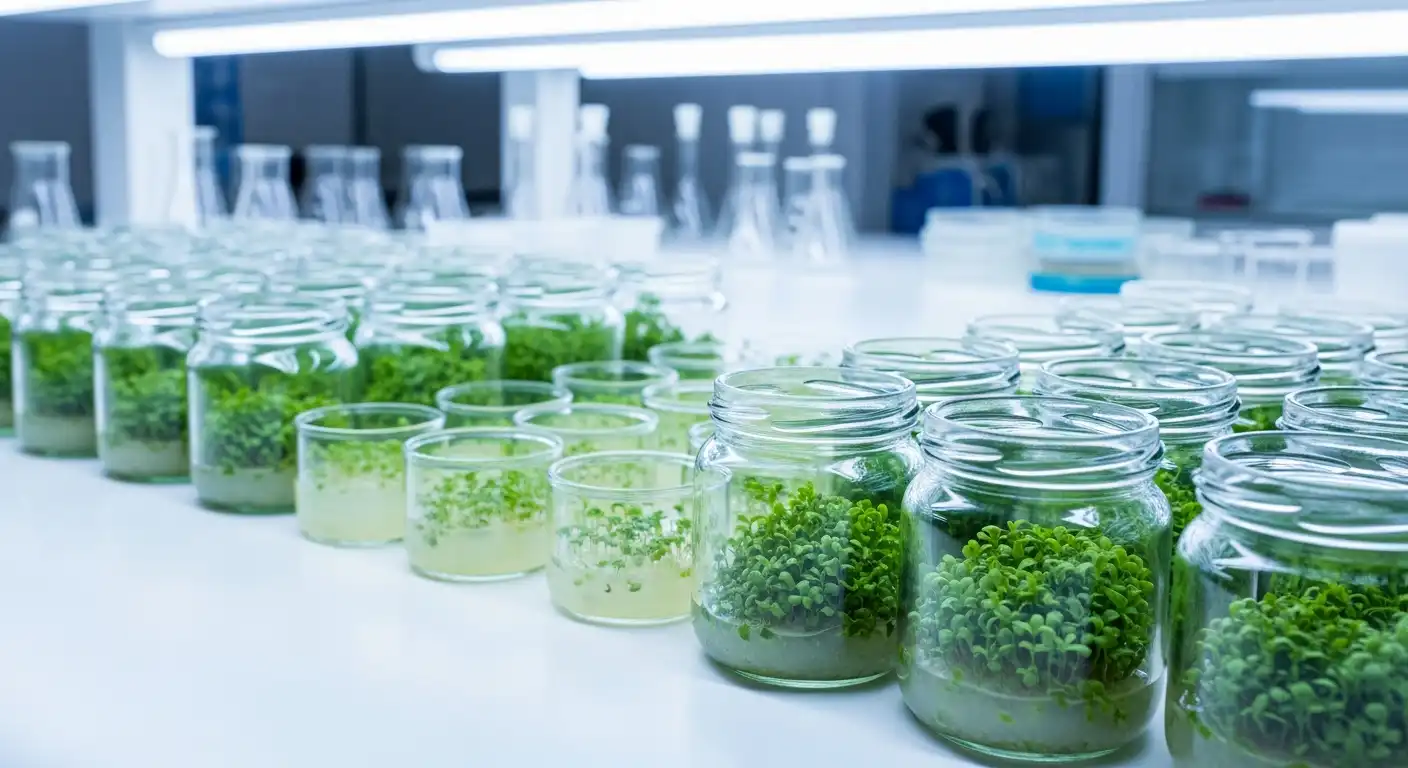
In the quest to feed a growing global population and save endangered plant species, traditional agriculture often hits a wall. Seeds take time to grow, diseases wipe out entire harvests, and some plants simply refuse to propagate naturally. Enter Plant Tissue Culture—a collection of techniques that allows scientists and growers to clone plants, not in a field of soil, but in a sterile jar of nutrient-rich jelly.
Often referred to as micropropagation, this biotechnology allows for the production of thousands of genetically identical plants from a tiny piece of tissue—sometimes just a few cells—in a fraction of the time required by nature. It is the science behind the orchids in your supermarket, the disease-free bananas in your smoothie, and the potential resurrection of extinct flora.
This comprehensive guide delves into the principles, techniques, and revolutionary applications of plant tissue culture, exploring how this sterile art form is reshaping modern botany and agriculture.
The Principle: Totipotency and Plasticity
The magic of tissue culture relies on two fundamental biological concepts inherent to plants:
- Totipotency: Unlike animal cells, which become specialized and rarely revert, plant cells are highly versatile. A single mature plant cell has the genetic potential to regenerate into an entire new plant. Theoretically, you can grow a whole oak tree from a single leaf cell.
- Plasticity: Plants can alter their metabolism, growth, and development to adapt to their environment. By manipulating the environment in a test tube, we can force the plant tissue to do what we want—grow roots, shoot up stems, or produce embryos.
The Laboratory Setup: A Sterile Fortress
Plant tissue culture is not gardening; it is surgery. The single biggest enemy of the process is contamination. Bacteria and fungi grow much faster than plant tissue in the nutrient-rich medium. If a single spore lands in the jar, the culture is ruined.
Therefore, the process takes place in a highly controlled environment:
- Laminar Air Flow Hood: A workbench that blows filtered, sterile air toward the user to prevent dust and microbes from settling on the samples.
- Autoclave: A high-pressure steam sterilizer used to kill all microbial life on tools and nutrient media.
- Growth Room: A climate-controlled room with precise lighting and temperature settings to incubate the cultures.
The Nutrient Medium: The Recipe for Life
Since the plants are not growing in soil, they need a substitute. The Nutrient Medium (most commonly the Murashige and Skoog (MS) medium) acts as the soil, water, and fertilizer all in one. It is usually solidified with agar (a gelatinous substance derived from seaweed) to give the plant support.
The medium is a cocktail of:
- Macronutrients: Nitrogen, Phosphorus, Potassium (N-P-K), Calcium, Magnesium.
- Micronutrients: Iron, Manganese, Zinc, Boron.
- Carbon Source: Usually sucrose (sugar), since the tiny plantlets cannot photosynthesize enough energy initially.
- Vitamins: Thiamine, Nicotinic acid.
- Plant Growth Regulators (PGRs): the “steering wheel.” By balancing two hormones—Auxins (which promote root growth) and Cytokinins (which promote shoot growth)—scientists can dictate how the plant develops.
Step-by-Step Techniques of Tissue Culture
While the specific method varies by plant species, the general workflow follows five stages.
Stage 0: Mother Plant Selection
It starts with a healthy parent plant. The plant must be vigorous and free from disease. To reduce contamination, the mother plant is often treated with fungicides and maintained in a clean environment before the process.
Stage 1: Initiation (Explant Establishment)
A small piece of plant tissue, called the explant, is removed. This could be a shoot tip, a leaf segment, a stem segment, or an anther.
The explant undergoes strict surface sterilization using alcohol and bleach to kill surface bacteria. It is then placed onto the nutrient medium in a sterile jar. If successful, the tissue remains green and free of mold.
Stage 2: Multiplication
This is the “cloning” phase. The goal is to increase the number of plants. The medium is rich in Cytokinins, which encourage the explant to produce multiple new shoots. These shoots are periodically cut and transferred to fresh jars (sub-culturing).
From a single explant, you can obtain 5 shoots per month. Those 5 can become 25, then 125, then 625. This exponential growth allows for mass production.
Stage 3: Rooting
Once enough shoots are produced, they need roots to survive in the real world. The shoots are transferred to a new medium with a higher auxin-to-cotyledon ratio. This signals the plant to stop producing leaves and begin developing a root system.
Stage 4: Acclimatization (Hardening Off)
This is the most dangerous phase. The plants have lived their whole lives in a “spa”—100% humidity, perfect sugar food, and low light. If you put them directly into soil and sun, they will die of shock (desiccation).
They are moved to a greenhouse and gradually exposed to lower humidity and higher light levels over several weeks until they develop a waxy cuticle on their leaves and functional stomata.
Specialized Techniques
Beyond standard micropropagation, tissue culture offers specialized methods for specific goals.
Meristem Culture (Virus-Free Plants)
Viruses travel through a plant’s vascular system (the plumbing). However, the apical meristem (the very tip of the growing shoot) grows so fast that the virus often cannot catch up to it. By dissecting a single, virus-free dome of cells and culturing it, scientists can regenerate a healthy plant from a diseased parent. This is standard practice in the potato and strawberry industries.
Somatic Embryogenesis
Instead of growing shoots and roots separately, scientists trick somatic cells (body cells) into becoming embryos, mimicking a natural seed. These “artificial seeds” can be encapsulated in a gel coating and planted directly in the soil, enabling scalable production of crops that don’t readily produce true seeds.
Protoplast Fusion (Somatic Hybridization)
Plant cells have tough cell walls. By using enzymes to strip away these walls, we obtain naked cells called protoplasts. Two protoplasts from different species (e.g., a potato and a tomato) can be fused electrically or chemically to create a hybrid cell. This allows breeders to cross species that cannot breed sexually in nature (resulting in the “Pomato”).
Anther/Haploid Culture
By culturing the anthers (pollen-producing organs), scientists can grow haploid plants (having only one set of chromosomes). By chemically doubling the chromosomes, they create “doubled haploids”—plants that are 100% homozygous (pure) in a single generation. This reduces the time required for the traditional plant breeding cycle.
Applications: Why Do We Need This?
The applications of plant tissue culture extend far beyond the laboratory. It is a pillar of the modern economy and conservation efforts.
Commercial Floriculture and Horticulture
If you buy an orchid, a fern, or a carnivorous plant, it was almost certainly grown in a jar. Tissue culture ensures that every plant sold is identical (clones), blooms at the same time, and is the exact color the customer wants. It allows nurseries to meet global demand for slow-growing plants.
Agriculture and Food Security
Tissue culture enables rapid, large-scale production of high-yield, disease-free crops, strengthening food security in regions vulnerable to pests, climate stress, and low-quality planting material.
- Disease-Free Stock: Cassava and banana crops in Africa and Asia are plagued by viruses. Tissue culture labs provide farmers with “clean” planting material, drastically increasing yields and food security.
- Rapid Introduction of Varieties: When a breeder develops a new apple variety, it would take decades to grow enough trees for orchards using traditional grafting. Tissue culture can produce millions of saplings in a few years.
Production of Secondary Metabolites
Many pharmaceuticals (such as Taxol for cancer or Ginseng for energy) are derived from plants. Instead of growing the whole plant in a field, scientists can cultivate only cells or roots at large scale in liquid bioreactors. This “cell farming” ensures a steady supply of the drug without relying on weather or harvesting wild plants.
Conservation of Endangered Species
For plants on the brink of extinction that have lost their pollinators or produce unviable seeds, tissue culture is the last line of defense. Botanists can take a tiny scrap of tissue from the last surviving wild specimen, clone it, bank the genetics, and reintroduce the plant to the wild.
Genetic Engineering (Transgenics)
Tissue culture is the foundation of GMOs. To create a genetically modified plant (like Bt Cotton), you cannot inject DNA into a whole tree. You inject it into a single cell or a small piece of tissue in a culture dish. You then use tissue culture techniques to regenerate a whole transgenic plant from a single modified cell.
Challenges and Limitations
Despite its power, tissue culture is not without drawbacks.
- Cost: Setting up a sterile lab requires expensive equipment and high electricity costs for lighting and climate control.
- Labor-intensive: Subculturing requires skilled technicians to cut and transfer plants manually. This labor cost makes it unviable for low-cost crops such as wheat or corn.
- Somaclonal Variation: Sometimes, the stress of the culture process causes random genetic mutations. While sometimes useful for breeding, this is disastrous for commercial cloning, where uniformity is the goal.
- Recalcitrance: Some plants (especially woody trees like oaks or pines) are notoriously difficult (recalcitrant) to grow in culture. They refuse to root or release toxic phenols that inhibit growth.
The Future: Automation and AI
To address labor cost challenges, the future of tissue culture lies in automation. Robots are being developed to identify, cut, and transfer plantlets under sterile conditions faster and more precisely than humans. Artificial Intelligence (AI) and machine vision are being used to monitor culture growth, predict contamination, and optimize hormone balance in the medium without human intervention.
Furthermore, “Photoautotrophic” tissue culture is gaining ground. This method uses sugar-free media and pumps in CO2, forcing the plants to photosynthesize from the start. This produces stronger plants that transition to the soil more successfully, reducing losses.
Conclusion
Plant tissue culture is a testament to humanity’s ability to decipher and direct the flow of biological life. It has moved beyond a scientific curiosity to become an industrial necessity. Whether it is putting food on the table, medicine in the pharmacy, or saving a rare orchid from extinction, the quiet, sterile work happening in agar plates is shaping the green world around us. As technology advances, this botanical alchemy will become increasingly vital to our efforts to sustain a growing planet.