Key Points
- Scientists have discovered how some bacteria can move through spaces barely larger than themselves.
- They wrap their flagella around their bodies to create a “corkscrew” motion.
- This allows them to “drill” their way through tight passages.
- A tiny, flexible joint in the flagellum called the “hook” is the key to this ability.
Scientists in Japan have discovered a clever trick that bacteria use to navigate through spaces that are barely larger than themselves. By wrapping their long, tail-like flagella around their bodies, the bacteria can transform into a kind of “corkscrew” and drill through tight passages.
The research team, led by a group at the University of Electro-Communications, built a special microfluidic device that mimicked the narrow channels of an insect’s gut. They then watched as a type of symbiotic bacteria called Caballeronia insecticola made its way through.
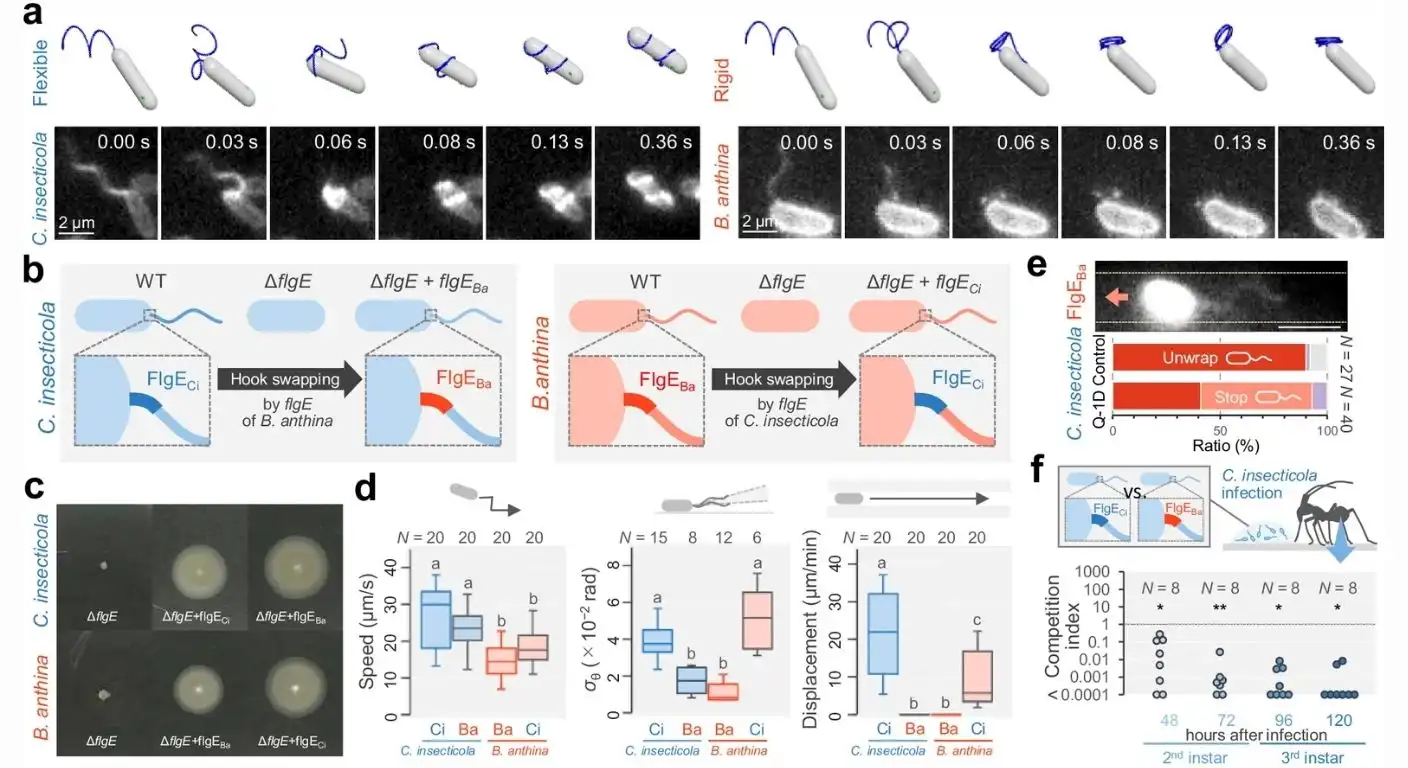
Under the microscope, they saw the bacteria repeatedly wrap and unwrap their flagella, creating a screw-like motion that propelled them forward. Other, related bacteria that couldn’t perform this “flagellar wrapping” got stuck.
Computer simulations confirmed what they were seeing. In a confined space, a normally rotating flagellum just stirs the fluid around, but a wrapped flagellum can push against the channel walls, creating much more efficient forward motion.
The team also pinpointed the specific part of the flagellum that enables this trick: a tiny, flexible joint called the “hook.” When they swapped the hook genes from a “wrapping” species to a “non-wrapping” one, the bacteria lost their ability to squeeze through the tight spaces.
This discovery is not just a cool piece of biology; it could also have real-world applications. Understanding these micro-scale drilling motions could inspire the design of tiny robots that can navigate challenging environments, such as human tissue or filtration systems. “Flagellar wrapping shows how life solves mechanical problems in elegant, unexpected ways,” said one of the lead researchers.
Source: Nature Communications (2026).