Key Points
- A new study has uncovered how the initial shape of a cell cluster can predict its future growth.
- The researchers found that “leader” cells always invade from the “sharper ends” of a slightly oval-shaped cluster.
- The cells reshape their surrounding environment by pulling on it, creating pathways for invasion.
- The invasion process can be controlled by changing the pressure of the surrounding environment.
Scientists have long been fascinated by how groups of cells can work together to build complex tissues like lungs and livers. It’s a process of collective construction, but the exact rules of the game have been a mystery. Now, a new study from Brown University has uncovered a surprising insight: the initial, slightly imperfect shape of a cell cluster can actually predict how it will grow and change in the future.
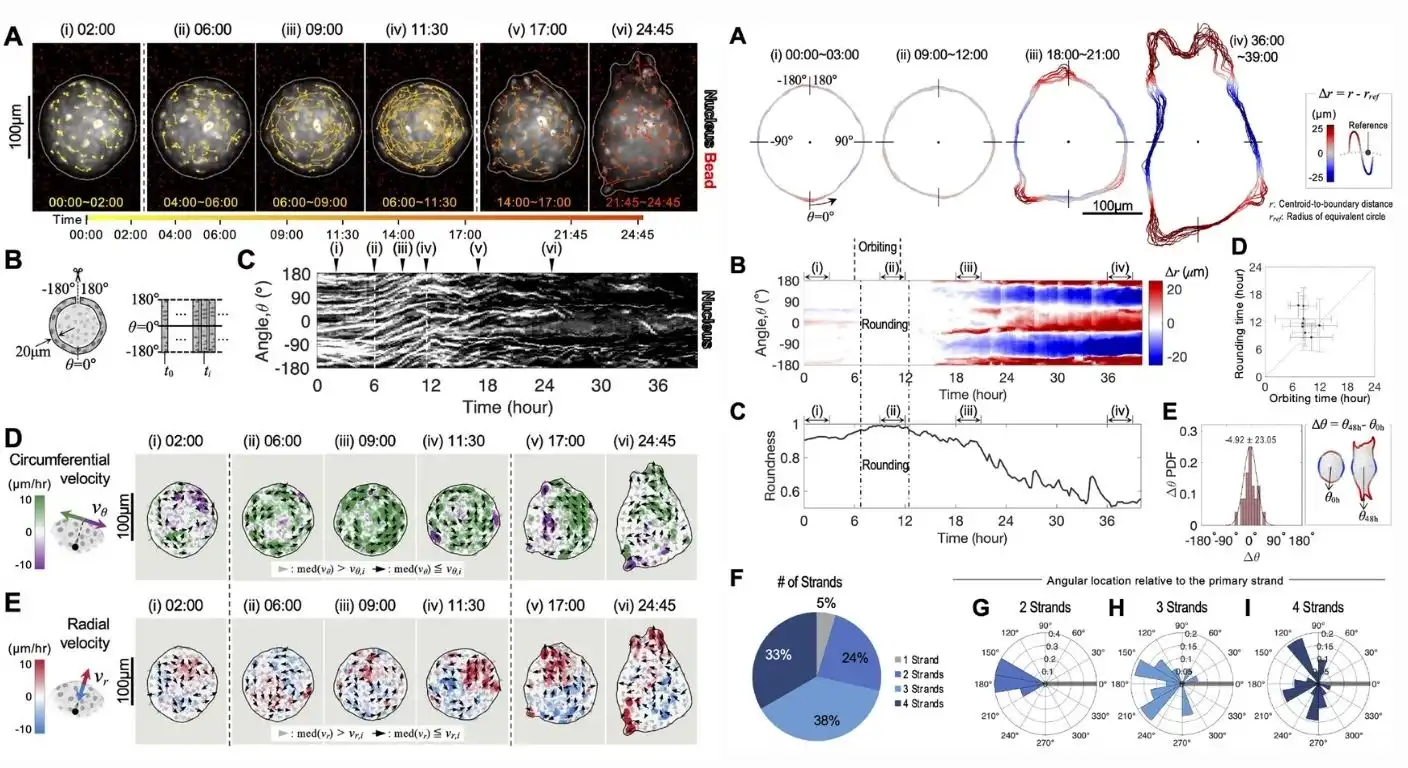
The researchers grew small, roughly spherical clusters of human cells and then embedded them in a collagen material that mimics the body’s natural environment. They then watched as the cells began to move and interact.
What they saw was striking. First, the entire cluster of hundreds of cells began to spin around inside the collagen. Then, after about 12 hours, a few “leader” cells began to break away and invade the surrounding material, creating small strands that pushed their way outward.
The key finding was that these invasions always started at the “sharper ends” of the original, slightly oval-shaped cluster. “Cells invade from these sharper ends, as if they have a memory of the original shape,” said the study’s lead author.
By using tiny tracer particles in the collagen, the researchers were able to see that the cells were pulling a little harder at these sharper points. This pulling action reshaped the surrounding collagen, creating pathways that the cells could then follow as they moved outward.
The researchers also found that they could control this invasion process by changing the pressure of the surrounding environment. When they “squeezed” the cell clusters, the invasion stopped, and the cells even retracted back into the original sphere.
This work is a major step toward understanding the complex dance of cells that leads to the formation of tissues. It could also provide new insights into how cancer cells break free from tumors and spread throughout the body.
Source: Nature Physics (2026).