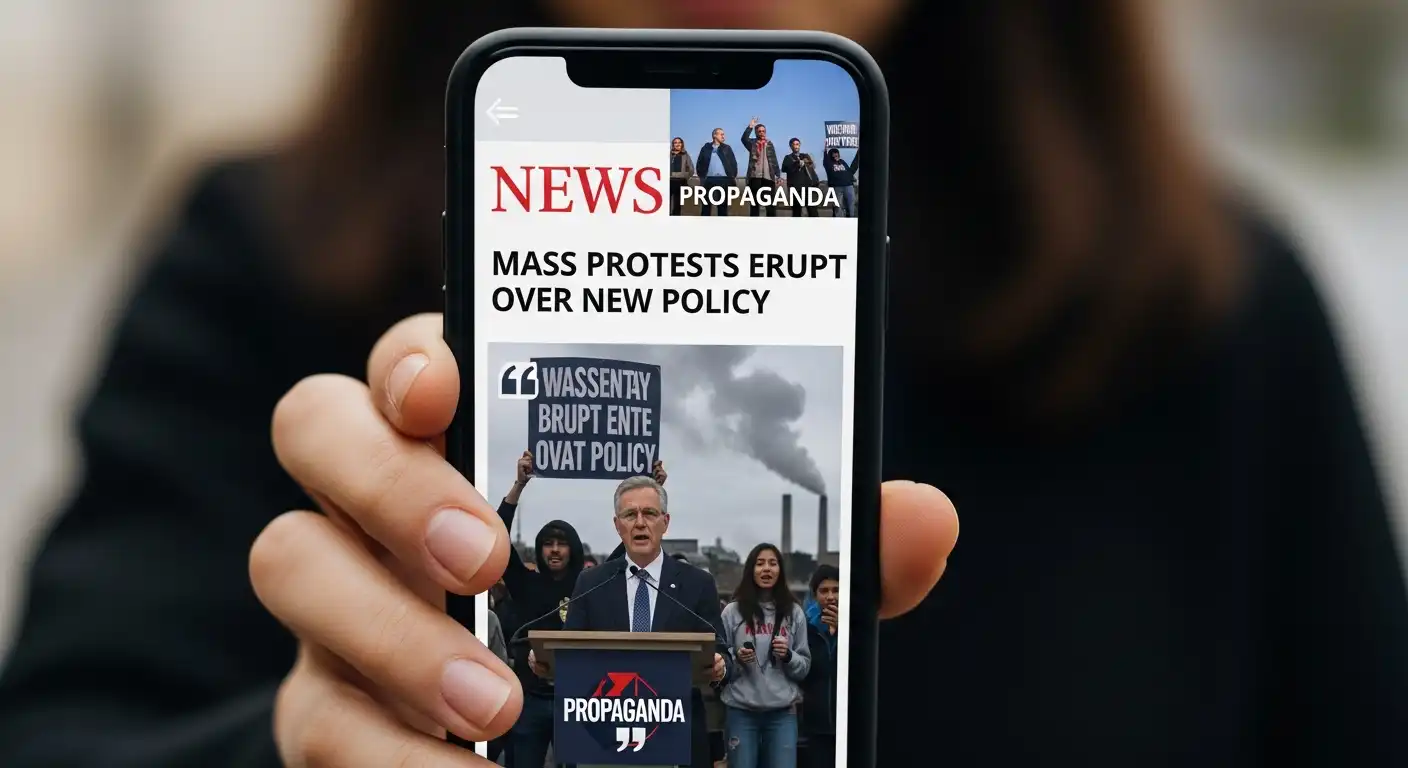
We like to believe that we are immune to manipulation. We look back at the stark, black-and-white posters of the 20th century—Uncle Sam pointing a finger, or crude caricatures of wartime enemies—and we think, “I would never fall for that.” We assume that propaganda is a relic of history, a tool used only by dictatorships or in times of total war.
This belief is dangerous. In reality, propaganda has not disappeared; it has evolved. It has traded the printing press for the algorithm, the megaphone for the meme, and the town square for the Twitter thread.
Today, we are swimming in a sea of persuasion. From the 24-hour news cycle and political advertisements to viral TikToks and corporate press releases, entities are constantly vying for a piece of your mind. They don’t just want to sell you a product; they want to shape your reality. They want to define who your enemies are, what you should fear, and what “truth” looks like.
Modern propaganda is subtle, sophisticated, and personalized. It leverages psychology, data analytics, and the speed of the internet to bypass your critical thinking defenses. To navigate the modern world without being manipulated, you must learn to see the invisible strings. You must become media literate.
This comprehensive guide will deconstruct the machinery of modern influence. We will explore the classic techniques that still work, the new digital tactics of the information age, and the practical steps you can take to reclaim your own opinion.
The Psychology of Influence: Why It Works
To recognize propaganda, you must first understand why it is so effective. Propaganda is not about logic; it is about biology. It targets the amygdala—the primitive part of your brain responsible for emotional responses like fear, anger, and tribalism—while bypassing the prefrontal cortex, where logic and reasoning reside.
The Cognitive Miser
The human brain is an energy-saving machine. Thinking critically is calorie-expensive and slow. Relying on heuristics (mental shortcuts) is cheap and fast. Propagandists exploit this by offering simple narratives to explain complex problems.
- Complex Reality: The economy is struggling due to a multifaceted combination of global supply chain issues, interest rates, and geopolitical shifts.
- Propaganda Narrative: The economy is failing because of Those People.
The second option is easier to process and satisfies the brain’s desire for a clear cause-and-effect relationship.
Confirmation Bias and Tribalism
We evolved to survive in tribes. Being cast out of the tribe meant death. Therefore, we are biologically wired to agree with our “in-group” and distrust the “out-group.” Propaganda hacks this survival mechanism. It rarely tries to change your mind; instead, it reinforces what you already suspect, validates your fears, and assures you that you are on the “right side” of history.
The 7 Classic Propaganda Devices
In the late 1930s, the Institute for Propaganda Analysis identified seven core techniques used to sway public opinion. Amazingly, nearly a century later, these seven devices remain the foundation of almost all modern political and corporate messaging.
Name-Calling
This is the most primitive form of propaganda. It involves attaching a negative label to a person or a group to trigger a rejection response without examining the evidence.
- How it works: By reducing a complex human or policy to a single dirty word, the propagandist encourages you to dismiss it entirely.
- Modern Examples: Words like “Fascist,” “Communist,” “Woke,” “Radical,” “Traitor,” or “Extremist.” When you hear these words used as insults rather than accurate political descriptors, you are witnessing name-calling. The goal is to dehumanize the opponent so that you don’t feel the need to listen to their arguments.
Glittering Generalities
This is the mirror image of name-calling. It involves using “virtue words”—vague, emotionally appealing phrases that sound great but mean very little. They are designed to bypass logic and make you feel good.
- How it works: Who could argue against “Freedom”? Who hates “Justice”? By wrapping a controversial policy in a “Glittering Generality,” the propagandist makes it impossible to criticize the policy without seeming like you oppose the virtue itself.
- Modern Examples: Slogans like “Make America Great Again,” “Build Back Better,” “Support Our Troops,” or “Family Values.” These phrases are containers; every listener fills them with their own personal definition of what “Great” or “Better” means.
Transfer
This technique uses symbols, images, or authority figures to transfer the prestige of a positive thing onto the propagandist’s cause.
- How it works: It acts by association. If a politician gives a speech standing in front of a massive American flag, they are hoping the patriotic feelings you have for the flag will transfer to them.
- Modern Examples: A YouTuber filming themselves in a library to appear intellectual; a supplement company using a person in a white lab coat (who isn’t a doctor) to sell pills; a politician posing with factory workers to seem “blue-collar.”
Testimonial
This is the classic endorsement. It relies on the fame or reputation of a person to sell an idea or product, regardless of their actual expertise.
- How it works: We trust people we recognize. This is known as the “Halo Effect.”
- Modern Examples: A pop star endorsing a presidential candidate; a famous podcaster pushing a cryptocurrency; an athlete selling insurance. The critical question to ask is: Does this person actually know anything about this topic, or are they just famous?
Plain Folks
This technique attempts to convince the audience that the propagandist and their ideas are “of the people.” It is an attempt to appear humble and relatable to avoid looking like an elite.
- How it works: It creates a false sense of intimacy and trust.
- Modern Examples: A billionaire politician eating at McDonald’s; a CEO wearing a t-shirt and jeans instead of a suit; a viral video of a celebrity doing their own laundry. The message is: “I am just like you, so you can trust me.”
Card Stacking
This is the most common form of media bias. It involves highlighting only the facts that support one side of the argument while suppressing, ignoring, or burying the facts that support the other side.
- How it works: It is not necessarily lying; it is the manipulation of context. It is telling 50% of the truth to create 100% of the deception.
- Modern Examples: A news report that focuses on the one peaceful protestor in a riot, or conversely, the one violent protestor in a peaceful march. It is “cherry-picking” data to prove a point. If a pharmaceutical ad tells you the benefits of a drug for 28 seconds and speeds through the side effects for 2 seconds, that is card stacking.
Bandwagon
This appeals to the human desire to fit in. It suggests that “everyone is doing it” or “the wave is coming,” and you must join now or be left behind.
- How it works: It triggers FOMO (Fear Of Missing Out) and social conformity.
- Modern Examples: “The fastest-growing app in history”; polls showing a candidate “surging in the lead”; social media challenges. When you see a post with 100,000 likes, you are psychologically primed to like it too, simply because others have.
The Digital Evolution: New Tactics for the Internet Age
The internet has supercharged these classic techniques and introduced new, more insidious ones. The digital battlefield is chaotic, fast, and often anonymous.
Whataboutism
This is a deflection tactic used to discredit an opponent’s position by charging them with hypocrisy without directly refuting or disproving their argument.
- The Tactic: Person A says, “This politician committed a crime.” Person B responds: “Yeah, well, what about when your politician did X five years ago?”
- The Goal: It derails the conversation. Instead of discussing the current issue/crime, the debate shifts to a comparison of evils. It suggests that because everyone is flawed, no one can be held accountable.
The Gish Gallop
Named after creationist Duane Gish, this debate tactic involves drowning the opponent in a torrent of weak, half-true, or irrelevant arguments.
- The Tactic: The propagandist speaks so fast and throws out so many claims that the opponent cannot possibly refute them all in the time allowed.
- The Goal: It makes the opponent look overwhelmed or unprepared. To the audience, the person who talked the most and “stumped” the other person appears to be the winner. In social media comments, this looks like a user posting a list of 50 links to dubious blogs and saying, “Do your research.”
Astroturfing
This is the illusion of grassroots support. “Grassroots” movements come from the people (the bottom up). “Astroturf” is fake grass; these movements are coordinated by corporations or political groups (top down) to look like they are organic.
- The Tactic: Using bot farms to flood Twitter with a specific hashtag; paying actors to attend a town hall meeting; creating fake Facebook groups to push a narrative.
- The Goal: To trigger the Bandwagon effect. If you think thousands of people are angry about an issue, you assume it must be important.
Rage-Baiting and Doom-Scrolling
Social media algorithms are designed to keep you on the platform. The emotion that keeps people engaged the longest is anger.
- The Tactic: content creators and news outlets purposefully use inflammatory headlines, misleading thumbnails, and controversial takes to trigger rage.
- The Goal: Engagement. Every angry comment, quote-tweet, or hate-share tells the algorithm that the content is “popular,” boosting its reach. The propaganda is the engagement itself.
Gaslighting
Derived from the play Gaslight, this is a form of psychological manipulation where the propagandist seeks to sow seeds of doubt in a targeted individual or group, making them question their own memory, perception, or sanity.
- The Tactic: “That never happened.” “You are overreacting.” “It was just a joke.” “You are seeing things.”
- The Goal: To destabilize the victim’s trust in reality, making them dependent on the propagandist for the “truth.”
Visual Propaganda: When Seeing Isn’t Believing
We are visual creatures. We process images 60,000 times faster than text. Propagandists know that a single image can bypass hours of logical argumentation. In the age of Photoshop and AI, visual literacy is a survival skill.
The Selective Crop
A photo never tells the whole truth; it only tells the truth of what is inside the frame.
- The Technique: A photo shows a police officer raising a baton. It looks like police brutality. Zoom out (the uncropped version), and you see someone charging the officer with a knife.
- The Counter: Always ask: What is happening outside the frame?
Forced Perspective
Camera angles manipulate reality.
- The Technique: A photo of a rally is taken from a low angle, with a telephoto lens, compressing the crowd to make it look packed and massive. The same rally, photographed from a drone overhead, reveals the crowd is thin and sparse.
Deepfakes and AI
We have entered the era of synthetic media. AI can now generate photorealistic faces of people who don’t exist, or create video footage of real people saying things they never said.
- The Technique: Creating an image of a political rival getting arrested, or a video of a CEO announcing a stock crash.
- The Signs: Look for the “Uncanny Valley.” In AI images, check the hands (often too many fingers), the text in the background (usually gibberish), and the symmetry of accessories like glasses or earrings. In audio, listen for unnatural breathing patterns or a lack of emotional inflection.
The “P.R.O.O.F.” Framework: How to Analyze Media
To fight back against propaganda, you need a system. You cannot simply trust your gut, because your gut is exactly what they are targeting. When you encounter a piece of emotionally charged content, pause and apply the P.R.O.O.F. framework.
P – Purpose (Why was this created?)
Does this content exist to inform, to entertain, or to persuade?
- Look at the ads on the page.
- Look at the “About Us” section.
- Is the language neutral (“The bill passed by 51 votes”) or loaded (“The radical left rammed through a disastrous bill”)?
R – Reputability (Who is the source?)
Is this a known entity with an editorial process?
- Check the URL. Is it abcnews.com.co (a fake clone) or abcnews.go.com (real)?
- Does the author have a bio?
- Is the source transparent about its funding? State-sponsored media (like RT or CCTV) have a different mandate than independent journalism.
O – Objectivity (Is the bias acknowledged?)
Every human has bias. The dangerous sources are the ones that claim to have none.
- Does the article present multiple viewpoints?
- Does it use “Card Stacking” to hide inconvenient facts?
- Does it use “Name-calling” to dismiss the opposition?
O – Origin (Where is the evidence?)
Propaganda thrives on vagueness. “Experts say…” “People are saying…”
- The Hyperlink Test: Click the links in the article. Do they go to primary sources (studies, transcripts, raw video)? Or do they go to other opinion blogs that loop back to the original claim? A circular loop of links is a hallmark of a propaganda echo chamber.
- Reverse Image Search: If the story relies on a shocking photo, right-click it and search Google Images. You might find that the “War Zone 2024” photo is actually from a movie set in 2012.
F – Feelings (How does it make me feel?)
This is the most important step.
- Does this headline make me angry? Afraid? Smug?
- If a piece of content triggers a high-arousal emotion, STOP.
- Propaganda is designed to bypass the wait-time of logic. If you feel an intense urge to share something immediately to “warn others” or “show the truth,” you are likely being manipulated. Take 10 minutes to cool down before sharing.
Conclusion
We often blame the social media platforms, the government, or the media companies for the spread of propaganda. While they hold significant responsibility, the final line of defense is you.
You are the gatekeeper of your own mind. You are the editor of your own feed. Every time you share an unverified meme, every time you click on a rage-bait headline, and every time you accept a comfortable lie over a difficult truth, you are keeping the machine running.
Recognizing propaganda is not about becoming a cynic who believes nothing; it is about becoming a skeptic who questions everything. It is about valuing truth more than tribalism.
The next time you see a headline that perfectly confirms everything you believe about “the enemy,” pause. Look for the strings. Check the source. And remember: if they are trying to scare you, they are trying to sell you something—usually, your own obedience.