Key Points:
- Scientists found evidence that empty space provides ingredients for matter.
- The study analyzed particle spins at the Relativistic Heavy Ion Collider.
- Real particles retained the “spin alignment” of virtual vacuum particles.
- The findings prove the quantum vacuum is full of fluctuating energy.
Scientists at the Department of Energy’s Brookhaven National Laboratory have uncovered new evidence about how “nothingness” transforms into the matter that makes up our world. A new study published in Nature shows that particles emerging from violent subatomic collisions keep the traits of the fleeting virtual particles that exist in the quantum vacuum.
For a century, physicists have known that empty space isn’t actually empty. The quantum vacuum is a busy place filled with energy fields. “Virtual” pairs of matter and antimatter constantly blink in and out of existence.
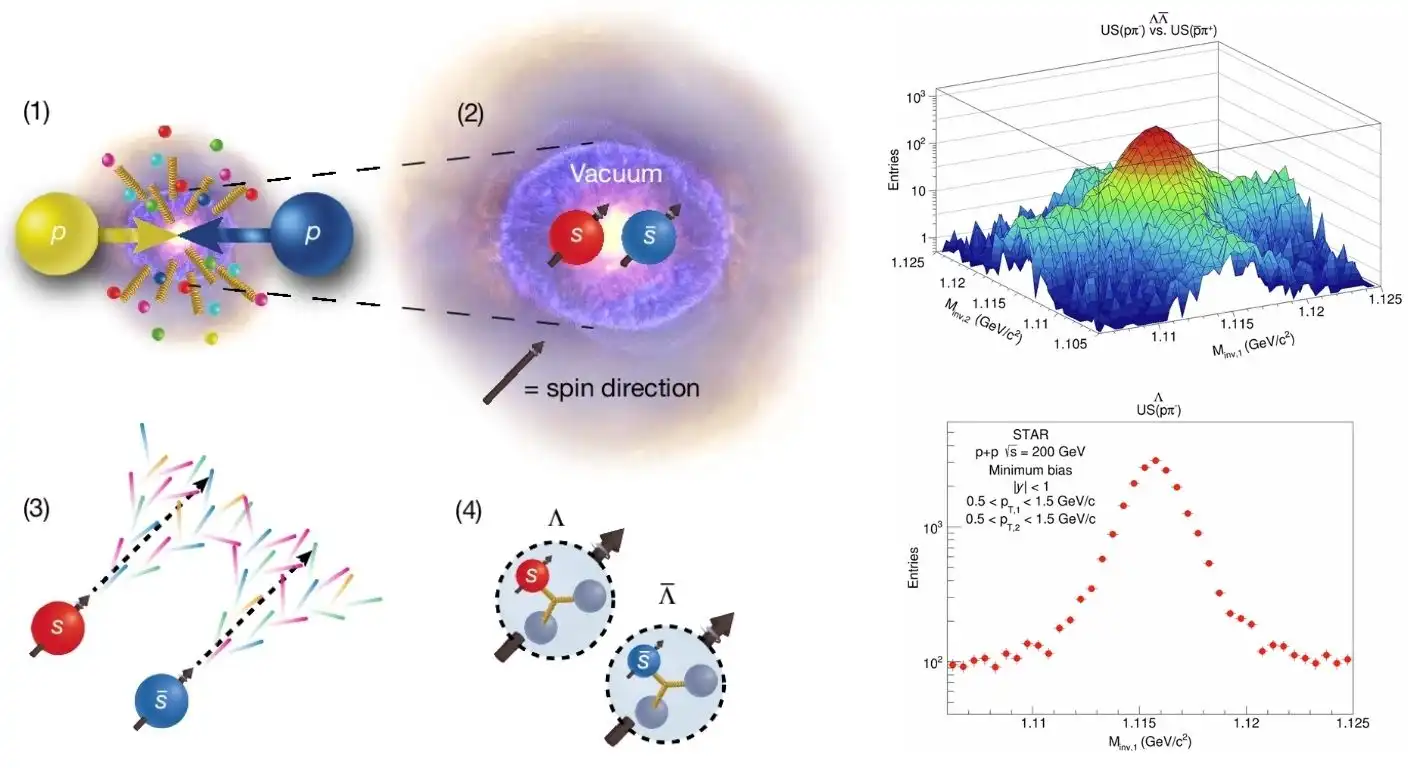
However, they usually vanish too quickly to measure. The STAR Collaboration team used the Relativistic Heavy Ion Collider (RHIC) to change that. By smashing protons together at high speeds, they gave these virtual pairs enough energy to become real, detectable particles.
The researchers focused on specific particles called lambda hyperons and their antimatter twins, antilambdas. In most crashes, particles fly out spinning in random directions. But the team noticed a pattern. When a lambda and an antilambda appeared close together, their spins were 100% aligned. This perfect synchronization matches the behavior of the virtual strange quarks found in the vacuum.
“This work gives us a unique window into the quantum vacuum,” said Zhoudunming Tu, a physicist who co-led the study. The data suggests that these new particles remembered their origins. Even after becoming real matter, they kept the quantum connection they established when they were just ghost-like fluctuations.
Jan Vanek, who led the data analysis, compared the particles to “quantum twins.” Because they started as an entangled pair in the vacuum, they acted the same way when they entered the physical world. This discovery offers a new way to explore how the universe builds mass. It connects the invisible quantum world to the stars, planets, and people we see today.
Source: Nature (2026).