Key Points:
- Chinese scientists developed a new, highly sensitive gas detection method.
- The technique uses parabolic mirrors instead of traditional lenses to collect light.
- The mirrors eliminate “blind spots” and capture much more signal.
- Advanced software helps extract weak gas signals from noisy backgrounds.
A research team in China has developed a new way to detect tiny amounts of gas with much greater accuracy. Scientists from the Hefei Institutes of Physical Science created a system that uses parabolic mirrors to overcome a major limitation in a common detection method. This breakthrough, published in Optics & Laser Technology, could improve environmental monitoring, industrial safety, and medical diagnostics.
The technology at the heart of this work is called Raman spectroscopy. It is an excellent tool for identifying multiple gases at once without interference from water vapor. However, its biggest weakness is that the signal it produces is very faint, which makes it hard to detect gases in very low concentrations.
For years, scientists have tried to boost this weak signal using lenses to collect the scattered light. The problem is that lenses have a limited field of view. They cannot efficiently capture the light that scatters in all directions, creating blind spots and losing valuable information.
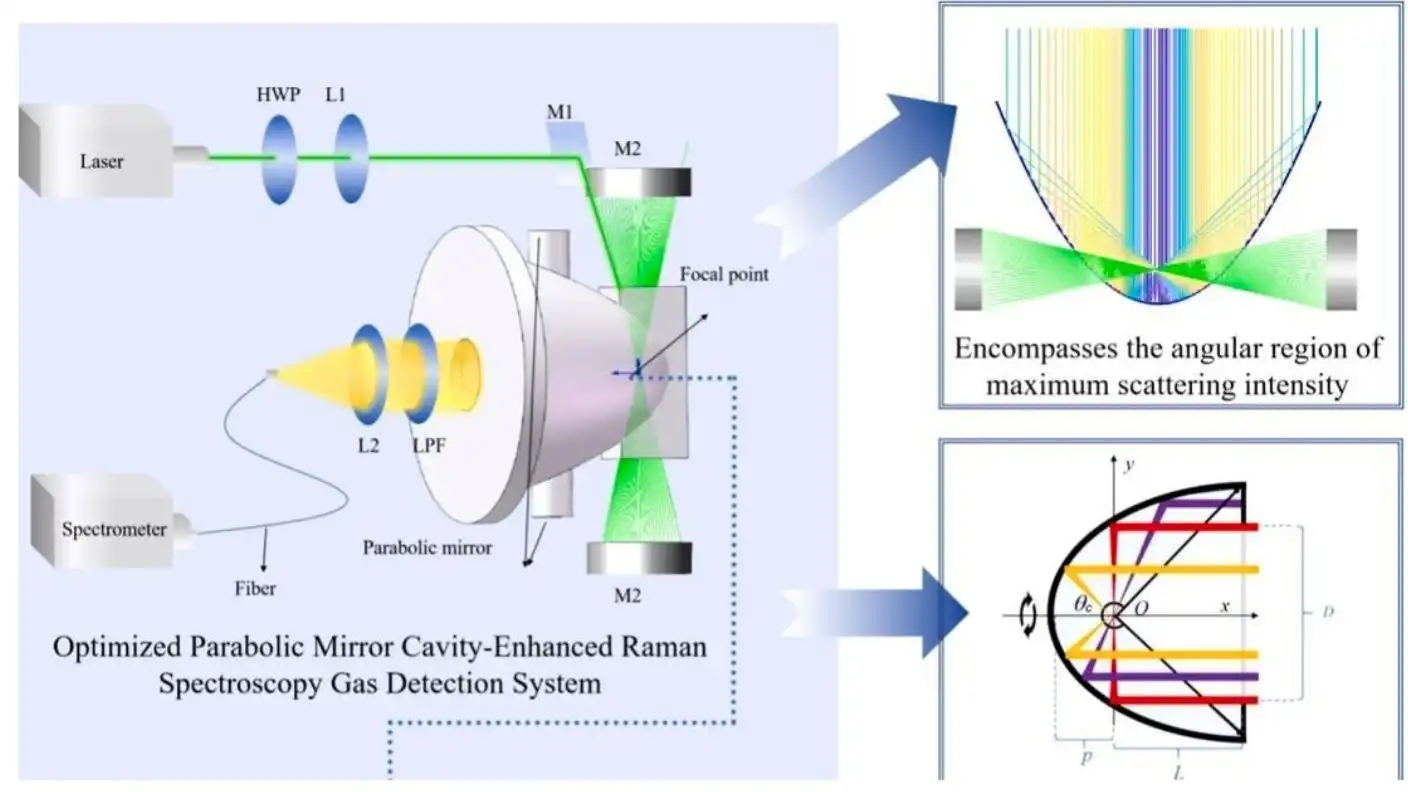
The Chinese team, led by Professor Fang Yonghua, solved this problem by replacing the lenses with parabolic mirrors. These curved mirrors have a much larger aperture, allowing them to gather significantly more of the scattered light. By carefully designing the system, they created a closed-loop optical path that effectively eliminates the blind spots and reduces interference from stray light.
To make the system even more powerful, the researchers also developed a smarter way to analyze the data. They designed a new software strategy that can reliably pull the weak Raman signal out from a noisy background. This allows the device to accurately identify trace amounts of gas that would have been missed by older methods.
Experimental results confirmed that the new system is substantially stronger and more sensitive than traditional setups. As an added bonus, the team was able to make the entire device much smaller, making it more practical for real-world applications where compact, portable sensors are needed.
Source: Optics & Laser Technology (2026).