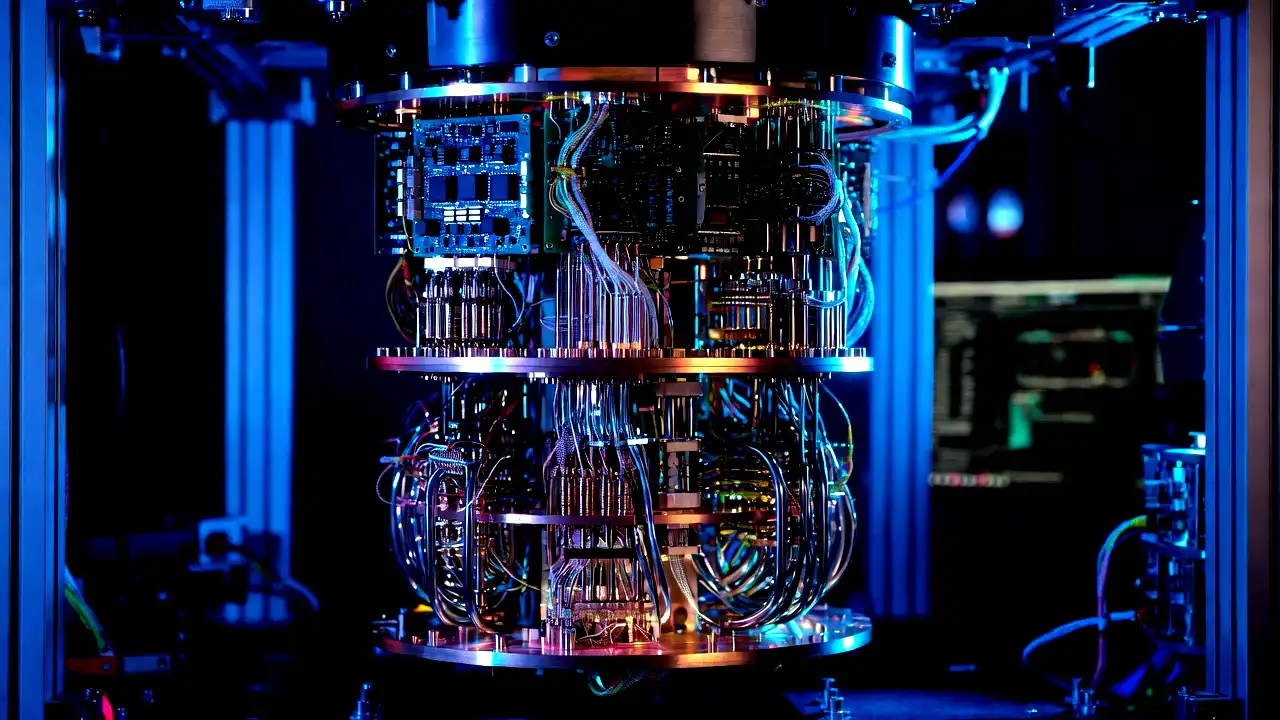
We are standing at the precipice of a new computational era. By 2026, quantum computing is transitioning from the experimental “NISQ” (Noisy Intermediate-Scale Quantum) era into the dawn of fault tolerance and practical utility. The hardware race has moved beyond simple qubit counts; the new battleground is qubit quality, error correction, and the ability to run long, complex algorithms that classical supercomputers simply cannot touch.
The companies leading this charge are solving some of the hardest engineering challenges in human history, utilizing everything from supercooled loops of wire to individual atoms suspended in lasers. Investors, researchers, and enterprise leaders are watching closely to see which architecture will scale first. Here are the top 5 quantum computing hardware companies defining the landscape in 2026.
International Business Machines Corporation (IBM)
IBM remains the undisputed heavyweight champion of the quantum world, adhering strictly to an aggressive development roadmap that has consistently delivered results. By 2026, IBM is focused on scaling its “Quantum System Two” architecture and leveraging its Heron and Flamingo processors to make “quantum utility” a reality for enterprise clients.
IBM’s strategy relies on superconducting qubits, and its massive fleet of quantum computers accessible via the cloud makes them the most accessible platform in the ecosystem. Their key strengths for 2026 include:
- Roadmap Reliability: IBM has successfully hit its hardware milestones year over year, instilling confidence in enterprises looking to build long-term quantum strategies.
- Error Mitigation: Before full error correction arrives, IBM leads the field in error mitigation techniques, allowing users to get useful results from noisy hardware today.
- The Qiskit Ecosystem: Their open-source software development kit, Qiskit, is the industry standard, ensuring that hardware advancements are immediately usable by a massive global developer community.
- Modular Scaling: The shift to modular quantum computing—connecting multiple chips to function as one larger processor—is central to their 2026 strategy for scaling beyond single-chip limits.
Primary Architecture: Superconducting Transmon Qubits
Alphabet Inc. (Google Quantum AI)
Google Quantum AI made history with its claim of “quantum supremacy” in 2019, and in 2026, they remain laser-focused on the scientific “holy grail” of the industry: a fully error-corrected logical qubit. Google’s approach is less about selling cloud access to the masses and more about achieving the engineering breakthroughs required to build a useful, large-scale quantum computer.
Their research into the Sycamore processor has paved the way for reducing error rates, which is the single biggest barrier to practical quantum computing. Their key differentiators include:
- Focus on Logical Qubits: Google is prioritizing the creation of a “logical qubit”—a cluster of physical qubits that work together to correct errors—aiming for a reliable building block for future scaling.
- Sycamore Architecture: Their proprietary processor design is highly optimized for specific complex tasks, consistently pushing the boundaries of what is computationally possible.
- Deep AI Integration: As a leader in AI, Google is uniquely positioned to explore the intersection of quantum mechanics and machine learning (Quantum ML).
- TensorFlow Quantum: Their software integration allows for rapid prototyping of hybrid quantum-classical models, bridging the gap for AI researchers.
Primary Architecture: Superconducting Qubits
IonQ, Inc. (IonQ)
As the first pure-play quantum computing company to go public, IonQ has staked its future on trapped-ion technology, which offers superior fidelity (accuracy) compared to superconducting approaches. By 2026, IonQ is capitalizing on its “Forte” generation of systems, focusing on manufacturing rack-mounted quantum computers that can integrate directly into standard enterprise data centers.
IonQ’s atoms are identical by nature, which removes the manufacturing variations that plague silicon-based competitors. Their strengths in the 2026 market include:
- High Fidelity and Connectivity: Trapped ions offer “all-to-all” connectivity, meaning every qubit can talk to every other qubit, allowing for more complex algorithms to be run with fewer operations.
- Algorithmic Qubits (#AQ): IonQ focuses on “Algorithmic Qubits” as a metric, prioritizing the useful work a system can do over just raw physical qubit counts.
- Data Center Integration: Their push to miniaturize systems into standard server rack sizes is a game-changer for on-premise deployment in government and financial sectors.
- Barium Qubits: The transition to barium ions has allowed for faster gate speeds and more reliable scaling compared to their earlier ytterbium-based systems.
Primary Architecture: Trapped-Ion
Quantinuum (Honeywell & Cambridge Quantum)
Formed by the merger of Honeywell Quantum Solutions and Cambridge Quantum, Quantinuum is a powerhouse that combines world-class hardware manufacturing with advanced software. In 2026, their H-Series quantum computers continue to hold records for “Quantum Volume,” a metric that measures the overall capability and performance of a system.
Quantinuum uses a trapped-ion architecture similar to IonQ but employs a unique “charge-coupled device” (CCD) architecture that physically shuttles ions around a trap to perform calculations. Their key advantages are:
- Highest Quantum Volume: Quantinuum consistently sets the bar for system performance, proving that its hardware has the lowest error rates in the industry.
- Logical Qubit Breakthroughs: They have successfully demonstrated the ability to create logical qubits that outperform physical qubits, a critical step toward fault tolerance.
- Quantum Cybersecurity: Through their software arm, they are leaders in quantum-generated cryptographic keys (Quantum Origin), offering immediate commercial value in cybersecurity.
- Hybrid Traps: Their advanced trap designs allow for mid-circuit measurement and qubit reuse, enabling them to run deeper circuits than many competitors.
Primary Architecture: Trapped-Ion
Rigetti Computing, Inc. (Rigetti)
Rigetti Computing is a pioneer in the hybrid cloud model, believing that quantum computers will work best as co-processors alongside classical supercomputers. By 2026, Rigetti’s multi-chip architecture and proprietary fabrication facility allow it to iterate on chip designs faster than almost anyone else in the superconducting space.
Rigetti’s unique value proposition lies in its vertical integration—they own the fab, the chip design, and the cloud infrastructure. Their strengths include:
- Multi-Chip Scaling: Rigetti’s Ankaa and Novera systems utilize a modular architecture that tiles multiple chips together to increase processor size without sacrificing performance.
- Hybrid Quantum-Classical Focus: Their platform is optimized for low-latency communication between quantum and classical processors, which is essential for variational algorithms used in chemistry and finance.
- On-Premise QPU Sales: Unlike competitors who only offer cloud access, Rigetti sells quantum processing units (QPUs) to national labs and research centers, expanding their hardware footprint.
- Rapid Fabrication Cycles: Owning their own Fab-1 facility allows for rapid testing of new chip designs, accelerating their R&D cycle significantly.
Primary Architecture: Superconducting Qubits
Conclusion
The quantum hardware landscape of 2026 is defined by a shift from experimentation to industrialization. While IBM and Google continue to push the boundaries of superconducting physics, IonQ and Quantinuum are proving that trapped ions offer a path to incredible accuracy. Meanwhile, Rigetti champions the hybrid infrastructure that will likely define the first generation of practical quantum applications. For investors and enterprises, the “winner” is not just the company with the most qubits, but the one that can keep those qubits quiet enough to solve problems that have baffled humanity for decades.