

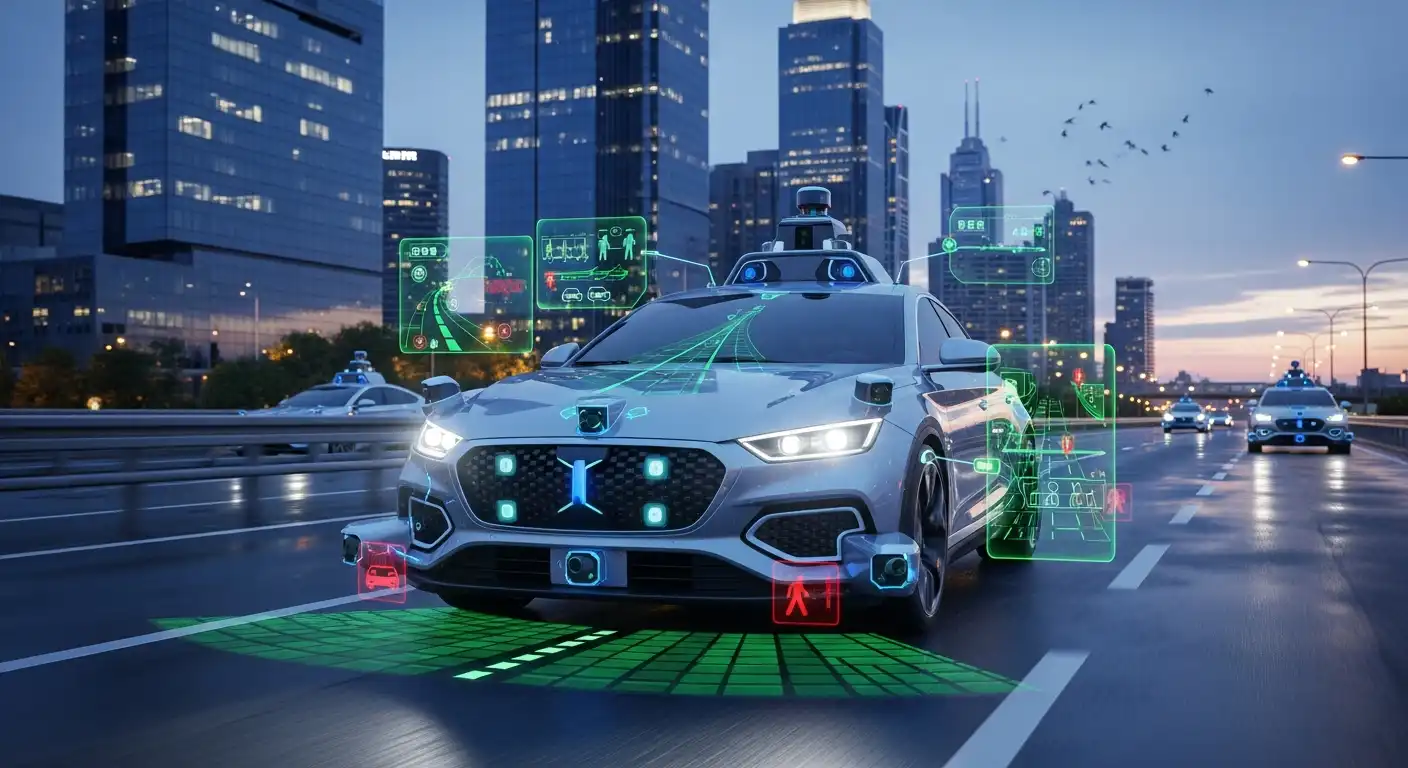
The dream of a fully autonomous vehicle—a car that can navigate our complex world without a human driver—is one of the most ambitious and transformative technological pursuits of our time. The journey is a marathon, not a sprint, requiring staggering advancements in AI, sensor technology, and high-performance computing.
As we look at the landscape in 2026, the industry has matured significantly. The initial hype has given way to a strategic race, with a few key players emerging as the dominant forces in both robotaxi development and advanced driver-assistance systems (ADAS). For anyone watching the future of mobility, these are the top 5 autonomous driving technology companies leading the charge.
Waymo (an Alphabet company)
Born out of the original Google Self-Driving Car Project, Waymo is the undisputed pioneer and long-standing leader in the pursuit of full autonomy. With more real-world, fully driverless miles than any other company, it has unparalleled experience and data.
Waymo’s strategy focuses on solving the hardest part of the problem first: fully autonomous, Level 4 ride-hailing in dense urban environments.
- The Waymo Driver: A highly sophisticated, multi-layered sensor suite that combines lidar, cameras, and radar, all powered by a powerful AI platform that has learned from billions of miles of simulated and real-world driving.
- Commercial Robotaxi Service: The first company to launch a fully driverless, commercial ride-hailing service to the public, now operating and expanding in major US cities like Phoenix and San Francisco.
- Deep Backing from Alphabet: Has the immense financial and technical resources of its parent company, Alphabet, allowing it to play the long game in this capital-intensive industry.
- Focus on Safety and Redundancy: The Waymo Driver is built with multiple layers of redundancy across all critical systems—from braking and steering to compute and sensors—to ensure safe operation.
Best For: Leading the world in Level 4 autonomous ride-hailing (robotaxis) and setting the benchmark for safety and experience.
Cruise (a General Motors subsidiary)
Cruise, backed by the manufacturing might of General Motors and investments from other major players, is Waymo’s primary competitor in the urban robotaxi space. The company has aggressively deployed its all-electric, driverless fleet in complex city environments.
Despite facing some regulatory and operational challenges, its rapid expansion and deep integration with a major automaker make it a formidable force.
- Deep Automaker Integration: As a GM subsidiary, Cruise has a direct path to mass-producing its autonomous vehicles at scale, a crucial advantage for long-term deployment.
- The Cruise Origin: A purpose-built, next-generation autonomous vehicle with no steering wheel or pedals, designed from the ground up for ride-sharing.
- Urban-First Deployment Strategy: Focused on mastering the most challenging driving environments first—dense, unpredictable cities—believing this will allow them to scale to simpler environments more easily.
- Significant Investment and Partnerships: Backed by GM, Honda, and Microsoft, giving it a strong financial and technological foundation.
Best For: Competing directly with Waymo in the robotaxi market with a strong focus on urban deployment and a direct link to mass manufacturing.
Tesla Inc.
Tesla has taken a radically different and highly controversial approach to autonomy, shunning lidar and radar in favor of a pure, camera-based vision system. Its strategy is not to build a Level 4 robotaxi first, but to incrementally improve its “Full Self-Driving” (FSD) ADAS through its massive fleet of consumer vehicles.
By 2026, Tesla will have collected an astronomical amount of real-world driving data, which it believes is the key to solving the problem.
- Vision-Only Approach: Bets that a neural network trained on a massive dataset of video from its cars can solve autonomy, just as humans drive with their eyes.
- Unmatched Data Collection Fleet: With millions of FSD-capable vehicles on the road, Tesla is collecting real-world driving data at a scale that no other company can match.
- Dojo Supercomputer: Has built its own custom supercomputer, Dojo, specifically to train the massive neural networks required for its vision-based autonomous driving system.
- Over-the-Air Updates: Can deploy new FSD software updates to its entire fleet simultaneously, allowing for rapid iteration and improvement.
Best For: Pioneering a vision-only approach to autonomy and leveraging a massive, real-world data collection fleet.
Mobileye (an Intel company)
Mobileye is the quiet giant of the automotive world. It is not building its own car or robotaxi service; instead, it is the leading supplier of ADAS technology—the cameras, chips, and software that power the safety and convenience features in hundreds of millions of cars from major automakers such as BMW, VW, and Ford.
Its strategy is to dominate the market for Level 2 and Level 3 systems and to build a high-definition mapping solution that will be critical to full autonomy.
- Market Leader in ADAS: The dominant supplier of the underlying technology for features like automatic emergency braking, lane-keeping assist, and adaptive cruise control.
- Road Experience Management (REM™): A brilliant, crowdsourced mapping technology that uses the cameras in millions of production vehicles to build and constantly update a high-definition, global road map.
- EyeQ® System-on-Chip (SoC): A highly efficient and powerful custom chip that is the brain behind its ADAS and autonomous driving systems.
- Multiple Paths to Autonomy: Offers a full stack of solutions, from the “Mobileye SuperVision™” system for hands-free driving to the “Mobileye Drive™” platform for fully driverless, Level 4 mobility-as-a-service.
Best For: Dominating the ADAS supply market and providing the foundational camera-based perception and mapping technology for the entire automotive industry.
NVIDIA Corporation
NVIDIA has leveraged its dominance in AI and high-performance computing to create NVIDIA DRIVE, a comprehensive, end-to-end platform for developing and deploying autonomous vehicles. It provides the “brains” and the “nervous system” for the software-defined car of the future.
It is not about building a car itself, but rather about providing open, scalable hardware and software that empower automakers and AV startups to build their own autonomous systems.
- Scalable DRIVE Thor™ Platform: A next-generation, centralized car computer that combines a powerful GPU and CPU to run everything from in-vehicle infotainment to the full autonomous driving software stack on a single chip.
- End-to-End Simulation (DRIVE Sim): A physically accurate, cloud-based simulation platform that allows developers to test and validate their autonomous driving software over billions of virtual miles.
- Open and Flexible Software: Offers a rich set of software development kits (SDKs) and a modular software stack, enabling automakers to build and customize their own AV applications.
- Strong Partnerships with Automakers: Has secured design wins with a wide range of automakers and robotaxi companies, including Mercedes-Benz, Volvo, and Jaguar Land Rover.
Best For: Providing a high-performance, open, and scalable compute platform (both hardware and software) for the entire automotive industry.
Conclusion
The race to autonomy in 2026 is a multi-front battle with different philosophies and business models. The dedicated robotaxi players Waymo and Cruise are proving their Level 4 models in cities. Tesla is pursuing a bold, vision-based strategy with its massive consumer fleet. And the key technology enablers, Mobileye and NVIDIA DRIVE, are providing the foundational hardware and software that will power the safety and autonomous features in millions of cars for years to come.
While the dream of a car that can drive you anywhere, anytime, in any condition remains on the horizon, the incredible progress of these five leaders ensures our journey toward a safer, more efficient, and more autonomous future accelerates every day.






