Key Points:
- German conservative leaders handed the EU Commission a list of 27 specific demands to reduce business regulations.
- EU Commission President Ursula von der Leyen agreed with German Chancellor Friedrich Merz on the need to cut red tape.
- Germany wants to relax artificial intelligence rules to help massive industrial companies like Siemens increase production.
- A group of 10 European countries strongly opposes the German push and warns it will remove important safety standards.
German conservative leaders and European Commission President Ursula von der Leyen downplayed their recent disagreements on Monday. They met in Berlin to discuss how to remove complicated rules that hurt local businesses. European companies complain daily about having to fill out endless forms instead of inventing new products. Chancellor Friedrich Merz and his center-right political group pushed von der Leyen hard behind closed doors. They want the European Union to slash red tape and make it much easier for companies to operate across borders.
Before the meeting even started, German lawmakers increased the pressure on the European executives. They wrote a detailed strategy paper titled the agenda for sustainable reduction of bureaucracy at EU level. This document reveals the tough tactics German politicians use to get their way in European politics. The paper includes a strict list of 27 far-reaching demands directed straight at the European Commission. The lawmakers believe that European companies spend too much time on paperwork instead of building new factories.
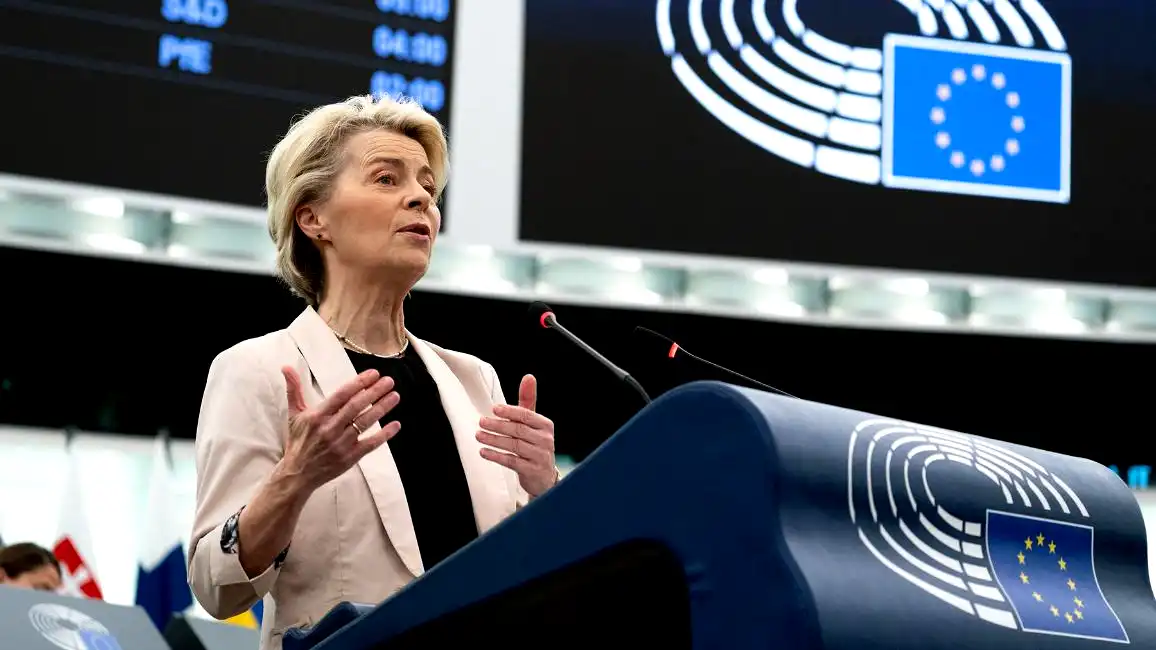
Despite the heavy pressure behind the scenes, the leaders showed a united front to the public in Berlin. Von der Leyen stood next to the German conservatives and smiled for the cameras. She told reporters that the European Commission fully supports Germany’s economic goals. She stated that everyone in Brussels wants to cut unnecessary rules and help businesses make more money. The leaders want to show that conservatives across Europe share a common vision for the future of the economy.
Von der Leyen expressed deep commitment to the deregulation effort during her speech. She mentioned that the German strategy document actually includes many ideas that the Commission already considers important. She promised to bring about real change across Europe and inside individual member states. Her main goal is to create an environment where companies can grow quickly and compete effectively on the global stage. She wants companies to spend money on workers rather than lawyers.
The leaders focused heavily on 2 major pieces of European legislation during their talks. First, they discussed the Industrial Accelerator Act. This law would create a strict preference for buying green products made inside the European Union. Second, they debated the new Artificial Intelligence Act. The German government actively tries to water down both of these laws to protect its local industries from heavy compliance costs. Officials want to ensure that buying local green products does not violate international trade rules or increase prices.
Jens Spahn serves as a leading figure among conservative lawmakers in Germany. He tried to maintain a friendly tone with the European executives during the press conference. He thanked the Commission for actively looking into deregulation and reducing the heavy bureaucracy that slows down trade. However, he made it clear that German politicians still want to change the exact details of these new laws before anyone signs them. He noted that lawmakers need to read every single page of the proposed laws to find hidden rules.
Spahn explained that Europe needs free and open markets to survive the current economic climate. At the same time, he recognized that Europe must fight back against giant economic rivals. He pointed out that the United States and China use very different approaches to protect their own companies. These countries spend billions of dollars to support local factories. Therefore, Spahn believes Europe must take strong measures to strengthen its local industries. He argued that ignoring the actions of foreign competitors will eventually destroy the European manufacturing sector completely.
The debate over artificial intelligence is causing the most friction among the member states right now. German officials demand that the European Union relax the rules concerning artificial intelligence inside factories. They want industrial manufacturing plants to use new computer systems without facing strict government oversight. Engineers use artificial intelligence to run robots and predict machine failures before they happen on the assembly line. This specific change would bring significant financial benefits to major German manufacturing companies such as Siemens.
However, Germany faces a tough fight regarding these artificial intelligence rules. A group of 10 other European countries joined forces last week to block the German plan. These nations issued a strong warning about the danger of removing too many rules. They argued that the German effort would strip away important safety regulations rather than simply make the paperwork easier for companies to complete. They fear that unchecked computer programs could make mistakes and hurt workers on the factory floor.
Spahn responded to the criticism by asking for more conversations and better compromises. He said the European Union must listen closely to German factories, small startup companies, and technology developers. He insisted that lawmakers need real input from the business world before they finalize any artificial intelligence laws. He ended the meeting by telling everyone they must strike the right balance between safety and corporate profits. He wants to build laws that protect citizens without punishing the companies that invent new technologies.