Key Points:
- Scientists created the RegVelo software to track how early cells develop into specific cell types, such as neurons or blood cells.
- The computer model links how cells change over time to the specific gene networks that control those changes.
- Researchers successfully used the tool to identify 2 new genes that specify pigment cell development in zebrafish embryos.
- This technology will help doctors develop more tailored cell therapies to treat complex developmental disorders.
Every human body starts as a blank slate of early cells. These basic building blocks eventually turn into highly specific blood cells, skin cells, and brain neurons. Scientists always wanted to know exactly how a simple cell decides what it will become. They desperately want to find the exact genetic regulators that steer a cell toward its final biological form.
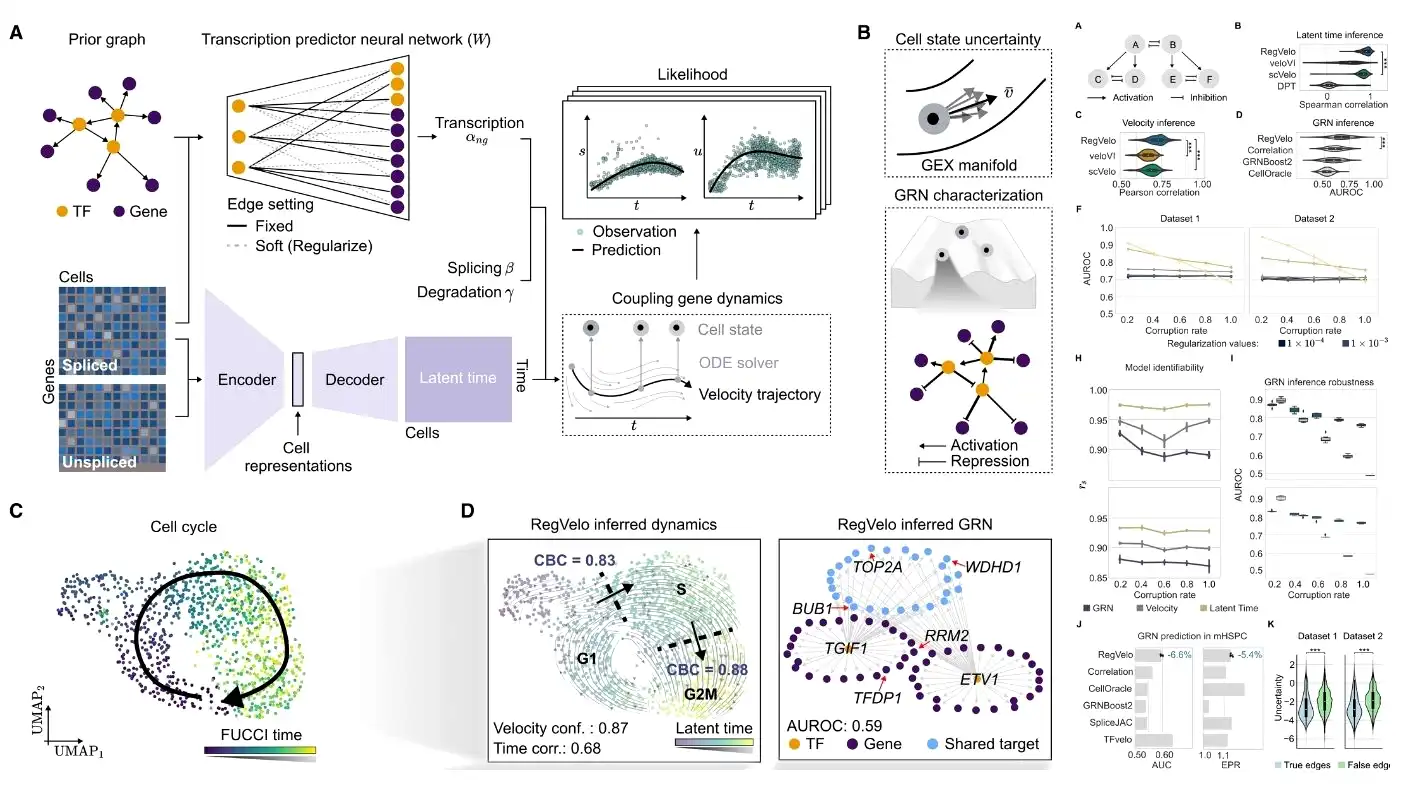
Researchers from the Stowers Institute for Medical Research and Helmholtz Munich finally solved this major problem. They built a powerful new system called RegVelo and recently published their findings in the journal Cell. This new technology connects two different areas of biology that usually operate separately. For decades, researchers struggled to merge data about cell movement with data about genetic behavior. The new system finally tracks how cells physically change over time and identifies the exact gene networks controlling those changes.
By combining these two pieces, RegVelo essentially lets scientists time-travel. The computer program predicts how cells will behave in the future and identifies the specific genes driving those behaviors. This software saves massive amounts of time and money because scientists no longer need to run every single experiment in a physical laboratory. The computer handles the heavy lifting first.
Tatjana Sauka-Spengler works as a lead investigator at the Stowers Institute and helped create the new tool. She explained exactly why this breakthrough matters for everyday medicine. If doctors know the exact instructions an early cell follows, they can recreate those same cell types in a clinical lab. Medical professionals can then use these custom cells to heal patients through advanced regenerative medicine.
Alejandro Sanchez Alvarado serves as the president of the institute. He noted that the team developed a completely new approach to processing complex biological data. The software finds the most likely path a cell will take through space and time. It uses deep learning models to guess these movements so scientists can easily test the best options in the real world.
To prove that the system works, the team examined the neural crest in zebrafish. These early embryonic cells have the potential to develop into many different body parts. RegVelo found a specific gene called tfec that initiates the physical process of pigment cell formation. It also discovered a second gene, elf1, that controls how those pigment cells complete their development.
The team did not just trust the computer screen. They went directly into the lab and used gene-editing tools to test these exact predictions on living cells. The physical lab tests proved the computer completely right. Sauka-Spengler said biologists usually view cellular development as a series of static pictures taken under a microscope. However, scientists really want to watch the whole movie in real time. They want to watch how cells make big decisions and transition smoothly from one biological state to another without missing any steps.
Single-cell biology usually keeps two core methods completely separate. One method observes how cells move through a landscape, and the other maps how genes relate to one another. Fabian Theis, a lead researcher from Munich, said scientists modeled these two things apart for a very long time. RegVelo finally combines them. Now, scientists can ask exactly which genes push a cell in a specific direction instead of just guessing where the cell will end up.
Gene regulatory networks act like a set of ordered instructions. Sauka-Spengler compared them to a cascade of falling dominoes. One group of genes turns another group on or off. Every single cell in the human body holds the same DNA. A skin cell looks completely different from a muscle cell simply because different gene combinations turn on at different times.
Testing 100 or even 1,000 genes one by one costs too much money and takes years of hard work. Scientists often look at networks containing massive amounts of complex data. RegVelo instantly narrows the search and saves countless hours of physical lab work. It serves as a highly accurate screening tool that directs researchers to the most important genetic drivers. By knowing exactly which genes matter, scientists can focus their full attention on the ones that cure diseases.
This deeper understanding will completely change modern medicine. Doctors can use this high-resolution mapping tool to find the root causes of severe birth defects. Over time, scientists will use these exact computer models to grow fresh skin grafts, repair damaged heart muscles, and build custom lab-grown cartilage for injured patients.
Source: Cell (2026).