Key Points:
- United States stock markets dropped on Friday, with the S&P 500 index falling 0.7% to close at 7,446.87 points.
- President Donald Trump ended his visit to China without announcing any major trade breakthroughs or signing any agreements.
- Brent crude oil prices jumped 3.2% to $109.10 a barrel as the Strait of Hormuz remains completely closed.
- Global bond markets suffered a massive sell-off, pushing the United States 30-year yield past the 5% mark.
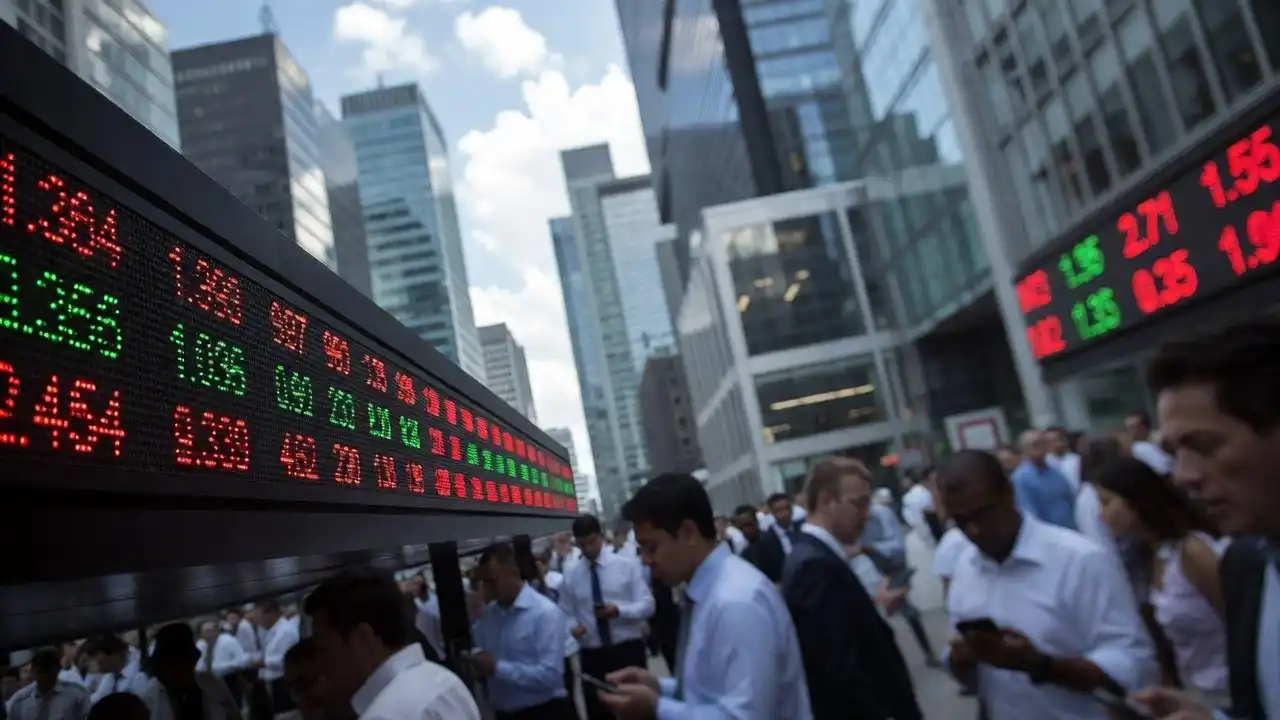
Wall Street stumbled on Friday as investors reacted to an underwhelming presidential trip to China and a massive global bond sell-off. The S&P 500 index dropped 0.7% to settle at 7,446.87 points. The tech-heavy Nasdaq shed 0.9% to close at 26,408.83 points, while the Dow Jones Industrial Average slipped 0.8% to end the day at 49,672.90 points. These declines forced the market to take a breather after a historic streak of record highs.
Market strategists saw this pullback coming. Mark Luschini works as the chief investment strategist at Janney Montgomery Scott. He explained that traders simply bought too many stocks too fast over the past few weeks. Luschini noted that the 10-year Treasury yield pushing toward 4.6% gives equity investors heartburn and naturally prompts price corrections. He views the current market action as a routine profit-taking exercise rather than the start of a massive crash.
President Donald Trump wrapped up his visit to China on Friday with very little to show the public. He boarded Air Force One and ended the first trip by a sitting American president to the Asian nation since his own previous visit in 2017. While Trump and Chinese President Xi Jinping held private meetings, both sides shared very few details about actual trade agreements.
Trump claimed during a Fox News interview that China agreed to purchase American oil, Boeing jets, and agricultural goods. He also stated that China would open its borders to Visa. However, investors wanted hard facts and signed contracts. Analysts at Vital Knowledge called the entire summit anticlimactic and noted the lack of any breakthroughs on topics that actually matter to the financial market.
Earlier in the week, traders felt optimistic that the United States might allow tech giant Nvidia to sell its artificial intelligence chips to 10 Chinese companies. This hope faded fast. United States Trade Representative Jamieson Greer told Bloomberg TV that Washington did not even make chip export controls a major topic of discussion during the meetings.
The ongoing war in the Middle East completely derailed any remaining positive market sentiment. Trump threatened Iran with harsh military strikes and complained about a lack of patience. The Strait of Hormuz remains entirely shut down. Iran effectively closed this vital waterway at the end of February, causing the biggest oil supply disruption in world history.
Oil prices instantly marched higher as the China trip ended and the Middle East conflict dragged on. Brent crude futures expiring in July spiked 3.2% to reach exactly $109.10 a barrel. This massive surge in energy costs terrifies traders because high oil prices directly drive stubborn global inflation. Factories pay more to produce products, and shipping companies pass their higher fuel costs straight to consumers.
This inflation panic triggered a historic sell-off in the global bond market. When investors sell bonds, bond yields automatically rise. The United Kingdom saw its 30-year yields hit the highest level since 1998. Japan saw its 30-year government bond yield reach an all-time high. High Japanese inflation data further supported the idea that the Bank of Japan will raise interest rates very soon.
The American bond market suffered the same fate. The benchmark United States 10-year yield jumped almost 14 basis points to hit 4.592%. The 30-year yield crossed a major milestone, climbing above the 5% mark to 5.124%. Traders have not seen the 30-year yield sit this high since June 2007. The shorter 2-year yield also climbed nearly 9 basis points to 4.079%.
Surging prices force central banks to take aggressive action. Prediction markets now show a 50% chance that the Federal Reserve will hike interest rates before July of next year. Diane Swonk serves as the chief economist at KPMG. She expects upcoming inflation reports to look incredibly hot. If prices keep rising, newly appointed Federal Reserve Chairman Kevin Warsh will face intense pressure to raise interest rates immediately to slow down the economy.
Looking at individual companies, some tech stocks cooled off while others shone brightly. Class A shares of Cerebras dropped 3.3% just one day after the chip designer’s massive market debut. Applied Materials slipped 0.8% despite the manufacturer reporting excellent quarterly revenue. On the bright side, Figma surged 14.4% as customers rushed to sign up for its new artificial-intelligence design tools.