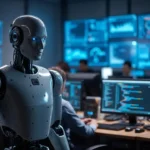
For centuries, the story of industrial progress has been a story of machines augmenting human muscle. From the steam engine to the assembly line, we built tools of immense power to do the heavy lifting, the repetitive tasks, the work that was too dull, dirty, or dangerous for human hands. The last industrial revolution, powered by computers, gave these machines a basic level of automation, the ability to follow a pre-programmed set of instructions with precision and speed. But they were, for the most part, blind, unthinking automatons, powerful but dumb. We are now living through the dawn of a completely new era, a revolution not just in what our machines can do, but in what they can perceive, learn, and decide.
This is the era of the sentient machine, a time defined by the profound and accelerating fusion of Artificial Intelligence (AI) and Robotics. This is not just a story about building better robots; it is about giving robots a mind. It is about infusing the physical machinery that moves our world with the cognitive power of artificial intelligence, creating a new class of intelligent agents that can sense their environment, adapt to variability, and perform complex tasks with a level of autonomy that was once the exclusive domain of science fiction. This convergence is not an incremental improvement; it is a tectonic shift —a force that is creating “next-generation” industries and fundamentally reshaping existing ones. From autonomous factories and self-driving supply chains to robotic surgery and precision agriculture, the fusion of AI and robotics is not just a trend. It is the very engine of the next great wave of economic productivity and human progress.
The Symbiotic Revolution: Deconstructing the Powerful Fusion of AI and Robotics
To understand the transformative impact of this new era, we must first grasp why the combination of AI and robotics is far more powerful than the sum of its parts. For decades, the two fields developed on largely separate tracks.
This convergence is a symbiotic relationship where each technology unlocks a new and more powerful set of capabilities in the other, creating a virtuous cycle of accelerating innovation.
Robotics: The Physical Body in Need of a Brain
Traditional robotics —the workhorse of the 20th-century factory —was a world of “dumb” automation.
- The “Caged” Robot: A traditional industrial robot, like the ones you would see on an automotive assembly line, is an incredibly powerful, precise, and fast piece of machinery. But it is also blind and rigid. It is programmed to perform the same motion, in the same spot, over and over again. It operates within a highly structured, predictable environment, often inside a safety cage to protect the human workers it would otherwise be oblivious to. If a part is slightly out of place, the robot will not adapt; it will either fail or cause a fault.
- The Physical Embodiment: What robotics provides is the physical embodiment—the actuators, the manipulators, the mobility platforms—the “body” that can interact with and manipulate the physical world. It is the bridge from the digital to the physical.
Artificial Intelligence: The Digital Brain in Need of a Body
Artificial intelligence, on the other hand, has for much of its history lived entirely in the digital world. It is a “disembodied” intelligence, a set of algorithms running on a server in a data center.
- The Power of Perception and Cognition: Recent breakthroughs in AI, particularly in machine learning and deep learning, have enabled algorithms to achieve superhuman performance across a range of cognitive tasks. Computer Vision models can now recognize objects with greater accuracy than humans. Natural Language Processing (NLP) models can understand and generate human language. Reinforcement Learning (RL) models can learn to master complex tasks, such as the game of Go, through trial-and-error.
- The Digital Confinement: What AI provides is the “brain”—perception, cognition, learning, and decision-making capabilities. But without a body, its ability to impact the physical world is indirect, limited to making a recommendation on a screen or changing a value in a database.
The Fusion: A “Mindful” Body and an “Embodied” Mind
When you fuse these two worlds, something magical happens. You give the powerful robotic body a mind, and you give the intelligent AI brain a body to perceive and act in the real world. This is the birth of the intelligent, autonomous robot.
This fusion unlocks capabilities previously impossible.
- Perception and Adaptability: An AI-powered robot is no longer blind. By equipping a robot with cameras, LiDAR, and other sensors, and feeding that data into a computer vision model, the robot can now see and understand its environment. It can identify different objects, navigate around obstacles, and adapt its actions to an unstructured and changing world.
- Learning and Optimization: An AI-powered robot is not limited to a fixed program. It can learn from experience. Using reinforcement learning, a robot can learn a complex manipulation task (such as picking up a delicate, unusual-shaped object) through trial and error, getting progressively better over time, just as a human would.
- Human-Robot Collaboration: AI gives robots the “social awareness” to work safely and effectively alongside humans. A collaborative robot (“cobot”) can use its vision system to perceive the presence and actions of its human co-worker, adapt its movements to avoid collisions, and even respond to human gestures and voice commands.
The Sentient Factory: AI and Robotics in Next-Generation Manufacturing (Industry 4.0)
The most immediate and profound impact of the AI-robotics fusion is on the factory floor. It is the central, enabling force behind the Fourth Industrial Revolution (Industry 4.0), transforming the traditional factory into a “smart,” autonomous, and self-optimizing system.
This is not about replacing humans, but about creating a new, more productive, and more resilient model of manufacturing that fuses human ingenuity with the power of intelligent automation.
The Rise of the Adaptive Robot: From Caged to Collaborative
The old, caged industrial robot is being replaced by a new generation of intelligent robots that can operate in the dynamic and unstructured environment of the modern factory.
- AI-Powered Vision for Complex Tasks:
- “Bin Picking”: One of the classic, long-standing challenges in robotics has been “bin picking”—the ability of a robot to identify and grasp a specific part from a bin of mixed, jumbled parts. This is an incredibly difficult task for a traditional robot, but it is a perfect application for AI-powered computer vision. A robot can now use a 3D camera and a deep learning model to identify the correct part and calculate the optimal grasp, unlocking a new level of automation in logistics and assembly.
- In-Line Quality Inspection: Robots equipped with high-resolution cameras and AI vision systems can perform quality inspections on the production line with superhuman speed and accuracy. They can detect microscopic cracks, soldering defects, or cosmetic blemishes that would be invisible to the human eye, ensuring 100% quality control.
- Collaborative Robots (Cobots): Cobots are designed to be a human’s partner on the factory floor. They use AI-powered safety systems (based on vision and force-torque sensors) to detect a human and slow down or stop to avoid contact. This allows them to be deployed right next to human workers, taking over the repetitive, strenuous, or ergonomically challenging parts of a task, while the human performs the higher-value, more dexterous parts.
Autonomous Mobile Robots (AMRs) and the Self-Navigating Factory Floor
The internal logistics of the factory—the movement of raw materials, work-in-progress, and finished goods—is being revolutionized by Autonomous Mobile Robots (AMRs).
Unlike their predecessors, the Automated Guided Vehicles (AGVs), which followed fixed magnetic strips, AMRs are the self-driving cars of the factory floor.
- How AMRs Work: AMRs use a combination of sensors (like LiDAR and cameras) and an AI-powered navigation algorithm called SLAM (Simultaneous Localization and Mapping) to build a map of the factory and navigate dynamically around obstacles. If a forklift or a group of people is blocking its path, an AMR will intelligently re-route itself, just as a human would.
- The Impact: AMRs create a far more flexible and efficient material handling system. They can be deployed in existing facilities without major infrastructure changes, and they can work collaboratively in fleets, managed by a central “fleet manager” software that optimizes their routes and tasks. This is leading to the vision of a fully autonomous factory warehouse.
Generative AI in Design and Manufacturing
The latest wave of generative AI is not just about creating text and images; it is a powerful new tool for engineering and design.
- Generative Design: An engineer can input a set of design constraints into a generative design software (e.g., “I need a bracket that can support this load, weighs less than this, and can be 3D printed from this material”). The AI will then generate hundreds, or even thousands, of potential design variations, often with novel, organic-looking shapes that a human engineer would never have conceived, all of which meet the specified criteria.
- AI for Robot Programming: Programming a robot to perform a complex task, like welding or painting, can be a time-consuming process. New AI-powered systems are emerging that can automatically generate the robot’s motion plan from a simple 3D CAD model of the part, or even by “watching” a human perform the task.
The Autonomous Supply Chain: Robots and AI Beyond the Factory Walls
The impact of the AI-robotics fusion extends far beyond the factory walls, transforming the entire end-to-end supply chain —from the warehouse to final-mile delivery.
The goal is to create a more efficient, resilient, and fully autonomous logistics network.
The Lights-Out Warehouse: A Symphony of Autonomous Robots
The modern e-commerce fulfillment center is a marvel of intelligent automation, a place where fleets of robots of different types work together in a carefully orchestrated symphony.
- The Amazon Robotics (Kiva) Model: Amazon revolutionized the warehouse with its acquisition of Kiva Systems. Instead of having workers walk miles of aisles to pick items, the Kiva robots autonomously bring the entire shelf (“pod”) of goods to a stationary human worker, who then picks the required item. This “goods-to-person” model dramatically increases picking speed and efficiency.
- A Fleet of Specialized Robots: The “lights-out” warehouse of the future will use a combination of robots: AMRs for transporting goods, robotic arms for picking and packing individual items, and autonomous forklifts and pallet jacks for moving large loads. All of these will be managed by a sophisticated, AI-powered Warehouse Execution System (WES) that acts as the “air traffic controller” for the entire operation.
The Future of Trucking and Freight: Autonomous Long-Haul
The trucking industry is the backbone of the global economy, but it is facing a chronic and severe driver shortage. Autonomous trucking is emerging as a powerful solution to this problem, with the potential to make shipping faster, cheaper, and safer.
The most promising near-term model is a “hub-to-hub” or “transfer hub” approach.
- How it Works: A human driver would handle the complex “first-mile” and “last-mile” driving on surface streets to get the truck from the distribution center to a highway-adjacent transfer hub. At the hub, the trailer is transferred to a fully autonomous truck, which then handles the long, relatively simple task of driving for hundreds of miles on the highway to another transfer hub near the destination. There, another human driver takes over for the final-mile delivery.
- The Key Players: Companies like Waymo, Via, Aurora, and TuSimple are the leaders in this space, having already logged millions of miles of autonomous highway driving with real customer freight.
The Final Frontier of Logistics: Last-Mile Delivery Drones and Sidewalk Robots
The “last mile”—the final journey from a local distribution hub to the customer’s doorstep—is the most expensive and inefficient part of the entire delivery process. A new generation of autonomous delivery robots is being developed to solve this challenge.
- Delivery Drones: Companies like Amazon Prime Air and Wing, a subsidiary of Google’s parent company, Alphabet, are developing and deploying drone delivery services for small, lightweight packages. These services promise to deliver items in minutes, a game-changer for on-demand convenience.
- Sidewalk Delivery Robots: For heavier items like groceries or takeout, a host of startups are deploying small, cooler-sized sidewalk robots that can autonomously navigate neighborhoods to make deliveries.
Healthcare Reinvented: AI-Powered Robots as Partners in Healing
The fusion of AI and robotics is poised to have a revolutionary impact on healthcare, creating tools that can enhance surgeons’ precision, automate lab tasks, and provide a new level of care and companionship for patients.
These are not about replacing doctors and nurses, but about creating powerful new partners that can augment their skills and free them up to focus on the most critical, human-centric aspects of care.
The Rise of the Robotic Surgeon
Robotic-assisted surgery has been in use for over two decades, with the da Vinci Surgical System being the most well-known example. In this model, a human surgeon sits at a console and controls a set of highly precise robotic arms.
The next generation of surgical robotics is now infusing these systems with AI to create a true human-machine partnership.
- AI-Powered Guidance and “No-Fly Zones”: The next-generation systems use AI to analyze preoperative scans (such as CTs and MRIs) and real-time video from the in-body camera. The AI can then overlay a 3D map onto the surgeon’s view, highlighting critical anatomy (such as major blood vessels or nerves) to be avoided, creating a “no-fly zone,” and even providing a gentle haptic “nudge” to the controls if the surgeon gets too close.
- The Path to Autonomy: While a fully autonomous robotic surgeon is still a long way off, researchers are making progress on automating specific, repetitive sub-tasks of a procedure, such as suturing. A company called Johnson & Johnson has acquired Auris Health, which is developing a robotic bronchoscope that uses AI to navigate the complex pathways of the lung and autonomously biopsy a suspicious nodule.
The Automated Clinical Lab
The clinical laboratory is a high-volume environment where thousands of samples are processed daily. This is a perfect environment for AI and robotics to improve speed, accuracy, and efficiency.
- Robotic Sample Handling: Robotic arms are being used to automate the entire pre-analytical process, from uncapping vials and pipetting liquids to loading samples into analytical machines.
- AI-Powered Pathology: AI-powered microscopes and computer vision algorithms are now used to assist pathologists in analyzing tissue samples. The AI can automatically scan a digital slide, identify and count cancer cells, and highlight the most suspicious areas for the human pathologist to review. This not only speeds up the diagnostic process but can also improve its accuracy.
Care and Companion Robots
As the global population ages, there is a growing need for technologies that help the elderly and those with chronic conditions live more independently.
A new generation of “care robots” and “companion robots” is emerging to meet this need.
- Assistive Robots: These robots can help with the physical tasks of daily living, such as retrieving items, providing mobility support, or reminding a person to take their medication.
- Social and Companion Robots: For elderly individuals who live alone, social isolation is a major health risk. Social robots, equipped with natural language processing and the ability to recognize emotions, can provide companionship, engage in conversation, and help connect a person with their family through video calls.
AI and Robotics on the Farm: The Future of Agriculture (Agriculture 4.0)
The agricultural industry is facing a monumental challenge: how to feed a growing global population of nearly 10 billion people by 2050, sustainably, in the face of a changing climate and a shrinking rural workforce.
The fusion of AI and robotics is the key to “precision agriculture,” a data-driven approach that is creating a new, more productive, and more sustainable agricultural revolution.
The Autonomous Tractor and Smart Farm Equipment
The self-driving revolution is not just for cars. The next generation of farm equipment is fully autonomous.
- How it Works: Companies like John Deere and CNH Industrial are now selling fully autonomous tractors that use GPS, LiDAR, and AI to navigate a field and perform tasks like tilling, planting, and spraying with centimeter-level precision, 24/7, without a human driver in the cab.
- The Impact: This not only solves the labor shortage but also enables much more efficient resource use. The tractor can follow the same path on every pass, reducing soil compaction and ensuring seeds and fertilizer are placed with perfect accuracy.
The Rise of the “See and Spray” Robots
One of the biggest environmental challenges in agriculture is the widespread, broadcast spraying of herbicides to control weeds. This is an inefficient and often harmful practice.
A new generation of intelligent sprayers is using AI to take a much more targeted approach.
- How it Works: These “see and spray” systems, developed by companies like John Deere and the startup Blue River Technology, are mounted on a tractor or a robotic platform. They use a series of high-speed cameras and a computer vision model to identify and differentiate between crops and weeds in real time as the machine moves through the field.
- The Impact: When the AI identifies a weed, it triggers a specific nozzle to deliver a micro-dose of herbicide directly onto that weed, and only that weed. This approach can reduce herbicide use by up to 90%, a massive win for both the farmer’s bottom line and the environment.
The Robotic Harvester: A Gentle Touch for Delicate Crops
While harvesting broad-acre crops like wheat and corn has been mechanized for decades, harvesting fresh produce like strawberries, apples, and lettuce remains an incredibly labor-intensive manual process. These “specialty crops” are delicate and require a gentle human touch and a discerning eye.
Intelligent robots are now being developed that can finally automate this challenging task.
- The Challenge: This is a fiendishly difficult robotics and AI problem. The robot needs to navigate a complex, unstructured farm environment, use its vision system to identify a ripe piece of fruit from one that is not, and then use a delicate robotic hand to pick it without bruising.
- The Progress: Companies and researchers are making rapid progress, developing robotic harvesters for a range of crops. While still in their early stages, these machines are essential to the long-term sustainability of the fresh produce industry amid a severe agricultural labor shortage.
Beyond the Factory and the Farm: Other Next-Generation Industries
The transformative power of the AI-robotics fusion is not limited to these sectors. Its impact is being felt across a wide and growing range of industries, creating new capabilities and new business models.
Construction and the Automated Job Site
The construction industry is one of the world’s largest, but it is also one of the least digitized and has been plagued by stagnant productivity for decades. AI and robotics are set to change that.
- Autonomous Construction Equipment: Companies like Caterpillar are developing autonomous bulldozers and excavators that can perform earthmoving and grading tasks with high precision, guided by a digital site plan.
- Robotic Bricklaying and Rebar Tying: Startups are developing robots to automate the physically demanding, repetitive tasks of bricklaying and rebar tying for concrete structures.
- Drones for Site Surveying: Drones equipped with LiDAR and cameras, powered by AI photogrammetry software, can autonomously survey a construction site in a matter of hours, creating a highly accurate 3D model and tracking progress against the digital blueprint.
Retail and the In-Store Robot
Beyond the warehouse, robots are now appearing in the customer-facing aisles of the retail store.
- Inventory and Shelf-Scanning Robots: Companies like Bossa Nova Robotics and Simbe Robotics have developed tall, autonomous robots that can roam the aisles of supermarkets and big-box stores. They use computer vision to scan shelves to detect out-of-stock items, misplaced products, and incorrect pricing, providing the store manager with a real-time, accurate picture of the shelves’ condition.
Space, Undersea, and Extreme Environments
One of the most powerful applications for intelligent robotics is in environments that are too dangerous, remote, or inaccessible for humans.
- The New Space Race: The next generation of space exploration is being driven by intelligent robotics. NASA’s Mars rovers, like Perseverance, are semi-autonomous geological robots, and future missions will rely on even greater levels of AI-driven autonomy to explore distant moons and asteroids.
- Deep-Sea Exploration and Maintenance: Maintaining subsea oil and gas pipelines and telecommunications cables is a dangerous and expensive task that is increasingly performed by remotely operated vehicles (ROVs) and, in the future, by fully autonomous underwater vehicles (AUVs).
The Societal and Economic Transformation: Navigating the Challenges of the AI-Robotics Era
The rise of the sentient machine is not just a technological revolution; it is a societal and economic one. The widespread deployment of intelligent automation will have profound implications for the nature of work, the structure of our economy, and the skills valued in the future.
Navigating this transition responsibly is one of the most significant challenges of our time.
The Future of Work: A Story of Augmentation, Not Just Replacement
The dominant narrative is often a fearful one of “robots taking our jobs.” While it is true that many routine, manual, and repetitive tasks will be automated, the historical precedent of technological revolutions suggests that the future is more likely to be one of augmentation and redefinition, not mass unemployment.
- The Shift from Manual to Cognitive Work: The jobs of the future, even in industries like manufacturing and agriculture, will be less about manual labor and more about “new collar” skills. These are the jobs of the robot technician, the AI-human team manager, the data analyst, and the automation specialist—the people who design, manage, and optimize these intelligent systems.
- The Premium on Human-Centric Skills: As AI and robots take over routine, analytical, and manual tasks, the skills that will become even more valuable are those that are uniquely human: creativity, critical thinking, complex problem-solving, emotional intelligence, and collaboration.
The Critical Need for Workforce Reskilling and Upskilling
The biggest single challenge of this transition is the massive skills gap it will create. The workforce of today is not equipped with the skills needed for the jobs of tomorrow. This will require a monumental, coordinated effort by governments, educational institutions, and corporations to invest in workforce reskilling and upskilling programs on an unprecedented scale. Lifelong learning will no longer be a personal choice; it will be an economic necessity.
The Ethical and Safety Considerations of Autonomous Systems
As we cede more and more decision-making authority to autonomous systems, we are forced to confront a host of new and complex ethical and safety challenges.
- The “Trolley Problem” and Algorithmic Ethics: The classic ethical dilemma of the “trolley problem” becomes a real-world engineering problem for an autonomous vehicle. In an unavoidable accident, how should the car’s algorithm be programmed to choose between two bad outcomes?
- Bias in AI: The AI models that power these robots are trained on data from the real world. If that data reflects existing societal biases, the AI can learn and even amplify those biases. A hiring robot trained on historical data might learn to discriminate against certain demographic groups. Ensuring the fairness and equity of these AI systems is a critical challenge.
- The “Black Box” Problem and Accountability: When a complex, autonomous system that is powered by a “black box” deep learning model makes a mistake, who is responsible? Is it the owner, the manufacturer, the developer who wrote the code, or the company that supplied the training data? Our existing legal frameworks for liability were not designed for a world of autonomous agents.
Conclusion
The fusion of artificial intelligence and robotics marks a pivotal moment in our technological evolution. We are moving beyond the era of simple automation and are entering the age of intelligent autonomy. This is a transformation as profound as the advent of the internet or the discovery of electricity. It will unlock new levels of productivity, create industries we can barely imagine today, and provide us with powerful new tools to solve some of humanity’s most pressing challenges, from curing disease to feeding the world and exploring the cosmos.
The path ahead is not without its challenges. The societal transition will be difficult, requiring a deep commitment to education and a thoughtful approach to the complex ethical questions that will arise. But the direction of travel is clear. The future will be built by, and in partnership with, the sentient machines we are now creating. This is not the beginning of the end for human endeavor, but the dawn of a new and more powerful human-machine partnership, one that will augment our intelligence, amplify our creativity, and allow us to reach for a future that was once only a dream.