For generations, the narrative of our working lives followed a predictable, linear path: we learned, we worked, we retired. Our skills, acquired in the first two decades of life, were a durable asset, a reliable currency for a career that often spanned forty years with a single company. That world, and the social contract that underpinned it, is not just fading; it is being systematically and rapidly dismantled. We are now standing at the precipice of the most profound transformation in work since the Industrial Revolution, a shift driven by the exponential rise of Artificial Intelligence.
As we accelerate towards, the conversation around AI and the workforce is moving beyond the simplistic, dystopian fear of “robots taking all the jobs.” The reality is far more nuanced, more complex, and in many ways, more challenging. This is not a story of mass unemployment, but one of mass redeployment. It is an era defined not by the automation of jobs, but by the automation of tasks within every job, creating a seismic wave of disruption that will touch every industry, from the creative studios of Hollywood to the trading floors of Wall Street. The core challenge is not how to stop this wave, but how to learn to surf it. This definitive guide will explore the intricate dynamics of AI-driven job automation, identify the critical skills that will define human value in an age of machines, and provide a strategic roadmap for the monumental task of workforce reskilling that will shape the future of our global economy.
The Pre-AI Workforce: A System Primed for a Paradigm Shift
To understand the sheer velocity and scale of the change we face, we must first recognize the inherent fragilities of the system it is disrupting. The 20th-century model of work and education, for all its successes, was built for an era of stability and predictability—two qualities that have all but vanished from the modern world.
The Limitations of the Traditional, Linear Career Path
The “learn-work-retire” model was the bedrock of the post-war economy. It was a simple, three-stage life plan that offered a sense of security and progression. A formal education provided a “full tank of knowledge” that was expected to last for an entire career.
This model, however, was predicated on a pace of change that is now unfathomably slow. It created a workforce that was highly specialized but often lacked the adaptability for a dynamic world.
- Front-Loaded Education: The vast majority of formal learning was concentrated in the first 20-25 years of a person’s life, with little to no expectation of fundamental reskilling later in a career.
- Static Job Roles: Job descriptions were often rigid and well-defined, with skills that remained relevant for decades. A career was a ladder to be climbed, not a lattice to be navigated.
- Knowledge as a Stock: Knowledge was viewed as a stock of information to be acquired and stored, rather than a dynamic flow to be continuously updated and applied.
Early Waves of Automation: The Precursors to the AI Revolution
The concept of technology displacing human labor is not new. The history of the 20th century is filled with examples of automation transforming industries. The key difference was the nature of the tasks being automated.
These earlier waves primarily impacted manual and routine procedural labor, leaving most cognitive work untouched. They set the stage for automation but did not prepare us for its cognitive leap.
- Industrial Automation: Robots and automated machinery transformed the factory floor, taking over repetitive, physically demanding, and dangerous manual tasks. This led to a massive shift from agricultural and manufacturing jobs to service-based economies.
- Digital Automation (RPA): In the early 2000s, software-based automation like Robotic Process Automation (RPA) began to automate routine, rules-based digital tasks, such as data entry, invoice processing, and report generation. This was the first major wave to impact white-collar office work, but it was limited to highly structured processes.
Decoding the AI Job Automation Wave: It’s About Tasks, Not Just Jobs
The AI revolution is fundamentally different from the waves that came before it. Its impact is not confined to the factory floor or the back office. It is a cognitive revolution, powered by a new class of AI that can reason, synthesize, and create. The key to understanding its impact is to shift from thinking about the automation of jobs to the automation of tasks.
The Rise of Generative AI: From Analyzing to Creating
The breakthrough that defines this new era is the maturation of Generative AI, particularly Large Language Models (LLMs) like those in the GPT family. While previous AI was excellent at analyzing existing data to find patterns (analytical AI), generative AI can create entirely new, original content—text, images, code, and music.
This leap from analysis to creation is what allows AI to automate cognitive tasks previously thought to be the exclusive domain of human knowledge workers. This wave of automation is impacting white-collar and creative professions so profoundly.
- Analytical AI: Analyzes data to classify, predict, or identify anomalies (e.g., fraud detection, medical image analysis).
- Generative AI: Creates new content based on a prompt (e.g., drafting an email, writing a piece of code, designing a marketing graphic, composing a jingle).
Which Tasks are Most Susceptible to Automation?
Every job is a bundle of different tasks. AI is not “automating the job of a lawyer”; it is automating specific tasks that a lawyer performs, such as legal research and contract summarization. The tasks most at risk are those that are predictable, repetitive, and can be learned from large datasets, regardless of whether they are manual or cognitive.
The following categories highlight the types of tasks, not jobs, that are seeing the highest degree of automation. Understanding this task-based view is crucial for identifying reskilling priorities.
- Routine Cognitive and Data-Intensive Tasks:
- Examples: Data entry, claims processing, transcribing audio, basic report generation, scheduling meetings.
- Why: These tasks are highly structured and rules-based, making them perfect candidates for automation by both traditional software and modern AI.
- Information Synthesis and Summarization Tasks:
- Examples: Summarizing long documents, conducting initial market research, creating annotated bibliographies, writing meeting minutes.
- Why: LLMs excel at ingesting vast amounts of text and extracting the key information, a task that is time-consuming for humans.
- Predictable Creative and Content Generation Tasks:
- Examples: Writing basic marketing copy, generating social media posts, creating simple stock images or website graphics, composing background music.
- Why: Generative AI models have been trained on billions of examples of this type of content and can produce “good enough” versions instantly.
- Code Generation and Software Testing Tasks:
- Examples: Writing boilerplate code, generating unit tests, debugging common errors, and translating code between languages.
- Why: AI code assistants (like GitHub Copilot) can dramatically accelerate the software development process by handling the more routine and predictable parts of coding.
The Augmentation Effect: AI as the Ultimate Copilot
The narrative of automation is only half the story. For every task that is fully automated, many more will be augmented. The dominant paradigm is not human vs. machine, but human + machine. AI is becoming a “copilot,” an intelligent tool that works alongside a human professional, amplifying their skills, freeing them from drudgery, and allowing them to focus on higher-value work.
This augmentation effect is the key to unlocking unprecedented levels of productivity and innovation. The most successful professionals will be those who master the art of collaborating with their AI copilot.
- The Augmented Programmer: Spends less time writing routine code and more time on complex system architecture and creative problem-solving.
- The Augmented Marketer: Uses AI to generate dozens of ad copy variations and analyze performance data, freeing them up to focus on high-level brand strategy and creative campaign concepts.
- The Augmented Lawyer: Leverages AI to instantly review thousands of legal documents for relevant precedents, allowing them to spend their time crafting legal arguments and advising clients.
- The Augmented Scientist: Uses AI to analyze massive experimental datasets and form new hypotheses, accelerating the pace of scientific discovery.
The New Social Contract: The Lifelong Learning and Reskilling Imperative
If the old social contract was built on the stability of a single career, the new social contract for the AI era must be built on the principle of perpetual adaptation. The half-life of skills is shrinking dramatically. The skills that make someone successful today may be obsolete in five years.
This reality makes workforce reskilling and upskilling not a one-time emergency measure, but a continuous, integrated part of a modern career. “Lifelong learning” is no longer a platitude; it is an economic necessity.
Defining ‘Reskilling’ vs. ‘Upskilling’
While often used interchangeably, these two concepts are distinct, and both are critical for the workforce. Understanding this distinction is key for individuals and organizations planning their learning and development strategies.
One is about learning new things for your current job; the other is about learning things for a new job.
- Upskilling: This involves learning new skills to become better at your current job. It is about deepening your existing expertise and adapting to new tools and processes within your career track. For example, a graphic designer learning how to use new AI-powered design tools.
- Reskilling: This involves learning an entirely new set of skills to transition into a completely different job or career path. For example, a data entry clerk learning the skills to become a data analyst, or a truck driver being retrained as a wind turbine technician.
Identifying the “Power Skills” of the Human-AI Era
As AI automates more routine cognitive tasks, the economic value of uniquely human skills will skyrocket. These are the “power skills” that are difficult, if not impossible, for AI to replicate. They are the core of what it means to be a valuable human professional in an age of intelligent machines.
The workforce must be built on a foundation of these durable, human-centric skills, complemented by a new layer of digital literacy. These skills are the focus of all effective reskilling and upskilling programs.
Category 1: Higher-Order Cognitive and Critical Thinking Skills
These are the skills related to deep, analytical, and strategic thought. As AI becomes the engine for generating answers and data, the human role shifts to asking the right questions and interpreting the outputs with wisdom and context.
- Complex Problem-Solving: Tackling novel, ill-defined problems that do not have a pre-existing playbook.
- Critical Thinking and Analysis: Evaluating the quality, bias, and veracity of information (especially AI-generated information), and applying logical reasoning to form judgments.
- Systems Thinking: Understanding how the different parts of a complex system (be it a business, an ecosystem, or a piece of software) interact and influence one another.
- Ethical Judgment: Making nuanced decisions that involve moral and ethical considerations, an area where AI, lacking true consciousness, struggles.
Category 2: Interpersonal and Emotional Intelligence (EQ) Skills
These are the skills that govern our ability to collaborate, communicate, and connect with other humans. As digital interactions increase, these high-touch skills become even more critical for effective teamwork and leadership.
- Communication: Clearly and persuasively articulating complex ideas, both verbally and in writing.
- Collaboration and Teamwork: Working effectively in diverse, often cross-functional teams to achieve a common goal.
- Empathy: Understanding and sharing the feelings of others, a cornerstone of effective leadership, sales, and customer service.
- Leadership and Social Influence: Inspiring, motivating, and guiding teams, and building consensus among stakeholders.
Category 3: Creative and Innovative Thinking Skills
While generative AI can produce content based on existing patterns, true originality and breakthrough innovation remain a profoundly human domain.
- Creativity and Originality: Generating novel ideas and solutions that are not simply remixes of existing data.
- Curiosity and Active Learning: Having a deep-seated desire to learn, explore new ideas, and continuously update one’s mental models.
- Adaptability and Cognitive Flexibility: The ability to mentally pivot, unlearn old ways of working, and embrace new approaches and technologies.
Category 4: Digital and AI Literacy Skills
This is the new foundational literacy for the 21st century, as essential as reading and writing were in the 20th century. It is not about being a coder, but about being an intelligent user and collaborator with AI systems.
- Prompt Engineering: The art and science of crafting effective prompts to elicit the desired and most accurate output from a generative AI model.
- Understanding AI Capabilities and Limitations: Knowing what AI is good at and, just as importantly, what it is bad at. Recognizing when an AI’s output is likely to be unreliable or biased is important.
- Ethical Use of AI: Understanding the ethical implications of using AI, from data privacy to algorithmic bias, and using the tools responsibly.
A Shared Responsibility: Architecting the Future-Ready Workforce
The challenge of reskilling an entire workforce is too vast for any single entity to solve alone. It requires a coordinated, systemic effort from every corner of society. The most successful economies will be those where corporations, governments, educational institutions, and individuals are all working in partnership to build a new ecosystem for lifelong learning.
The Role of Corporations: From Consumers of Talent to Creators of Talent
In the old model, corporations were primarily “consumers” of talent produced by the education system. In the new model, they must become active “creators” of talent. The pace of change is now so fast that the only way to ensure a skilled workforce is to build it from within.
The most forward-thinking companies view their learning and development budget not as a cost, but as a critical strategic investment. They are building a culture where learning is not an event, but a continuous part of the daily workflow.
- Building Internal “Skills Academies”: Creating dedicated internal programs to reskill employees for high-demand new roles within the company (e.g., reskilling customer service agents to become data analysts).
- Providing Learning Stipends and Time: Giving employees an annual budget and dedicated, paid time to spend on their own professional development.
- Skills-Based Hiring and Promotion: Shifting from a focus on credentials and job titles to a focus on a candidate’s verifiable skills portfolio. This opens up opportunities for non-traditional candidates and incentivizes continuous learning.
- Embracing Apprenticeships: Revitalizing the apprenticeship model for digital-era jobs, allowing people to “earn while they learn” and gain practical, on-the-job experience.
The Role of Government and Policymakers: Building the Scaffolding for Transition
The government has a crucial role to play in providing the “scaffolding” that supports workers and businesses through this transition. This involves creating the right incentives, funding the right programs, and providing a robust social safety net.
Public policy must be designed to make lifelong learning accessible and affordable for all citizens. This is an investment in a nation’s long-term economic competitiveness and social stability.
- Funding for Reskilling Programs: Providing grants and tax incentives for companies that invest in worker training, and directly funding programs at community colleges and vocational schools.
- Portable Benefits and Social Safety Nets: Modernizing the social safety net (e.g., unemployment insurance, health benefits) to support a more fluid workforce that will include more freelance and gig workers.
- Public-Private Partnerships: Fostering deep collaboration between industry and education to ensure that training programs are aligned with the real-world skills that employers need.
The Role of the Education System: A Revolution from K-12 to Higher Ed
The traditional education system, designed for the industrial era, is in desperate need of a fundamental overhaul. A system based on rote memorization of static facts is producing graduates who are ill-equipped for a world that values critical thinking and adaptability.
The mission of education must shift from “teaching what to think” to “teaching how to think.” The most innovative educational institutions will be redesigning their entire curriculum around the power skills.
- K-12 Reform: Integrating critical thinking, collaboration, and digital literacy into the core curriculum from an early age.
- Higher Education Evolution: Moving away from long, rigid degree programs towards a more modular and flexible model that includes micro-credentials, stackable certificates, and a greater emphasis on experiential, project-based learning.
- Fostering Lifelong Learning: Universities must see themselves not just as institutions for young adults, but as lifelong learning partners, offering professional education and upskilling programs for alumni throughout their careers.
The Role of the Individual: Embracing the Growth Mindset
Ultimately, the responsibility for adaptation also rests with the individual. In the AI era, the most important attribute a worker can possess is a “growth mindset”—the belief that their abilities are not fixed and can be developed through dedication and hard work.
The individual must transition from a passive passenger in their career to an active, empowered CEO of their own skills portfolio. This requires taking ownership of one’s own learning journey.
- Cultivating Curiosity: Actively seeking out new knowledge and skills, both within and outside of one’s formal job description.
- Building a Personal Learning Habit: Dedicating a small amount of time each week—even just a few hours—to reading, taking an online course, or experimenting with a new tool.
- Leveraging Online Learning Platforms: Taking advantage of the explosion of high-quality, low-cost learning resources available on platforms like Coursera, edX, and LinkedIn Learning.
A Glimpse into the Workplace: The Human-AI Symbiosis in Practice
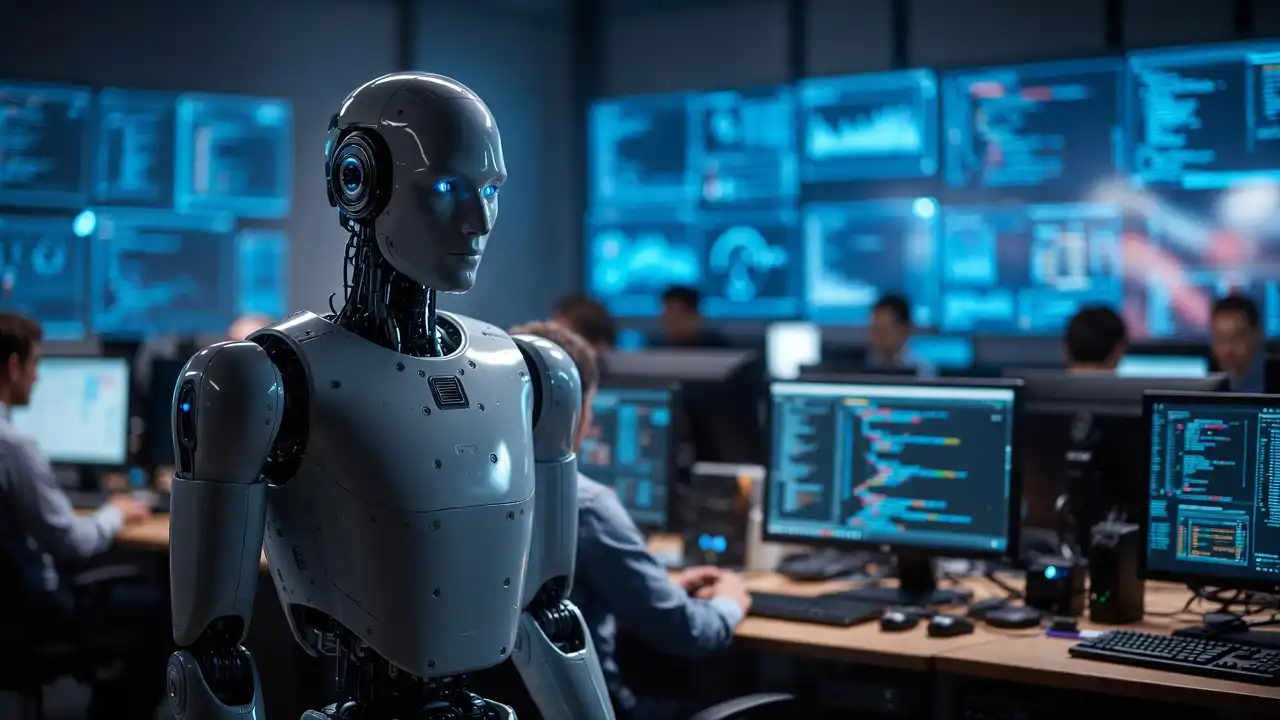
What does this all look like in practice? The workplace is not a sterile, human-less environment. It is a dynamic, collaborative space where humans and AI work in a symbiotic partnership, each bringing their unique strengths to the table.
The “Centaur” Workforce: Augmentation in Action
The “centaur” model, where a human provides the strategy, creativity, and ethical judgment while the AI provides the data analysis, speed, and scale, is the new standard.
- The Centaur Doctor: Uses an AI diagnostic tool that analyzes medical images and patient history to suggest potential diagnoses, but the human doctor makes the final judgment, communicates with the patient with empathy, and creates the treatment plan.
- The Centaur Financial Analyst: Leverages an AI that sifts through millions of data points to identify market trends and anomalies, while the human analyst provides strategic interpretation, understands the geopolitical context, and makes the final investment recommendation.
The Skills-Based Organization: From Job Titles to Project Teams
Companies are moving away from rigid, hierarchical structures based on fixed job titles. Instead, they are organizing work around agile, cross-functional project teams that are assembled based on the specific skills needed for a given task. This allows the organization to be much more adaptive and better leverage the unique talents of each individual.
Beyond Skills: Navigating the Ethical and Societal Headwinds
The transition to an AI-driven economy is not just a skills challenge; it is also fraught with profound ethical and societal questions that must be addressed to ensure a just and equitable future.
- Algorithmic Bias in Hiring and Management: AI systems used for hiring and promotion can perpetuate and even amplify existing human biases if they are trained on biased historical data.
- The Challenge of the Digital Divide: The benefits of the AI revolution will not be distributed equally. There is a major risk that it could exacerbate the divide between the digitally literate and those who are left behind.
- The Future of Wages and Economic Inequality: If the productivity gains from AI flow primarily to the owners of capital and a small group of highly skilled “AI wranglers,” it could lead to a dramatic increase in economic inequality. This is sparking urgent debates about policies like Universal Basic Income (UBI) and new forms of wealth sharing.
Conclusion
The recent innovations mark the end of the beginning for the AI revolution in the workplace. The technology has arrived, and its influence is an irreversible and accelerating force. The narrative of fear and mass unemployment, while understandable, distracts from the real and much more complex challenge ahead: orchestrating a massive, global transition in how we work, learn, and define value.
The future is not a predetermined path that we are forced to walk. It is a landscape of possibilities that we have the power to shape. We can choose a future of deepening inequality and social dislocation, or we can choose to build a future where AI acts as a great equalizer, augmenting human potential and freeing us from drudgery to focus on the creative, strategic, and empathetic work that gives us meaning. This choice requires a new social contract, a shared commitment from every stakeholder—from the CEO to the policymaker, from the university president to the individual worker—to invest in our greatest asset: our uniquely human capacity to learn, to adapt, and to create. The machines are here. The real work of building our human-machine future has just begun.