
Key Points:
- NASA Administrator Jared Isaacman told CNBC that restoring Blue Origin’s exploded Launch Complex 36 could take until 2028, causing severe program delays.
- Blue Origin CEO Dave Limp disputed the timeline, posting on X that the company’s propellant farm is safe and New Glenn will fly before the end of 2026.
- The May 28, 2026, explosion destroyed a heavy-lift rocket on the pad, threatening NASA’s uncrewed “Blue Moon” lander mission planned for this year.
- If the launchpad gap is prolonged, NASA may consider using SpaceX’s Falcon Heavy as an alternative launcher for the lunar landing system.
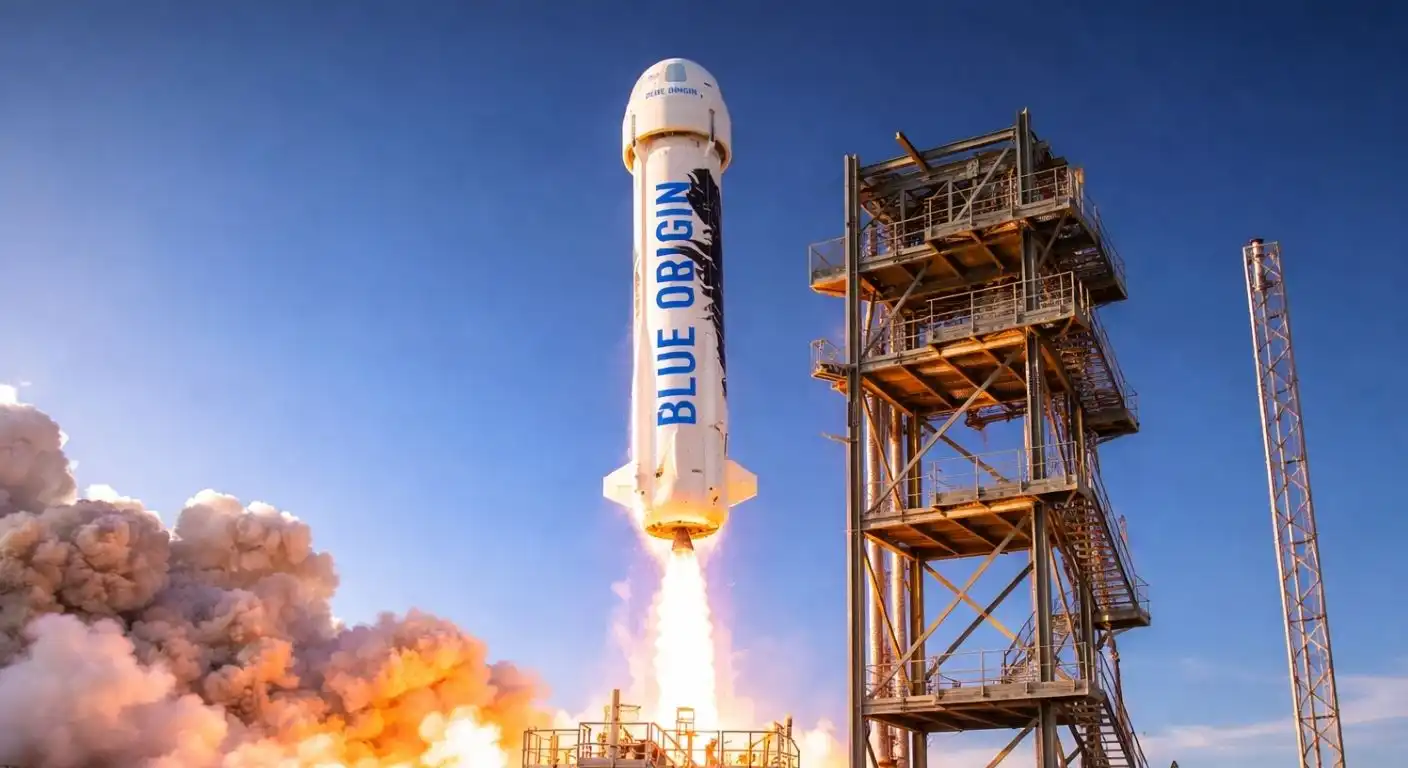
A major debate regarding the timeline for the recovery of Blue Origin’s main Florida launch facility has erupted among top space leaders. Following a spectacular explosion of its heavy-lift New Glenn rocket on May 28, 2026, NASA Administrator Jared Isaacman told CNBC in an interview on Monday, June 1, 2026, that restoring Launch Complex 36 (LC-36) could take until 2028. This projection sent shockwaves through the aerospace sector, as the facility represents Blue Origin’s only operational launchpad for New Glenn. However, Blue Origin’s newly appointed CEO, Dave Limp, quickly disputed the government’s timeline, claiming his team can achieve a full recovery much sooner.
The industrial accident occurred at approximately 9:00 p.m. Eastern Time on Thursday, May 28, 2026, at the Cape Canaveral Space Force Station in Florida. During a static “hotfire” engine test—a critical pre-launch validation step where engineers ignite the booster’s first-stage engines while keeping the vehicle bolted to the pad—the New Glenn rocket suffered a catastrophic anomaly. The vehicle erupted into a massive fireball, destroying the booster and causing extensive, visible structural damage to the surrounding launchpad infrastructure.
Speaking to CNBC, NASA Administrator Jared Isaacman initially voiced major concerns about the physical condition of LC-36. Isaacman explained that, based on historical cases of rebuilding ruined launchpads in human spaceflight, a full restoration will require considerable time. He stated that even on an accelerated schedule, a 2028 recovery timeline is highly realistic. This assessment threatened to stall Jeff Bezos’s space ambitions completely, as it would effectively bar New Glenn from the skies for nearly two years.
Blue Origin CEO Dave Limp rejected this prolonged timeline on Tuesday, June 2, 2026, sharing a highly optimistic update on social media after engineers regained physical access to the pad. Limp wrote on X that the company’s critical long-lead items were spared destruction. The highly complex propellant farm—including liquid oxygen, liquid hydrogen, and liquefied natural gas (LNG) storage tanks—remains in good shape. Furthermore, Limp claimed that while the massive support tower sustained noticeable damage, teams can repair it in place rather than tearing it down and replacing it. While the repair costs represent only a modest 1.5% of Blue Origin’s total valuation, the temporal delay remains the primary concern. “We will fly again before the end of this year. Gradatim Ferociter,” Limp declared.
Following Limp’s public rebuttal, Isaacman issued an official clarification on X to ease tensions and correct media reports. He explained that his reference to a 2028 timeline actually referred to the scheduled launch of NASA’s next-generation lunar base and recently awarded crewed rover missions, rather than the launchpad itself. “The question was about the timing of the Moon Base… I was pointing out that those missions are not until 2028, which should be well within what is possible for pad recovery,” Isaacman clarified. He praised Blue Origin’s rapid response and promised that NASA will do everything in its power to assist with root cause analysis and accelerate the recovery of LC-36.
Despite the mutual attempts to project optimism, the accident highlights Blue Origin’s extreme vulnerability to single-pad operations. Currently, LC-36 in Florida is the only completed launchpad capable of supporting the New Glenn. While Blue Origin is actively constructing a second New Glenn launch site at Vandenberg Space Force Base in California, the facility remains far from complete. Consequently, until engineers fully restore LC-36 or complete the California facility, all New Glenn launches will remain grounded, placing immense financial pressure on the company’s commercial partners.
This launchpad freeze carries immediate, negative consequences for NASA’s flagship Artemis program, which aims to land American astronauts on the Moon by 2028. Later this year, NASA had planned to launch Blue Origin’s uncrewed “Blue Moon” lander, designated as the MK1, aboard a New Glenn rocket. Landing a heavy spacecraft on the lunar surface requires immense cargo-transport capability, a key part of NASA’s $20 billion moon base plan. If the recovery of LC-36 is significantly delayed, NASA’s tight Artemis schedule will face inevitable, highly disruptive adjustments, as another key partner—SpaceX’s Starship—is also experiencing developmental delays.
Faced with a potential multi-year gap in launchpads, Isaacman admitted that NASA might have to explore alternative launch vehicles to keep the Artemis program on track. He noted that in practice, private companies capable of operating heavy-lift launch vehicles are effectively limited to SpaceX and Blue Origin. “One of them has lost a launchpad,” Isaacman remarked. He suggested that NASA could consider using SpaceX’s heavy launcher, the Falcon Heavy, to deliver Blue Origin’s uncrewed lunar lander into orbit, though adapting the Blue Moon lander for a SpaceX rocket would introduce its own complex engineering challenges.
Ultimately, the battle over the New Glenn launchpad recovery timeline highlights the high-stakes and volatile nature of the modern private space race. While Blue Origin’s leadership is moving at a highly aggressive pace to repair the damaged support tower and prove that they can fly before the end of 2026, the physical reality of the damage remains a major hurdle. Whether Jeff Bezos’s company can deliver on its promise of a rapid recovery, or whether the shadow of the explosion will linger until 2028, will define the future of the Artemis program and shape the competitive balance of the global commercial launch market.